In 1983, a 61-year-old potato farmer named Cliff Young shuffled up to the registration desk of Australia’s inaugural Sydney to Melbourne Ultramarathon wearing ratty cut-off pants and cheap sneakers.
Nobody took him seriously.
But what happened next would completely transform how elite runners approach ultra-distance racing—and it all came down to one unconventional strategy learned from decades of herding sheep.
Young’s story reveals something profound about human potential, perseverance, and challenging accepted wisdom in pursuit of seemingly impossible goals.
Jump to:
The Farmer Nobody Expected to Compete
When Young requested his participant bib for the 544-mile, week-long race, organizers were stunned. Over 100 young, sponsored marathoners had registered—elite athletes with corporate logos plastered across expensive gear.
Then there was Young: six decades old, living with his mother on their farm, wearing homemade ventilated pants. Registration staff thought he wanted to watch the race, not run it.

If you want something simple that actually works, this is one of the most effective tools I’ve used to build strength, conditioning, and endurance without needing a full gym setup.
- Full-body training with one weight using swings, squats, and presses
- Solid cast iron build that feels stable and lasts for years
- Comfortable grip that makes high-rep workouts easier to handle
They gave him his bib anyway, though skepticism followed him everywhere. At the starting line, competitors laughed or stared in disbelief as this elderly farmer lined up beside them.
When the starting gun fired, every runner sprinted ahead while Young simply shuffled along at his peculiar, slow pace.
Training Measured in Decades, Not Months
What spectators didn’t know was that Young had spent his entire life preparing for this moment—just not in any conventional way.
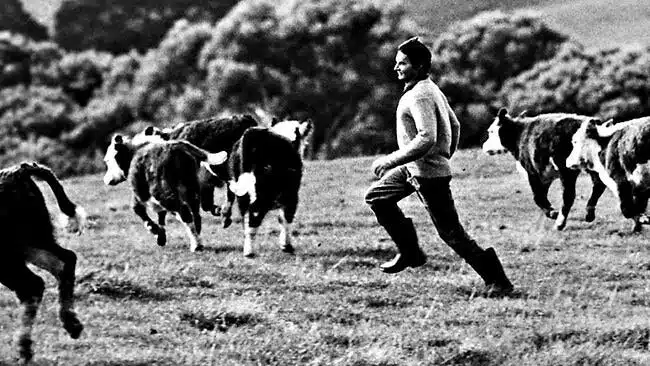
Growing up on a 2,000-acre farm with 2,000 sheep, Young’s family couldn’t afford horses or tractors. When storms rolled in, young Cliff had to chase down their entire flock on foot.
See, I grew up on a farm where we couldn’t afford horses or tractors, and the whole time I was growing up, whenever the storms would roll in, I’d have to go out and round up the sheep. We had 2,000 sheep on 2,000 acres. Sometimes I would have to run those sheep for two or three days. It took a long time, but I’d always catch them. I believe I can run this race.
Those multi-day sheep-herding marathons had taught Young something invaluable: how to keep moving when everyone else stops.
The Secret Weapon: Refusing to Sleep
In 1983, conventional wisdom dictated that ultra-distance runners needed to run approximately 18 hours daily, then sleep six hours to recover adequately.
If you want something simple that actually works, this is one of the most effective tools I’ve used to build strength, conditioning, and endurance without needing a full gym setup.
- Full-body training with one weight using swings, squats, and presses
- Solid cast iron build that feels stable and lasts for years
- Comfortable grip that makes high-rep workouts easier to handle
Every elite competitor followed this protocol. Every single one—except Cliff Young.
Young’s decades herding sheep had conditioned him to function on minimal sleep. While competitors rested six hours nightly, he needed only two.
This meant something extraordinary: each morning when Young’s competitors woke refreshed, he was already dozens of miles down the road.
His competition remained confident they’d eventually catch the shuffling farmer. But sleep proved too essential to skip, and Young’s lead grew longer each day.
A Victory That Shocked the Running World
When Young crossed the finish line in Melbourne, he didn’t just win—he obliterated expectations.
He finished nearly 10 hours ahead of second place, completing the 544-mile journey faster than anyone thought possible for such an unconventional runner.
If you want something simple that actually works, this is one of the most effective tools I’ve used to build strength, conditioning, and endurance without needing a full gym setup.
- Full-body training with one weight using swings, squats, and presses
- Solid cast iron build that feels stable and lasts for years
- Comfortable grip that makes high-rep workouts easier to handle
True to his humble character, Young split most of his $10,000 prize money among fellow competitors. Fame hadn’t changed the man who still lived with his mother and had remained a virgin his entire life.
How the “Young Shuffle” Changed Ultra-Running Forever
Young’s unconventional running style—dubbed the “Young shuffle” throughout Australia—became legendary. But more importantly, his sleep strategy revolutionized ultra-distance racing.
After 1983, elite ultra-runners began minimizing sleep during competitions, recognizing that continuous movement could trump traditional rest periods.
Young had proven that accepted wisdom wasn’t always correct, that decades of practical experience could outweigh expensive training programs and corporate sponsorships.
Life After Legendary Victory
Following his stunning win, Young married a woman nearly 40 years younger. Though that marriage eventually ended (they remained friends, he later reported), Young continued pursuing his passion.
He competed in ultra-marathons well into his seventies, even attempting to run across Australia’s entire 8,316-mile continent. At 78 years old, he set an age-group record in a six-day race.
If you want something simple that actually works, this is one of the most effective tools I’ve used to build strength, conditioning, and endurance without needing a full gym setup.
- Full-body training with one weight using swings, squats, and presses
- Solid cast iron build that feels stable and lasts for years
- Comfortable grip that makes high-rep workouts easier to handle
Despite lacking material wealth—he ran without dentures because they rattled uncomfortably—Young maintained his training regimen, running 20 to 30 kilometers daily while managing farm duties.
The doctors once told me I had arthritis in my joints and to take it easy, so I said ‘I’ll fix that up, I’ll run it out.’ So I kept running and it disappeared… It is like rust that gets into a vehicle. Well, I think it was like rust in me. I reckon you have to keep your joints moving. Absolutely. No matter what you do, you have to keep moving. If you don’t wear out, you rust out, and you rust out quicker than you wear out.
Lessons From a Shuffling Legend
Young passed away in 2003 at age 81, nearly a generation ago. Yet his legacy endures because his story transcends running.
His approach reveals powerful truths about achieving seemingly impossible goals:
- Consistency beats intensity: Young’s shuffle looked ridiculous compared to elite runners’ powerful strides, but steady persistence won the race
- Question conventional wisdom: Everyone “knew” ultra-runners needed six hours sleep—until someone proved otherwise
- Life experience matters: Decades of practical work prepared Young better than any structured training program
- Keep moving forward: Progress doesn’t require speed, just relentless forward motion
Young never possessed expensive gear, professional coaching, or corporate sponsorship. He had something more valuable: unshakeable dedication to his purpose and refusal to let doubt derail his pursuit.
One Foot in Front of the Other
What makes Young’s story so compelling isn’t just his unlikely victory. It’s his approach—shuffling along, slowly covering ground, placing one foot ahead of the other without fanfare or flash.
He demonstrated that extraordinary achievements don’t require extraordinary resources—just extraordinary persistence.
If you want something simple that actually works, this is one of the most effective tools I’ve used to build strength, conditioning, and endurance without needing a full gym setup.
- Full-body training with one weight using swings, squats, and presses
- Solid cast iron build that feels stable and lasts for years
- Comfortable grip that makes high-rep workouts easier to handle
Author Candice Millard noted that stories of struggle connect us because struggle is universal. Young’s journey from ridiculed farmer to ultra-running legend embodies this truth.
He faced skepticism, physical limitations, and overwhelming odds. But through dedication honed over decades herding sheep across Australian farmland, he discovered how far human determination can travel.
His philosophy remained elegantly simple: keep moving, never rust out, and always believe you can catch those sheep—even if it takes days.
That mindset carried a 61-year-old potato farmer 544 miles to victory and inspired countless runners to reconsider their own limits.