Sitting for hours wreaks havoc on your body, locking up muscles and joints in ways most people don’t even realize.
But there’s good news: reversing these effects doesn’t require hours of stretching or expensive equipment.
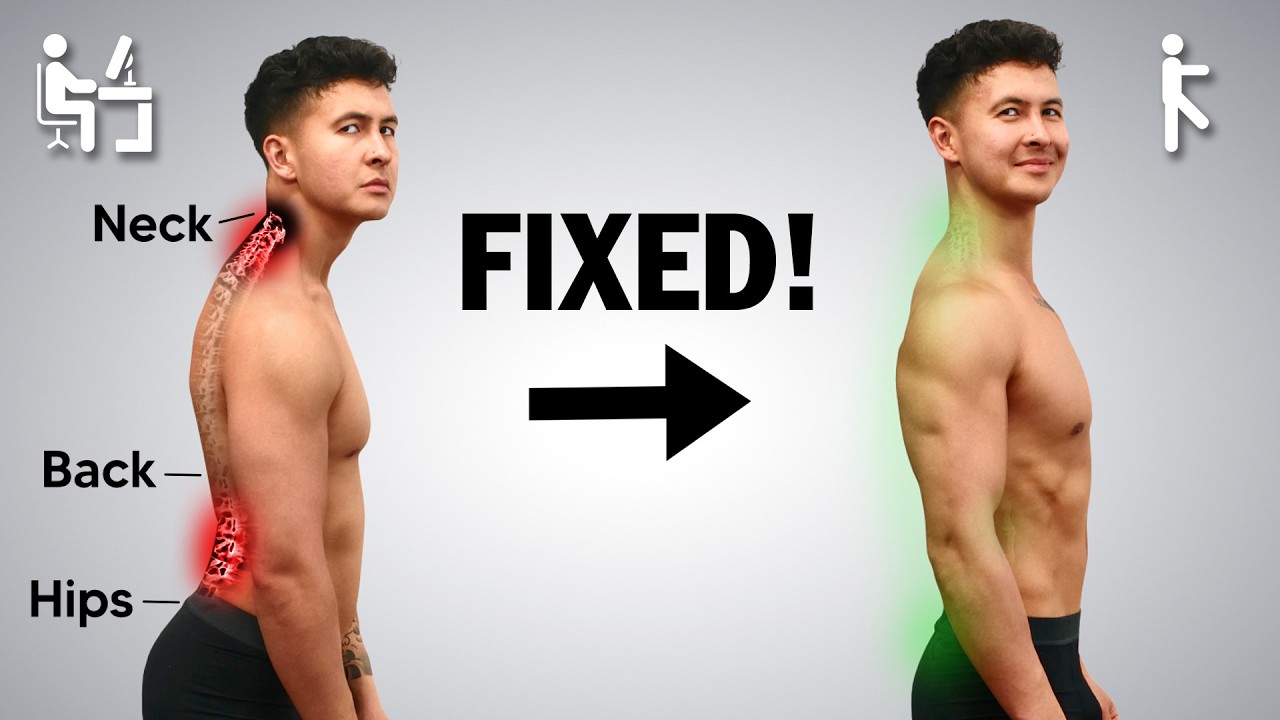
In a recent YouTube video, fitness expert Jeremy Ethier broke down exactly how to undo sitting-related stiffness in just three minutes a day using three targeted exercises.
And the science behind why they work might surprise you.
Jump to:
The Surprising Science Behind Sitting Stiffness
Ethier references a fascinating study where researchers had participants sit for 4.5 hours straight to measure how it affected muscle stiffness. Predictably, everyone’s back became increasingly tight as time dragged on.
But here’s where it gets interesting: participants were split into three groups. One group simply sat without intervention, while two other groups received neuromuscular electrical stimulation to their back muscles at regular intervals.

If you want something simple that actually works, this is one of the most effective tools I’ve used to build strength, conditioning, and endurance without needing a full gym setup.
- Full-body training with one weight using swings, squats, and presses
- Solid cast iron build that feels stable and lasts for years
- Comfortable grip that makes high-rep workouts easier to handle
One test group received low-level currents that created just a tingling sensation. The other received high-amplitude currents strong enough to actually contract their back muscles, mimicking exercise.
Both the control group and low-level stimulation group showed progressively worse stiffness. But the high-amplitude group—whose muscles actively contracted during sitting—experienced almost complete reversal of back stiffness.
Why Your Body Creates Stiffness When You Sit
According to Ethier, when joints remain locked in one position for extended periods, your body essentially “turns off” unused muscles. Over time, you lose your ability to move these joints effectively.
Your body then creates stiffness as a signal—an attempt to get you to move and actually use those dormant muscles. This happens even with perfect posture.
This was just after 4 and 1/2 hours of sitting, so imagine what happens to your back if you sit all day every day for years.
The takeaway isn’t that everyone needs electrical stimulation devices at their desk. Instead, the solution is far simpler: move the joints and contract the muscles you don’t use while sitting.
Three Exercises To Reverse Sitting Damage
Rather than prescribing lengthy mobility routines people won’t stick with, Ethier identified three key exercises targeting the most problematic areas. Start by doing these a few times per week, then work toward once or twice daily to break up sitting sessions.
If you want something simple that actually works, this is one of the most effective tools I’ve used to build strength, conditioning, and endurance without needing a full gym setup.
- Full-body training with one weight using swings, squats, and presses
- Solid cast iron build that feels stable and lasts for years
- Comfortable grip that makes high-rep workouts easier to handle
Exercise 1: Wall Clock (For Rounded Shoulders)
This movement loosens tight chest and shoulder muscles while strengthening weakened upper back areas for long-term posture improvements.
How to perform:
- Stand sideways with fingertips touching a wall, thumb pointing down
- Engage your core without arching your back
- Slowly draw your palm in a large semicircle forward and up the wall
- Let your shoulder blade move forward, then upward—feeling a chest stretch
- Complete the circle by moving your arm back and down, letting your shoulder blade move back and down
- Reverse the circle to return to start
- Perform for 30 seconds on each side
Distance from the wall controls difficulty—closer creates more stretch, but harder isn’t necessarily better. Aim for a four or five out of 10 stretch intensity, avoiding pain or discomfort.
Exercise 2: Cat-Cow With Rotation (For Back and Neck)
When you finally stand after prolonged sitting, your body instinctively wants to arch backward. This exercise provides a better way to wake up dormant back muscles and move through full range of motion.
Part 1 – Extension:
- Get on all fours, hands directly under shoulders
- Spin elbows toward thighs to engage lats
- Inhale, gently lift tailbone toward ceiling
- Reach chest forward through biceps to stretch abs
- Squeeze shoulder blades together, lift chin toward ceiling
- You should feel midback muscles activate
Part 2 – Flexion:
If you want something simple that actually works, this is one of the most effective tools I’ve used to build strength, conditioning, and endurance without needing a full gym setup.
- Full-body training with one weight using swings, squats, and presses
- Solid cast iron build that feels stable and lasts for years
- Comfortable grip that makes high-rep workouts easier to handle
- Exhale and imagine a rope pulling midback toward ceiling
- Round your spine upward
- Push floor away to open shoulder blades
- Tuck chin by looking toward knees or belly button
- Feel deep stretch in back and neck muscles
- Perform for 30 seconds
Part 3 – Rotation:
- Return to neutral position
- Turn and look toward left foot, stretching right side of lower back and rib cage
- Return to center
- Repeat on opposite side
- Inhale returning to neutral, exhale looking toward each foot
- Continue for 30 seconds
Exercise 3: 90/90 Hip Sequence (For Locked Hips)
Hips remain locked in one position all day during sitting, despite being designed for multidirectional movement. This progressive exercise moves hips through multiple planes while strengthening muscles weakened by prolonged sitting.
Level 1 – Basic Stretch:
- Sit on floor with one leg bent in front at 90 degrees
- Position back leg similarly at 90 degrees
- Use hands for support if needed
- Sit tall, position shoulders square to front shin
- Exhale, reach chest forward, hinging over front leg
- Feel deep stretch on outside of front hip or glute
- Focus on bending at hip, not rounding spine
- Inhale returning to start
- Perform 30 seconds each side, deepening stretch with each rep
Level 2 – Adding Activation:
- Maintain same 90-degree leg position
- As you lean forward, push front shin down into ground
- Lift hips to bring torso upright
- Feel glutes working and hip flexors of back leg stretching
- Lower slowly while leaning forward
- Perform 30 seconds each side
Level 3 – Dynamic Transitions:
- Repeat level 2 movement pattern
- Instead of staying on one side, windshield wiper knees to opposite side on the way down
- Creates deeper groin and hip flexor stretch
- Reach arms forward and engage core during transitions
- Use hands for support as needed
Making These Exercises Stick
Ethier emphasizes that consistency matters more than intensity with mobility work. The entire sequence takes just three minutes, making it realistic to perform multiple times throughout the day.
If you want something simple that actually works, this is one of the most effective tools I’ve used to build strength, conditioning, and endurance without needing a full gym setup.
- Full-body training with one weight using swings, squats, and presses
- Solid cast iron build that feels stable and lasts for years
- Comfortable grip that makes high-rep workouts easier to handle
Unlike extensive stretching routines that people abandon after a few attempts, these three exercises target the most critical areas affected by sitting without overwhelming your schedule.
The benefits extend beyond just feeling less stiff. Regular practice will improve posture so you naturally stand taller and straighter, increase range of motion for more effective gym sessions, and relieve muscle tension throughout shoulders, back, and hips.
For those wanting visual references, Ethier provides a free PDF with step-by-step pictures demonstrating each exercise properly. And while these three movements provide an excellent foundation, addressing sitting-related damage comprehensively requires combining mobility work with proper strength training and movement throughout your day.
But if you’re looking for where to start—three minutes, three exercises, and science-backed results—this routine delivers exactly what desk workers need.