Olympic sprint coach Stu McMillan recently walked Dr. Andrew Huberman through a complete sprint workout, revealing techniques that elite athletes use to run faster.
The session, filmed at Malibu High School, offers practical insights for anyone looking to improve their speed and movement quality.
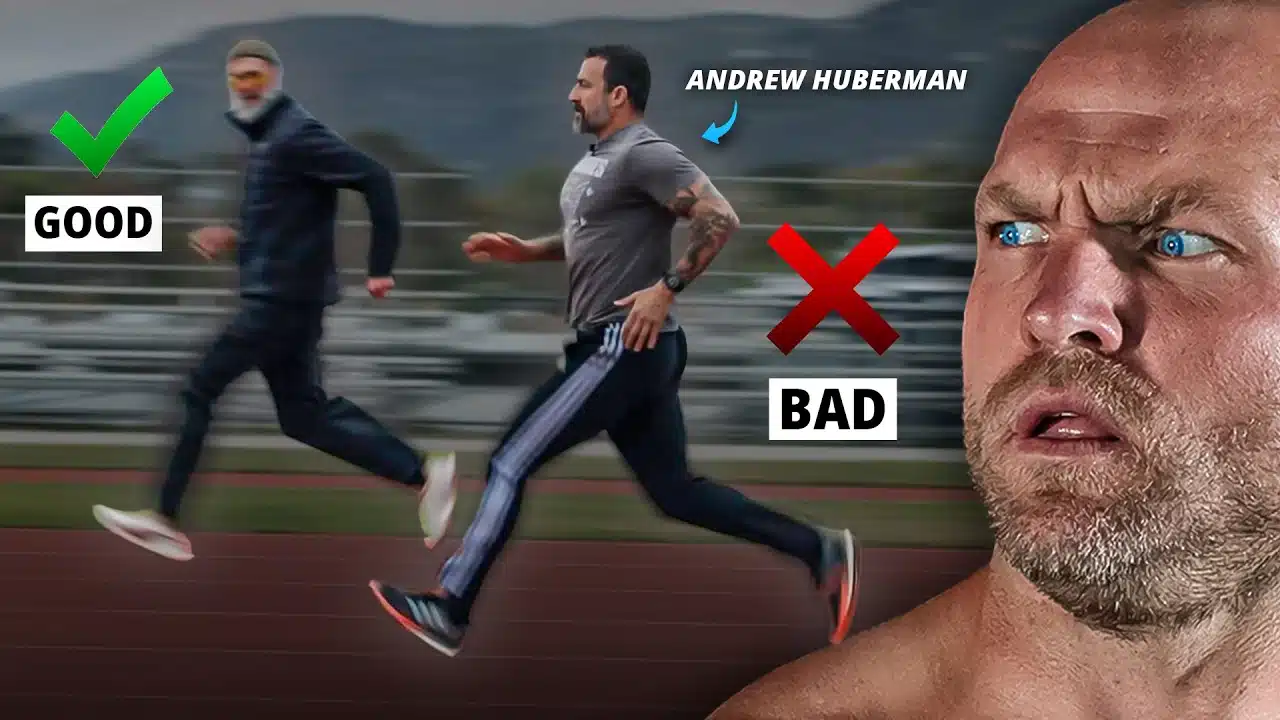
Whether you’re an athlete or simply aging gracefully, these principles can transform how you move.
McMillan’s approach challenges conventional wisdom about warming up and introduces biomechanical concepts that separate sprinting from jogging entirely.
Jump to:
- The Revolutionary Warm-Up: Skip, Don’t Jog
- Front-Side Mechanics: The Core Principle
- Posture and Expression: Sprinting as Total Body Movement
- The Comprehensive Warm-Up Sequence
- Technical Cues That Transform Performance
- Benefits Beyond Athletic Performance
- Implementing Sprint Training Safely
- The Underground Sprint Community Debate
- Applying These Principles Today
The Revolutionary Warm-Up: Skip, Don’t Jog
McMillan dropped a bombshell early in the session when Huberman asked about pre-sprint jogging.
So you recommend not jogging before a sprint workout actually? 100%.
Instead of traditional jogging, McMillan advocates for skipping and striding as the primary warm-up methods. The reasoning is biomechanical: sprinting requires completely different movement patterns than jogging.

If you want something simple that actually works, this is one of the most effective tools I’ve used to build strength, conditioning, and endurance without needing a full gym setup.
- Full-body training with one weight using swings, squats, and presses
- Solid cast iron build that feels stable and lasts for years
- Comfortable grip that makes high-rep workouts easier to handle
Jogging involves rolling through your ankle and knee, pushing your way around the track. Sprinting demands systemic stiffness coordinated across ankle, knee, and hip joints.
Why Skipping Prepares You Better
Skipping creates a gait pattern remarkably similar to sprinting mechanics. When you skip, stiffness occurs naturally at three critical joints, keeping you tall and bouncy.
McMillan demonstrated this principle effortlessly, his 6’4″ frame moving with fluid coordination despite being 55 years old. Huberman, meanwhile, appeared more robotic initially—a common pattern when learning these movements.
The distinction between joint stiffness (beneficial) and robotic stiffness (problematic) emerged clearly during the demonstration.
Front-Side Mechanics: The Core Principle
McMillan emphasized one fundamental concept throughout the session: everything happens in front of your center of mass when sprinting.
Jogging is back here, sprinting is in front. Sprinting is in front.
This front-side mechanics approach focuses on pulling thighs forward rather than pushing off behind. The mental cue is simple but powerful: think about bringing your thigh forward, not leaving your foot behind.
If you want something simple that actually works, this is one of the most effective tools I’ve used to build strength, conditioning, and endurance without needing a full gym setup.
- Full-body training with one weight using swings, squats, and presses
- Solid cast iron build that feels stable and lasts for years
- Comfortable grip that makes high-rep workouts easier to handle
When striding, athletes should maintain flat feet on the ground while pulling thighs forward with each step. This creates the proper biomechanical foundation for explosive speed.
The Heavy Bag Analogy
To illustrate proper ankle stiffness, McMillan used a striking analogy from boxing.
You wouldn’t hit a heavy bag like this. So, you shouldn’t really sprint with a really, really relaxed ankle as well. As if you’re hitting a heavy bag over and over and over again.
This visualization helps athletes understand the level of stiffness required. Each ground contact should feel like striking a heavy bag—forceful, controlled, and deliberate.
The audible “pop, pop, pop” when landing correctly indicates proper technique. Flat-footed landings with stiff ankles create this distinctive sound pattern.
Posture and Expression: Sprinting as Total Body Movement
McMillan made clear distinctions between jogging posture (closed, lower-body focused) and sprinting posture (open, total-body engagement).
Jogging is kind of a lower body activity. Sprinting is a total body activity.
Proper sprinting requires what McMillan calls being “expressive”—tall, open, and free with movement. Shoulders bounce and rock naturally. Arms swing loosely but purposefully.
If you want something simple that actually works, this is one of the most effective tools I’ve used to build strength, conditioning, and endurance without needing a full gym setup.
- Full-body training with one weight using swings, squats, and presses
- Solid cast iron build that feels stable and lasts for years
- Comfortable grip that makes high-rep workouts easier to handle
The spine plays a crucial role, possibly the most important component. Shoulder blades must glide freely up and down the rib cage while the torso rotates counter to hip movement.
Vertical Versus Horizontal Force
A critical technical distinction emerged: jogging generates primarily horizontal force, while sprinting produces nearly 100% vertical force.
This vertical emphasis—straight down, straight up—creates the elastic rebound necessary for speed. McMillan repeatedly cued Huberman to think “up, up, up” rather than pushing backward.
The Comprehensive Warm-Up Sequence
What stood out most was the thoroughness of McMillan’s warm-up protocol. The video showed over 16 minutes of preparatory work before any actual sprinting occurred.
This extensive preparation is precisely why many people get injured sprinting—they skip essential preparatory steps.
Key Warm-Up Components
- Skipping: Building ankle, knee, and hip stiffness patterns
- Striding: Practicing front-side mechanics at slower speeds
- Mobility drills: Opening hip and spine range of motion
- Three-plane movement: Forward, sideways, and rotational patterns
- Linear and lateral leg swings: Universal among elite sprinters
- RDL to hip lock progressions: Activating proper positions
McMillan explained that warm-ups should move the body through three planes, three velocities, and three types of range of motion. This comprehensive approach prepares every system involved in sprinting.
If you want something simple that actually works, this is one of the most effective tools I’ve used to build strength, conditioning, and endurance without needing a full gym setup.
- Full-body training with one weight using swings, squats, and presses
- Solid cast iron build that feels stable and lasts for years
- Comfortable grip that makes high-rep workouts easier to handle
A practical protocol he suggested: skip 100 meters, walk 100 meters, repeat for a mile. This simple routine builds proper movement patterns without traditional jogging.
Hip Extension Focus
Throughout the warm-up sequence, nearly every drill targeted hip extension—the ability to drive the rear leg backward powerfully.
Everything we do from the warm-up is really trying to get better access to gain better access to hip extension.
Exercises included dolphin positions, rotational movements dropping shoulders to fists, lateral flexion holds, and various dynamic stretching patterns. Each drill systematically opened the posterior chain.
Technical Cues That Transform Performance
McMillan’s coaching style emphasized specific, actionable cues rather than vague instructions.
Essential Mental Cues
- Pull thighs forward (not push feet backward)
- Step over the opposite knee with each stride
- Think “thigh high” by the end of acceleration
- Keep feet flat on ground during warm-up strides
- Be expressive—open, tall, and free
- Relax arms while maintaining shoulder rhythm
- Get vertical—up, not back
One particularly useful drill was the “dribble”—essentially a sprint at half range of motion. This allows athletes to feel proper mechanics at manageable intensity.
The top position of a sprint requires specific alignment: laces directly under knee, knee height at belly button level. Individual mobility determines exact positioning, but this framework applies universally.
If you want something simple that actually works, this is one of the most effective tools I’ve used to build strength, conditioning, and endurance without needing a full gym setup.
- Full-body training with one weight using swings, squats, and presses
- Solid cast iron build that feels stable and lasts for years
- Comfortable grip that makes high-rep workouts easier to handle
Benefits Beyond Athletic Performance
While the session focused on sprint mechanics, the implications extend far beyond competitive athletics.
For older individuals especially, sprint training offers tremendous benefits. The coordination, stiffness, and fluidity developed through these drills translate to better movement quality in daily life.
McMillan’s own movement at 55 demonstrated this principle beautifully. His continued coaching keeps him thinking about and practicing fluid, coordinated movement patterns constantly.
The ability to catch yourself quickly during a slip, maintain balance on uneven surfaces, and move with confidence all stem from athletic movement training.
Movement Charisma
An interesting concept emerged: movement charisma—the quality of looking athletic and fluid rather than stiff and robotic.
Even powerlifters and distance runners benefit from developing this quality. Expressiveness in movement creates efficiency and reduces injury risk across all athletic endeavors.
If you want something simple that actually works, this is one of the most effective tools I’ve used to build strength, conditioning, and endurance without needing a full gym setup.
- Full-body training with one weight using swings, squats, and presses
- Solid cast iron build that feels stable and lasts for years
- Comfortable grip that makes high-rep workouts easier to handle
Implementing Sprint Training Safely
The session revealed why consistency matters tremendously with sprint training.
McMillan’s recommendation: incorporate this work at least once weekly. Regular exposure to skipping, striding, and mobility drills builds the foundation necessary for safe, effective sprinting.
The extensive warm-up isn’t optional—it’s essential. Injuries occur when athletes skip preparatory steps or attempt to sprint without proper technical development.
Starting with skipping and slow striding allows your nervous system to learn proper patterns before adding intensity. Gradually increasing speed ensures coordination develops alongside strength.
Progressive Intensity
McMillan demonstrated progressive loading throughout the session. Initial strides ran at 50% intensity, then 60%, gradually building toward full sprints.
This methodical approach allows the body to adapt at each level before progressing. Rushing this process invites injury and prevents proper skill development.
If you want something simple that actually works, this is one of the most effective tools I’ve used to build strength, conditioning, and endurance without needing a full gym setup.
- Full-body training with one weight using swings, squats, and presses
- Solid cast iron build that feels stable and lasts for years
- Comfortable grip that makes high-rep workouts easier to handle
The Underground Sprint Community Debate
McMillan briefly referenced an “underground sprint community” that disagrees with front-side mechanics despite overwhelming evidence and results.
This highlights an important principle: follow coaches who produce results with real athletes. McMillan’s credentials speak for themselves—he’s considered one of the premier sprint coaches globally.
Theoretical debates matter less than practical outcomes. The techniques demonstrated in this session represent proven methods used by world-class sprinters consistently.
Applying These Principles Today
You don’t need to be a competitive sprinter to benefit from these techniques.
Start with the basic warm-up sequence: skip-walk intervals, mobility drills focusing on hip and spine movement, and slow striding with emphasis on pulling thighs forward.
Practice stiff ankle contacts, flat-footed landings, and expressive upper body movement. These fundamentals build the foundation for everything else.
If you want something simple that actually works, this is one of the most effective tools I’ve used to build strength, conditioning, and endurance without needing a full gym setup.
- Full-body training with one weight using swings, squats, and presses
- Solid cast iron build that feels stable and lasts for years
- Comfortable grip that makes high-rep workouts easier to handle
The beauty of McMillan’s approach is its accessibility. While elite athletes perform these movements at extreme intensities, the same patterns benefit everyone at appropriate intensity levels.
Weekly sprint work—even at moderate intensity—develops coordination, power, and movement quality that translates across all physical activities. The key is consistency with proper technique rather than maximum effort without preparation.
McMillan’s charismatic coaching style and deep expertise make these complex biomechanical concepts approachable. His ability to break down sprinting into actionable cues transforms an intimidating skill into learnable components.
Whether you’re 25 or 65, incorporating these sprint principles enhances movement quality, builds resilience, and develops what might truly be called movement charisma—the confidence and fluidity that marks exceptional movers at any age.