Picture someone in their 70s or 80s who can barely stand without assistance, shuffling instead of walking, struggling with everyday objects.
Now imagine another person the same age moving confidently, standing easily, handling daily tasks without issue.
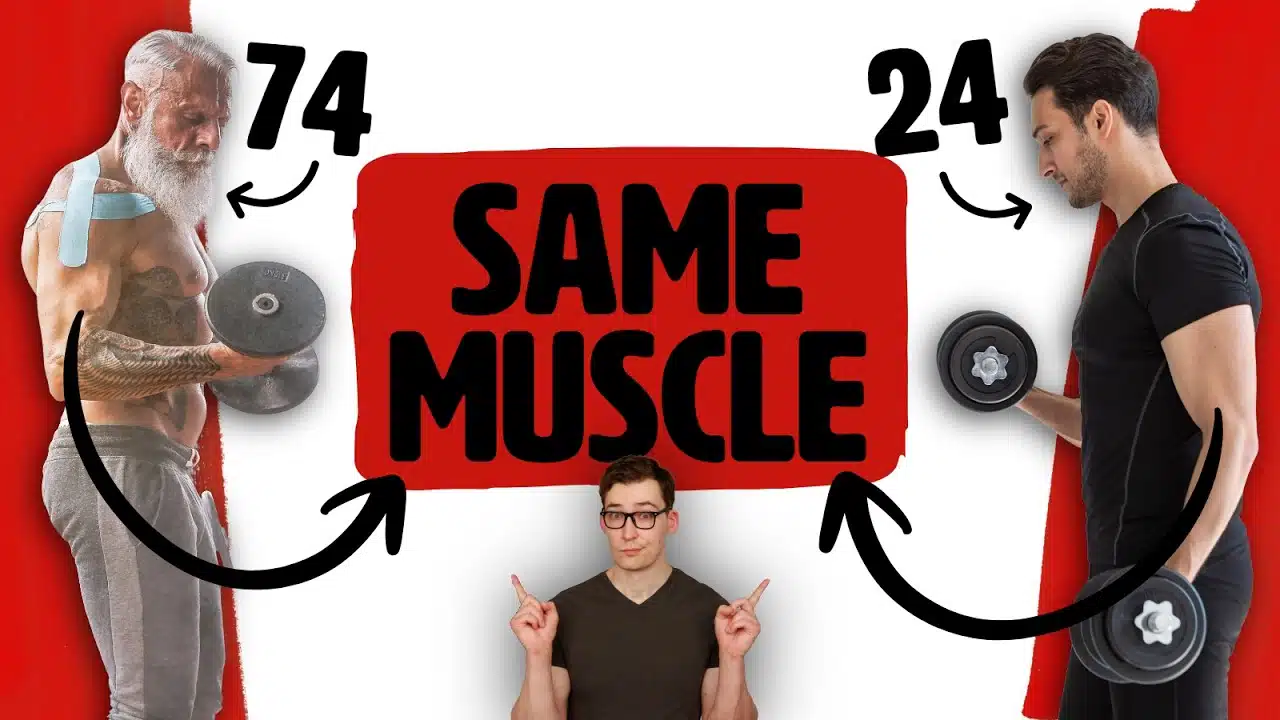
The difference? Muscle tissue—and more specifically, how they’ve trained it throughout their lifetime.
In a recent video, health educator and physiologist Nic Verhoeven examined groundbreaking research showing that lifelong strength training doesn’t just slow aging—it can make 70-year-olds stronger than sedentary people in their 20s.
Jump to:
Your Muscles Are With You for Life
Muscle tissue is called postmitotic, meaning the same muscle cells propelling you through childhood are sustaining you five decades later.
Unlike most body cells that divide and die as needed, your muscle cells stick around. Taking care of them becomes absolutely critical as years pass.
Comparing Young vs. Old Muscle
Verhoeven highlighted research comparing muscle tissue between people in their 20s and various groups in their 70s. The findings reveal something extraordinary about strength training’s protective effects.
Researchers examined cross-sections of muscle tissue from four groups: young people, older sedentary individuals, older endurance athletes, and older strength trainers. All older groups had exercised for decades—just in different ways.
Understanding Muscle Fiber Types
Scientists stain muscle cells to identify two main types:
- Type I fibers (stained blue): Produce less force but sustain effort over longer periods
- Type II fibers (stained red): Generate more force but for shorter durations
Neither type is inherently better. Both serve essential functions.
However, aging typically causes a shift toward Type I fibers as muscles lose force-generation capacity. Older muscle generally shows more blue in cross-sections.
Strength Training Preserves Youthful Muscle
The sedentary older group showed exactly what researchers expected—predominantly blue muscle tissue indicating Type I dominance.
But those who strength trained for decades? Their muscle tissue showed significantly more red, resembling young muscle far more closely than their sedentary age-matched peers.
This wasn’t just one image either. The fiber type difference held consistent across multiple participants in the study.
Functional Strength: The Real Test
Maintaining youthful muscle fiber composition means nothing without functional strength to match.
The performance data proved even more remarkable. Older individuals who didn’t exercise regularly showed the worst results across all strength measures—no surprise there.
But lifelong strength trainers didn’t just maintain muscular performance. They outperformed recreationally active people 50 years younger.
This tissue that’s been part of you since you were born that has had to endure a lifetime of work delivers another mindblowing performance.
The young comparison group weren’t couch potatoes either. They stayed recreationally active, just not with dedicated strength training like bodybuilders or powerlifters.
Why Muscle Preservation Matters
Verhoeven calls muscle’s ability to preserve its youth “one of the greatest biological marvels” he’s encountered.
Strength training maintains musculature not just in appearance but in function—the ability to move, lift, and live independently.
Multiple mechanisms explain these benefits:
- Direct stimulation causes muscle cells to grow
- Gene expression maintains muscle cell structure
- Prevention of denervation (nerve disconnection from muscle)
- Effects on stem cells that support muscle repair
Important Study Limitations
Verhoeven acknowledges two critical caveats about this research.
First, this was a comparative study, not a longitudinal one following people over 50 years. Researchers grouped participants based on exercise habits rather than tracking them through time.
Technically, scientists can’t say exercise alone caused these results. Other factors like testosterone supplementation or specific dietary patterns could theoretically contribute.
I do think it’s unrealistic to think that exercise didn’t play a major, if not the major role in these differences.
Exercise remained the consistent thread throughout decades, unlike other potential variables.
Variation Across Studies
Not every study shows identical results. Most trend in this direction, but exact findings vary.
Different assessment methods likely explain discrepancies. One study might test leg press strength while another examines pull-ups or bicep curls. Same measure, different methodology.
Nearly all research demonstrates significant improvements from strength training. The degree of improvement just varies somewhat between studies.
Practical Takeaways for Your Training
We’re all playing against time. Starting early gives you the most significant advantage.
Verhoeven offers clear action steps: