In a feat once thought impossible, Kenyan distance runner Eliud Kipchoge shattered one of the last great barriers in athletics—completing a marathon in under two hours.
On October 12, 2019, during the INEOS 1:59 Challenge in Vienna, Austria, the 34-year-old clocked in at 1:59:40, making history and redefining human potential.
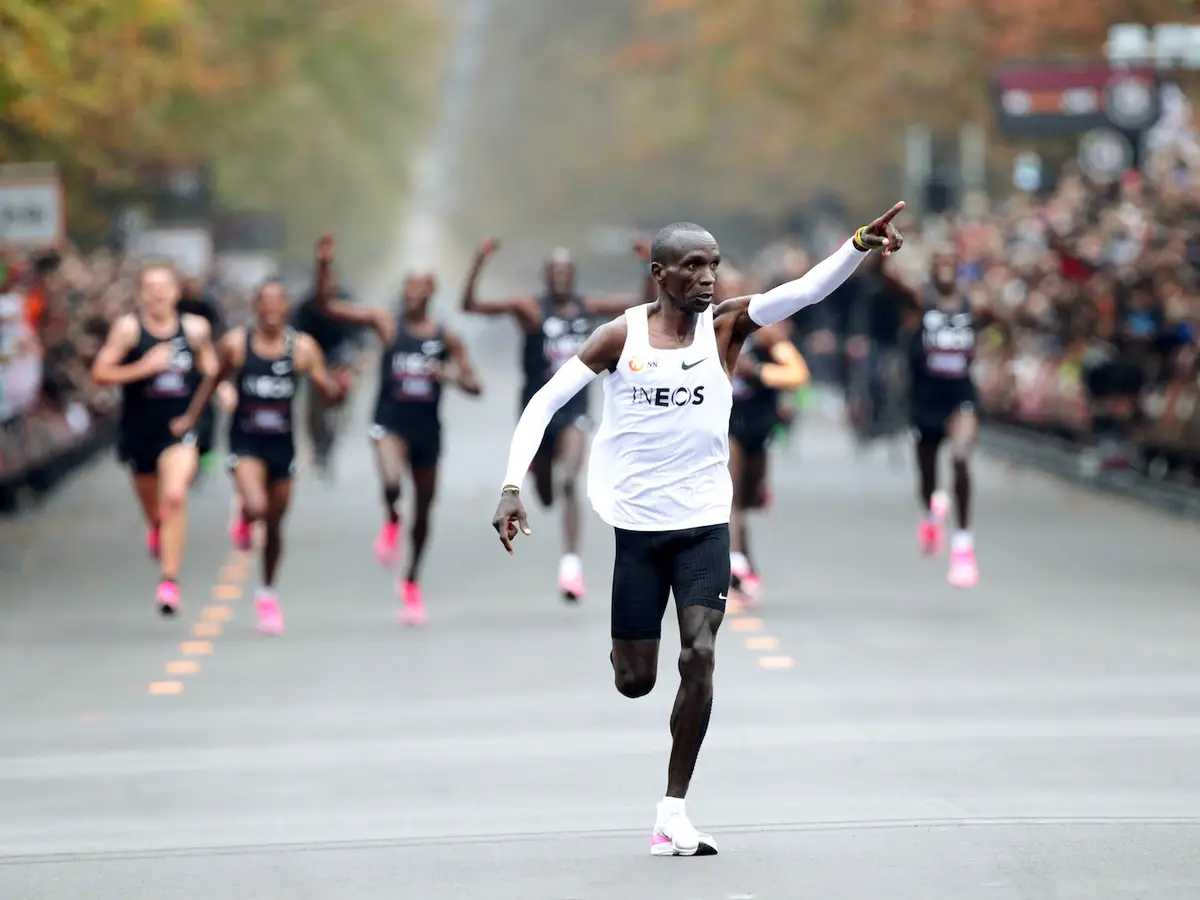
But this wasn’t just a story of speed—it was a masterclass in science, strategy, and supreme mental resolve.
Jump to:
A Historic Run Fueled by Precision and Planning
Kipchoge’s historic sub-two-hour marathon didn’t occur under standard race conditions, and it doesn’t qualify as an official world record. Yet, its significance remains unmatched.
Organized by INEOS, the event was meticulously designed to offer optimal conditions: a flat, straight route through Vienna’s Prater Park, ideal temperatures of around 9°C, minimal wind resistance, and a rotating team of 41 elite pacemakers. Even the start time—8:15 AM—was carefully chosen to match Kipchoge’s circadian rhythm and maximize performance.
He maintained a blistering pace of roughly 2:50 per kilometer (4:34.5 per mile), every single split falling between 2:48 and 2:52/km. The result was equivalent to running eight consecutive 5Ks in 14:13 each—an astonishing feat even by Olympic standards.

If you want something simple that actually works, this is one of the most effective tools I’ve used to build strength, conditioning, and endurance without needing a full gym setup.
- Full-body training with one weight using swings, squats, and presses
- Solid cast iron build that feels stable and lasts for years
- Comfortable grip that makes high-rep workouts easier to handle
The Science of Supremacy: How Kipchoge Did It
Behind Kipchoge’s superhuman run lies a convergence of technological innovation, sports science, and years of elite conditioning.
Aerodynamic Teamwork
To reduce drag, pacemakers ran in a rotating V-formation, with Kipchoge tucked into the base and flanked by two runners behind. A laser-pacing system from a lead electric car ensured constant speed, while shielding him from wind resistance. This arrangement borrowed principles from cycling pelotons, where air resistance is slashed by up to 70% in optimal formations.
Nutrition on the Move
Kipchoge’s fueling strategy was another critical factor. He consumed Maurten’s carbohydrate-rich sports drink—up to 100 grams of carbs per hour. Delivered via bike-mounted support staff, this method helped sustain energy without gastrointestinal distress, a frequent issue for endurance athletes.
“Consuming carbohydrates during exercise will maintain performance or, at least, prevent a drop off,” noted Stephen Mears, a sports nutrition expert from Loughborough University.
The Power of Environment
Vienna’s flat terrain and low altitude (165 meters above sea level) provided ideal conditions. Unlike high-altitude races that limit oxygen intake, Kipchoge ran in an oxygen-rich environment. Additionally, the course had minimal turns and smooth tarmac, maximizing energy efficiency.
The race’s timing also synced closely with Kipchoge’s Kenyan training schedule, minimizing circadian disruption and jet lag.
If you want something simple that actually works, this is one of the most effective tools I’ve used to build strength, conditioning, and endurance without needing a full gym setup.
- Full-body training with one weight using swings, squats, and presses
- Solid cast iron build that feels stable and lasts for years
- Comfortable grip that makes high-rep workouts easier to handle
Cutting-Edge Footwear
Kipchoge wore a prototype of Nike’s then-unreleased AlphaFLY shoe. Built with multiple carbon plates and air pods, these shoes were designed to return more energy with every step. Studies have backed Nike’s claims—Vaporfly and its successors reportedly enhance running economy by 4% to 5%, a margin that can mean the difference between history and heartbreak.
Mind Over Miles: Psychological Mastery
Beyond physical preparation, Kipchoge’s mental approach set him apart. He’s long preached his mantra: “No human is limited,” and Vienna was his platform to prove it.
During the run, crowd support was electric—thousands lined the course, offering a psychological boost absent from previous closed-door attempts like Nike’s Breaking2 in Monza. “That last kilometre where he actually accelerated and came through on his own was just superhuman,” said INEOS chairman Sir Jim Ratcliffe.
Kipchoge himself described the run as “going to the moon and coming back.” His ability to smile, wave, and even engage with pacers during the race reflected supreme mental clarity under extreme physiological stress.
What Runners Can Learn from Kipchoge’s Journey
While most runners will never chase a sub-two-hour marathon, Kipchoge’s methods offer lessons for all.
Train Smart and with Structure
Structured training plans, like those offered by Runner’s World, emphasize balance: interval training, lactate threshold runs, long runs, and recovery are all key. Building core strength with exercises like planks, bridges, and bicycles can maintain form and prevent injury.
If you want something simple that actually works, this is one of the most effective tools I’ve used to build strength, conditioning, and endurance without needing a full gym setup.
- Full-body training with one weight using swings, squats, and presses
- Solid cast iron build that feels stable and lasts for years
- Comfortable grip that makes high-rep workouts easier to handle
Fueling Matters—Before, During, and After
For half-marathoners aiming to break two hours, proper fueling is non-negotiable. Nutritionist Pamela Nisevich Bede advises 45-60g of carbs per hour during a race. More importantly, training with your race-day fueling strategy can prevent GI issues and energy crashes.
Know Your Body
Differentiate between discomfort from exertion and signs of injury. “You need to experience some discomfort so that when it occurs in a race, you know you can push through it,” says sports psychologist Jim Taylor.
Respect Rest Days
Rest isn’t laziness—it’s how the body adapts. Use off days for reflection, recovery, and stress reduction.
The Future of Marathon Running
Kipchoge’s achievement wasn’t just a personal milestone—it changed what the world believes is possible. Like Roger Bannister’s sub-four-minute mile, this barrier-breaking run will inspire future generations to chase new limits.
“I expect more people all over the world to run under two hours after today,” Kipchoge said. With advances in training, gear, and sports science, he may be right sooner than we think.
In the words of the champion himself: “I want to make the sport an interesting sport whereby all the human beings can run and together we can make this world a beautiful world.”
If you want something simple that actually works, this is one of the most effective tools I’ve used to build strength, conditioning, and endurance without needing a full gym setup.
- Full-body training with one weight using swings, squats, and presses
- Solid cast iron build that feels stable and lasts for years
- Comfortable grip that makes high-rep workouts easier to handle
Kipchoge didn’t just run a fast marathon—he ran into the pages of history.