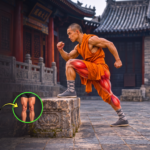
In a recent YouTube video, fitness coach Stephanie of Training and Coaching with Stephanie took on a maddening puzzle: aching knees and throbbing elbows despite flawless form.
Her diagnosis is a “connective tissue adaptation lag.”

Muscles bounce back within weeks, while tendons lag behind by months.
Her fix is a two-step loading protocol designed to bulletproof joints without sacrificing strength.
One step works as a pre-lift “off switch” for pain.
Another exposes a popular gym machine that may be quietly punishing your knees.

If you want something simple that actually works, this is one of the most effective tools I’ve used to build strength, conditioning, and endurance without needing a full gym setup.
- Full-body training with one weight using swings, squats, and presses
- Solid cast iron build that feels stable and lasts for years
- Comfortable grip that makes high-rep workouts easier to handle
Jump to:
Why Great Form Can’t Save Your Joints
If you warm-up use perfect form and still wake up 24 hours later with aching knees or throbbing elbows, you don’t have a form problem. You have a connective tissue adaptation lag.
Muscles are packed with blood vessels. Lifting sends blood rushing in with oxygen, amino acids, and repair signals, so muscle fibers rebuild in roughly 48 to 72 hours, according to Stephanie.
Tendons and ligaments play by different rules.
They are hypovascular, meaning they have minimal direct blood supply compared to muscle tissue.
Sparse nutrient flow means slow cellular turnover. Dense collagen fibers need months to remodel and build real structural stiffness.
- Muscles: adapt in weeks, fueled by rich blood supply
- Tendons and ligaments: adapt over months, with limited blood flow
- Nervous system: adapts fast, which makes you feel ready for more weight
The Trap Hiding Inside Progress
When your brain tells you you’re ready to add weight to the bar, your connective tissue is still drowning in last month’s workload.
Strong-feeling muscles say add 10 pounds. Tendons, still catching up to what was lifted three weeks ago, quietly disagree.
Why Couch Rest Backfires
When tendinitis flares up, standard advice sounds sensible: take two weeks off, ice it, and pop anti-inflammatories. Stephanie calls that approach one of the worst moves for long-term tendon health.
Tendons are mechanical structures. They require a mechanical load to stimulate collagen synthesis.
Her argument: weeks on the sofa leave a tendon with less load-bearing capacity, not more. Return to old weights, and the flare-up comes roaring back.
If you want something simple that actually works, this is one of the most effective tools I’ve used to build strength, conditioning, and endurance without needing a full gym setup.
- Full-body training with one weight using swings, squats, and presses
- Solid cast iron build that feels stable and lasts for years
- Comfortable grip that makes high-rep workouts easier to handle
Passive days off also leave tendons “cold and starved” of nutrients, she says. Her prescription is gentle, active circulation that avoids taxing the nervous system.
Worth noting: sharp, severe, or lingering pain deserves a qualified healthcare provider’s eyes. Her advice targets nagging overuse irritation, not diagnosed injuries.
Fast Reps and the Leg Extension Problem
Picture the bottom of a squat or bench press. Dropping fast and bouncing out of the hole leans on the stretch-shortening cycle, with tendons acting like rubber bands.
Recovered tendons handle that spring beautifully. Under-adapted ones suffer micro-damage right where tendon meets bone.
Enter the machine she warned about: the seated leg extension with fast, kicking reps. Lifters often choose it believing it is gentler than squats.
Kicking up rapidly places direct shearing tension right across an inflamed patellar tendon.
So rest weakens tendons, and speed aggravates them. What remains?
If you want something simple that actually works, this is one of the most effective tools I’ve used to build strength, conditioning, and endurance without needing a full gym setup.
- Full-body training with one weight using swings, squats, and presses
- Solid cast iron build that feels stable and lasts for years
- Comfortable grip that makes high-rep workouts easier to handle
Step 1: Heavy Isometric Holds
Isometrics mean holding a weight in a fixed position with zero joint movement. Stephanie says that creates intense mechanical strain without joint friction or tendon sliding.
Her claim: sports science shows heavy isometric contractions dial down pain signals for up to 45 minutes while cueing tendon cells to lay down new collagen. Response varies from person to person, so treat it as something to test, not a guarantee.
Knee Pain: Wall Sit Holds
- Sets: three to four
- Duration: 30 to 45 seconds each
- Angle: knees bent 60 to 90 degrees
- Option: rest a dumbbell in your lap for extra challenge
Do these before squats or lunges. Aim for high muscular effort, zero movement.
Elbow or Bicep Pain: Mid-Range Curl Holds
Grab moderate dumbbells. Curl until forearms sit parallel to the floor, palms facing each other, then freeze for 30 to 40 seconds across three rounds.
By the time you finish three rounds of these static holds, the tendon feels primed, the pain response is turned down, and you can train your primary lifts without sharp discomfort.
Step 2: Controlled Eccentrics
Once the joint is calmer, main sets build structural thickness. The tool is a strict three to four second lowering phase on every rep.
When you lower a weight slowly, you eliminate the bouncing rebound at the bottom.
Tendon fibers then absorb force smoothly across the full range of motion. Stephanie credits that with driving gains in tendon stiffness and cross-sectional area.
If you want something simple that actually works, this is one of the most effective tools I’ve used to build strength, conditioning, and endurance without needing a full gym setup.
- Full-body training with one weight using swings, squats, and presses
- Solid cast iron build that feels stable and lasts for years
- Comfortable grip that makes high-rep workouts easier to handle
- Squats: take a full three to four count to reach depth
- Dumbbell presses and rows: control the descent completely, pause, then drive up
- Working weight: drop 15 to 20 percent to hold that tempo
Swallowing pride is part of the deal. Muscles may move heavier iron, yet tendons need slower time under tension to survive it.
The Golden Rule for Joint Longevity
Your muscles will tell you that you are ready to jump 10 lbs before your joints have built the structural armor to carry it.
When a tendon starts whispering, Stephanie suggests neither vanishing from the gym for weeks nor grinding through sharp pain to look tough.
- Keep the movement pattern
- Drop load by roughly 20 percent
- Own a strict four-second lowering phase
- Prime the joint with heavy static holds before lifting
Give your tendons the time and mechanical loading they need to catch up.