For someone who’s built a Hollywood empire on strength, charisma, and near-mythical fitness levels, Dwayne “The Rock” Johnson continues to be a marvel.
With a physique that turns heads and decades of hard-earned muscle, it’s no wonder fans are curious about every detail — including his abs.
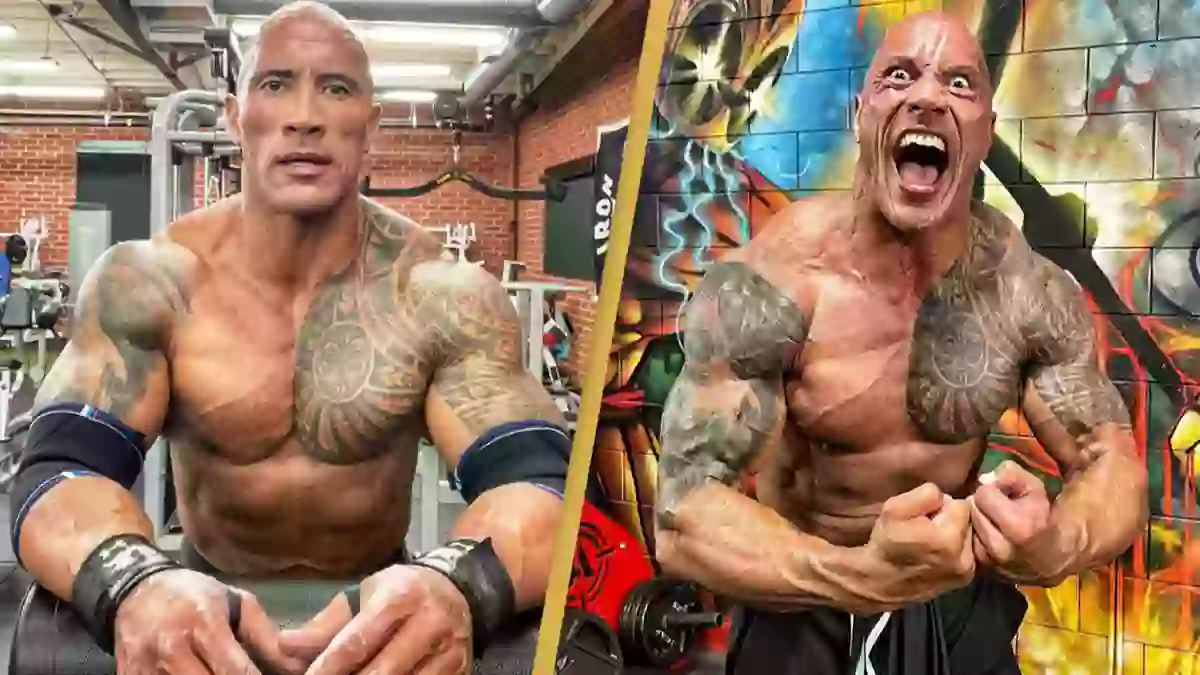
But in a refreshingly candid moment, Johnson addressed the elephant in the room: he doesn’t have the textbook six-pack you might expect.
The reason? A brutal wrestling injury that would’ve sidelined most mortals.
Jump to:
It’s Not About Fat — It’s About History
Despite having low body fat, a rigorous training regimen, and a sculpted torso, Johnson admits his abdominal muscles don’t conform to the symmetrical six-pack ideal often plastered across fitness magazines and Instagram grids.
“I got like a five-and-a-half pack, sometimes a four-and-a-half pack,” Johnson joked during a Wired “Autocomplete” interview alongside Jungle Cruise co-star Emily Blunt. But behind the humor lies a serious backstory.
A Devastating Injury Changed His Physique Forever
In a 2013 WrestleMania match against John Cena, Johnson suffered a catastrophic injury that tore the top of his quadriceps off his pelvis. But that was just the beginning. The injury triggered a chain reaction, leading to a complete abdominal wall rupture.
“What that did was that caused a chain reaction and it tore my abdomen wall,” Johnson explained. “So then I had to do a triple hernia emergency surgery, of a tear, a tear and a tear.”
He also described how his adductor muscle detached from his pelvis — an intensely painful injury that required surgical intervention and has lasting effects on his midsection’s appearance.
Surgery Scars and Muscle Trauma Altered His Ab Structure
Unlike superficial scrapes or strains, abdominal tears and hernias drastically alter muscle symmetry and structure. Even after surgery, the abdominal wall doesn’t always return to its pre-injury form — especially for athletes like Johnson who push their bodies to the edge.
Post-surgical scar tissue, weakened connective tissue, and altered muscle alignment all contribute to how the abs appear externally. So while his abs remain strong, they no longer form the uniform six-pack look seen on fitness influencers.
The Social Media Abs Myth
Johnson’s response also served as a subtle jab at unrealistic body standards in the digital age. “All these Instagram fitness models have these incredible six-, eight-, 12-, 24-pack stomachs,” he said with a smirk. But those hyper-visible abs are often the result of lighting, posing, genetics — and sometimes even photo editing.
The notion that visible six-packs are the pinnacle of fitness is both misleading and discouraging. In truth, core strength, athleticism, and function matter far more than ab aesthetics.
You Can Be Fit Without a Six-Pack
Dwayne Johnson isn’t alone. Many elite athletes — from powerlifters to NFL stars — don’t flaunt a chiseled six-pack. Genetics, muscle insertions, past injuries, and surgeries all play a role in how abdominal muscles look, even at very low body fat.
More importantly, ab definition doesn’t directly correlate with health or performance. Functional core strength — the kind that supports lifting, sprinting, and real-world movement — matters far more than how sharply defined those muscles are.
The Takeaway: Strength Is More Than Skin Deep
Johnson’s transparency about his injuries and physical limitations is a refreshing antidote to the perfectionism plaguing fitness culture. His story underscores a powerful message: real strength includes resilience, recovery, and the courage to laugh in the face of judgment.
So next time someone wonders why The Rock doesn’t have a perfect six-pack, the answer is simple — he doesn’t need one. He’s already overcome more than most bodies could handle, and that’s the kind of core strength that truly counts.