At 60 years old, most runners are thinking about slowing down.
Not this guy.
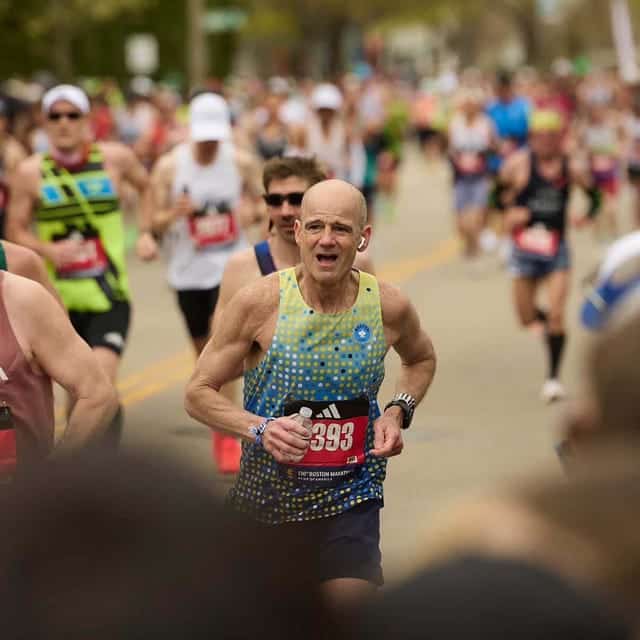
In a story that’s equal parts inspiration and disbelief, Pennsylvania-based runner and IT professional Jeff just crossed the Boston Marathon finish line in a jaw-dropping 2:48:16 — a personal record — and he’s already setting his sights on going faster.
What makes this even more remarkable? He only started running seriously again five years ago, after a nearly three-decade break — and his journey from casual jogger to Boston qualifier is the kind of story that makes you want to lace up your shoes immediately.
Jump to:
- From “That’s Too Far for an Old Man” to Marathon Contender
- A Knee Injury, a Decades-Long Hiatus, and a COVID-Era Comeback
- The Group That Turned a Jogger Into a Marathoner
- The Secret Weapons: Strength Training, Speedwork, and AI
- Chasing Sub-3: The Breakthrough That Changed Everything
- Boston 2026: A Friendly Rivalry and a New PR
- His 3 Tips for Getting Faster After 60
From “That’s Too Far for an Old Man” to Marathon Contender
It was October 2021 when everything changed. A colleague named Rachel “Rae” Butz invited him to join her running group, the Breakfast Club Runners (BCR), based in Nazareth, Pennsylvania.
His first reaction to their Sunday long runs? Flat-out refusal.
No products found.
That’s too far for an old man!
At the time, he was barely logging three to five miles at a stretch. The group was casually knocking out six to ten miles every weekend.
He showed up anyway — and kept his struggles to himself.
I didn’t want to show weakness. I didn’t want to be the guy who complained or cut runs short. I just kept showing up and doing what everyone else was doing.
That quiet determination would become the engine behind one of the most surprising athletic glow-ups in recent memory.
A Knee Injury, a Decades-Long Hiatus, and a COVID-Era Comeback
Running wasn’t always a foreign concept to him. Back in high school, he competed in track and cross-country, and after graduating in 1984, he joined the Air Force and moved to Germany — where he continued racing middle-distance events, including his favorite: the 1500-meter.
Then came one reckless decision that cost him decades on the road.
In the late 1980s, he entered a half marathon on a whim — undertrained, overconfident, and way too aggressive from the start. The result was a devastating knee injury that never fully healed. He switched to mountain biking and didn’t run again for roughly 30 years.
No products found.
COVID-19 quietly changed all of that. Stressed out from a demanding IT role and searching for something he could control, he returned to running — slowly, cautiously, and solo.
The Group That Turned a Jogger Into a Marathoner
BCR didn’t just give him a training partner. It gave him an entire community — and the muscle memory of something he hadn’t felt since his twenties in Germany.
The whole dynamic brought me back to my days running in Germany with my friend Klaus. We trained hard, but it never really felt like it because we were joking around and talking about our lives the whole time. We’d go out for a run, then grab dinner and head to the discotheque, back when discotheques were a thing.
Within the group, he found two mentors who would prove invaluable: Chris Mertz, a runner with 32 consecutive Boston Marathons to his name, and Michael “Brownie” Browne, a high school cross-country coach.
They have so much running knowledge and are familiar with the marathon distance, so I basically just did what they told me to do.
His first marathon — the 2022 Jim Thorpe Area Running Festival — ended in a 3:22:31 finish, good enough for second place in his age group. He was already hungry for more before he crossed the line.
The Secret Weapons: Strength Training, Speedwork, and AI
After a physical therapist helped him address a nagging recurrence of his old knee injury — prescribing hip and glute strengthening exercises like single-leg Romanian deadlifts and hip thrusts — he made a decision that transformed his running.
He started lifting. Specifically, he embraced Tom Brady’s TB12 program, a core-focused system built around resistance bands, leg strengthening, and stability work — timed almost perfectly to align with a marathon training cycle.
No products found.
He also leaned hard into speedwork, utilizing the middle school track behind his workplace every Wednesday evening. And in a move that surprised even him, he began using AI tools to design interval sessions.
As someone who works in technology, I know how scary A.I. can be. But in this case, I’ve found it to be really useful.
One AI-suggested workout — 16 x 200 meters — became an instant favorite.
Chasing Sub-3: The Breakthrough That Changed Everything
By 2023, after finishing Boston in 3:09:38 and Jim Thorpe in 3:03:31, a previously unthinkable goal started to feel within reach: breaking three hours.
Mathematically, it all came down to shaving off less than 10 seconds a mile. That felt possible.
At the 2023 Erie Marathon, he latched onto the three-hour pacer and never let go. His finishing time? 2:59:05.
He’d done it.
Since returning to the sport five years ago, he’s completed 12 marathons and set personal records in nine of them — a staggering rate of improvement that most runners half his age would envy.
No products found.
Boston 2026: A Friendly Rivalry and a New PR
This year’s Boston Marathon was personal. He and Brownie trained for it together and ran the majority of the course side by side — fueled by a competitive friendship that pushed both men harder than either might have gone alone.
At the start of the race he kept telling me we should probably slow down. And every time he said something, I would pick up the pace.
Brownie pulled ahead on Heartbreak Hill and ultimately beat him by about 30 seconds. But crossing that finish line in 2:48:16 — a brand new personal record — was its own kind of victory.
His 3 Tips for Getting Faster After 60
For anyone wondering how to replicate what he’s built, he keeps it straightforward.
- Run with a group. A supportive community — especially one with seasoned runners willing to share knowledge — accelerates improvement in ways solo training simply cannot.
- Be realistic with your goals. He tracks everything through Garmin, Strava, and Runalyze — weekly mileage, heart rate, VO2 max, sleep, stress — and uses that data to set goals grounded in evidence, not ego.
- Strength train. Twice a week. No excuses. At 60, he considers it non-negotiable. “As you age, your muscles just aren’t the same, and you have to do more to take care of yourself,” he says.
Next on the schedule is a return trip to the New York City Marathon, where he’s planning to push his peak training week from 88 miles to 95 — and force himself to tackle the hill repeats he openly admits to hating.
Hills pay the bills.
At 60, still accelerating, still competing, and already eyeing the next PR — the old man is just getting started.