Core training might not be everyone’s first choice at the gym, but 86-year-old fitness icon Erika Rischko is making it look both impressive and achievable.
In a recent Instagram post, she shared her go-to Bosu ball core workout—and it’s packed with moves that challenge stability, strength, and balance all at once.
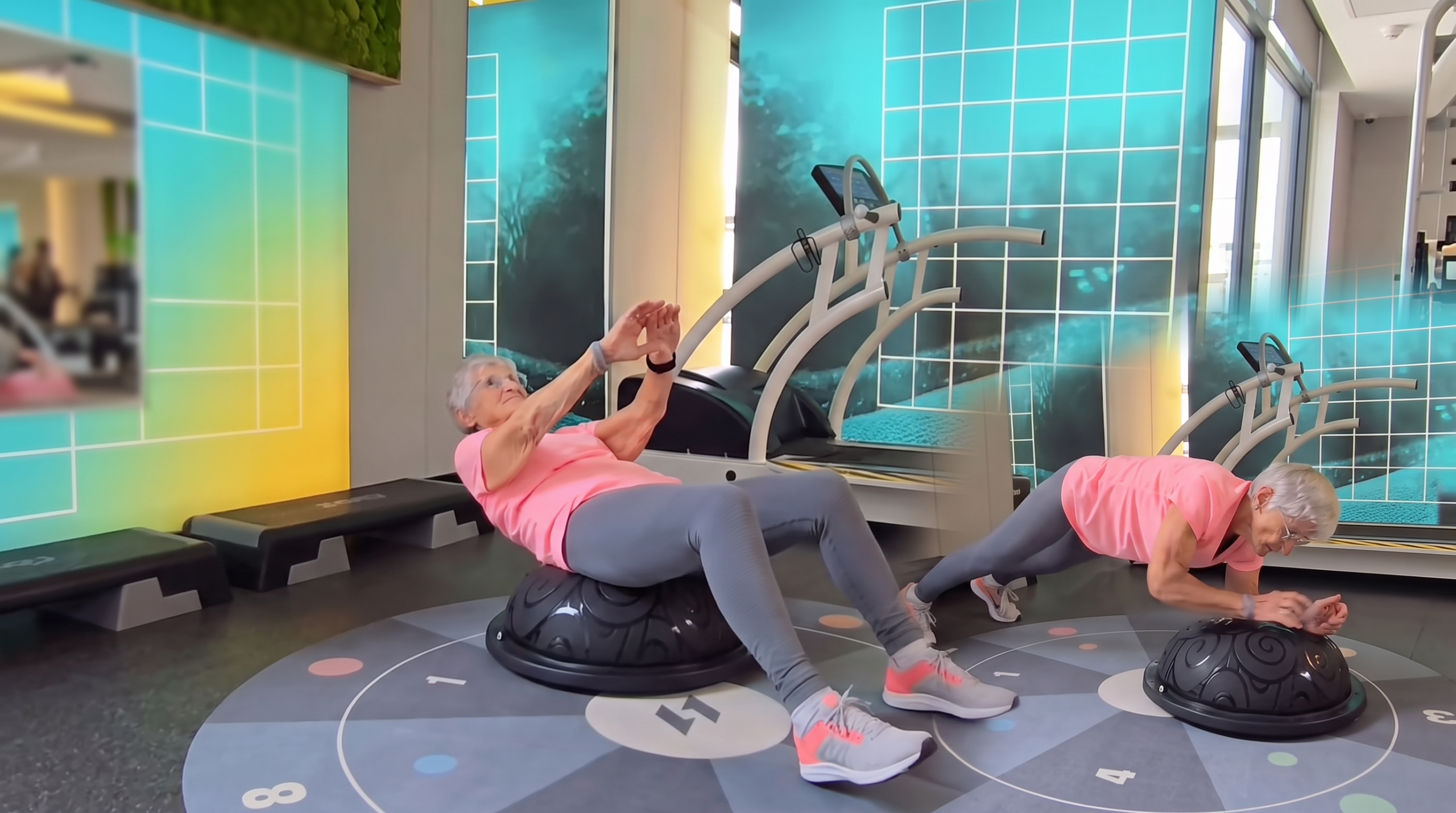
The secret? The instability of the Bosu ball forces your core muscles to work overtime to keep you steady.
Here’s a breakdown of the six moves she demonstrated, plus how you can incorporate them into your own routine.
Jump to:
Why Training on a Bosu Ball Works
The Bosu ball—short for “both sides up”—adds an element of instability to traditional exercises, which means your core has to engage more deeply to maintain proper form.
This type of training doesn’t just build strength; it also improves balance and proprioception, which are critical for preventing falls and maintaining functional fitness as we age.
No products found.
86 years old and picking a fight with a wobbly half-ball/balance trainer. My core is working hard, my balance is being dramatic and I’m trying to look like this was all my idea.
Erika’s workout is a masterclass in making instability work for you, not against you.
The Six Moves in Erika Rischko’s Bosu Ball Core Workout
1. Commando Plank
This move transitions you from a forearm plank to a high plank—and back down again—while balancing your forearms on the Bosu ball.
- Start in a plank position with forearms on the rounded side of the Bosu ball, feet hip-width apart.
- Push up onto your right hand, then your left, moving into a high plank.
- Lower back down to forearms, one arm at a time.
- Keep your core tight and avoid rocking side to side.
Why it works: The unstable surface amplifies the challenge to your shoulders, triceps, and deep core stabilizers.
2. Sit-Up to Standing
This dynamic movement combines core strength with functional power—the kind you use when getting up from a low chair or the floor.
- Sit on the Bosu ball, leaning back slightly with heels on the floor.
- Use your core to sit up and rock forward.
- Use momentum to push into a standing position without using your hands.
- Reverse the movement to return to seated.
This exercise mimics real-life movement patterns, making it incredibly practical for everyday strength and independence.
3. Plank Toe Tap
A high plank with feet on the Bosu ball becomes a balance and anti-rotation challenge when you add alternating toe taps.
No products found.
- Start in a high plank with hands on the mat and feet together on the Bosu ball.
- Tap one foot out to the side, then return to center.
- Repeat on the other side, keeping your hips stable.
Pro tip: Focus on keeping your torso still—resist the urge to twist or shift your weight.
4. Side Plank
Side planks are already tough. Add a Bosu ball, and you’ve got a serious oblique and hip stabilizer workout.
- Lean on the Bosu ball with your forearm, elbow directly beneath your shoulder.
- Push up through your arm, lifting your hips so your body forms a straight line.
- Hold this position, keeping your core braced.
If the full version feels too intense, drop your bottom knee to the floor for a modified hold.
5. Mountain Climber (Slow Tempo)
Slowing down the tempo on mountain climbers turns a cardio move into a controlled strength exercise that torches your core.
- Start in a high plank with feet on the Bosu ball.
- Drive your right knee toward your right elbow, moving slowly and with control.
- Return to center and repeat on the other side.
- Avoid rocking your torso; keep everything stable.
Key focus: Quality over speed. The slower you go, the harder your core has to work.
6. Cross-Body Mountain Climber (Slow Tempo)
This variation adds a rotational element, which fires up your obliques and challenges your anti-rotation strength.
No products found.
- Start in a forearm plank with forearms on the Bosu ball and feet on the floor.
- Drive your right knee toward your left elbow.
- Return to center and repeat on the opposite side.
- Keep the movement slow and controlled.
This move is deceptively difficult—your core has to resist rotation while also controlling the movement.
How to Structure Your Bosu Ball Core Workout
If you’re new to Bosu ball training, start by performing each move for 20–30 seconds, resting for 30 seconds between exercises.
Complete 2–3 rounds, focusing on form over speed.
As you build strength and confidence, you can increase the work intervals to 40–45 seconds or add more rounds.
Beginner-friendly modifications:
- Perform planks on your knees instead of your toes.
- Skip the Bosu ball and do the moves on a stable surface first.
- Hold static positions (like the side plank) instead of moving through reps.
Why Core Strength Matters at Every Age
Core strength isn’t just about aesthetics—it’s about functional movement, posture, and injury prevention.
No products found.
A strong core supports your spine, improves balance, and makes everyday activities—like lifting groceries, bending down, or even walking—easier and safer.
For older adults, core training is particularly important for maintaining independence and reducing the risk of falls.
Erika’s workout is proof that age is no barrier to building serious strength and staying active.
What You’ll Need
To recreate Erika’s workout at home or in the gym, you’ll need:
- A Bosu ball: Look for one that’s sturdy and inflated to the right firmness (not too soft, not too hard).
- A yoga mat: For cushioning and grip.
- Comfortable workout clothes: You’ll be moving through a range of positions, so flexibility is key.
The Core Balance 2-in-1 Dome Balance Trainer is a solid, affordable option that works for both beginner and advanced users.
Final Thoughts
Erika Rischko’s Bosu ball core workout is a brilliant example of how to train smart, not just hard.
No products found.
By adding instability to classic core exercises, you challenge your muscles in new ways, build better balance, and improve functional strength that carries over into daily life.
Whether you’re 26 or 86, these six moves are a powerful addition to any fitness routine—and a reminder that strength training is for every body, at every stage of life.