Building impressive biceps requires more than just standard curls with free weights.
Men’s Health fitness director Ebenezer Samuel recently highlighted a unique cable exercise that can take arm development to new heights: the crucifix curl.
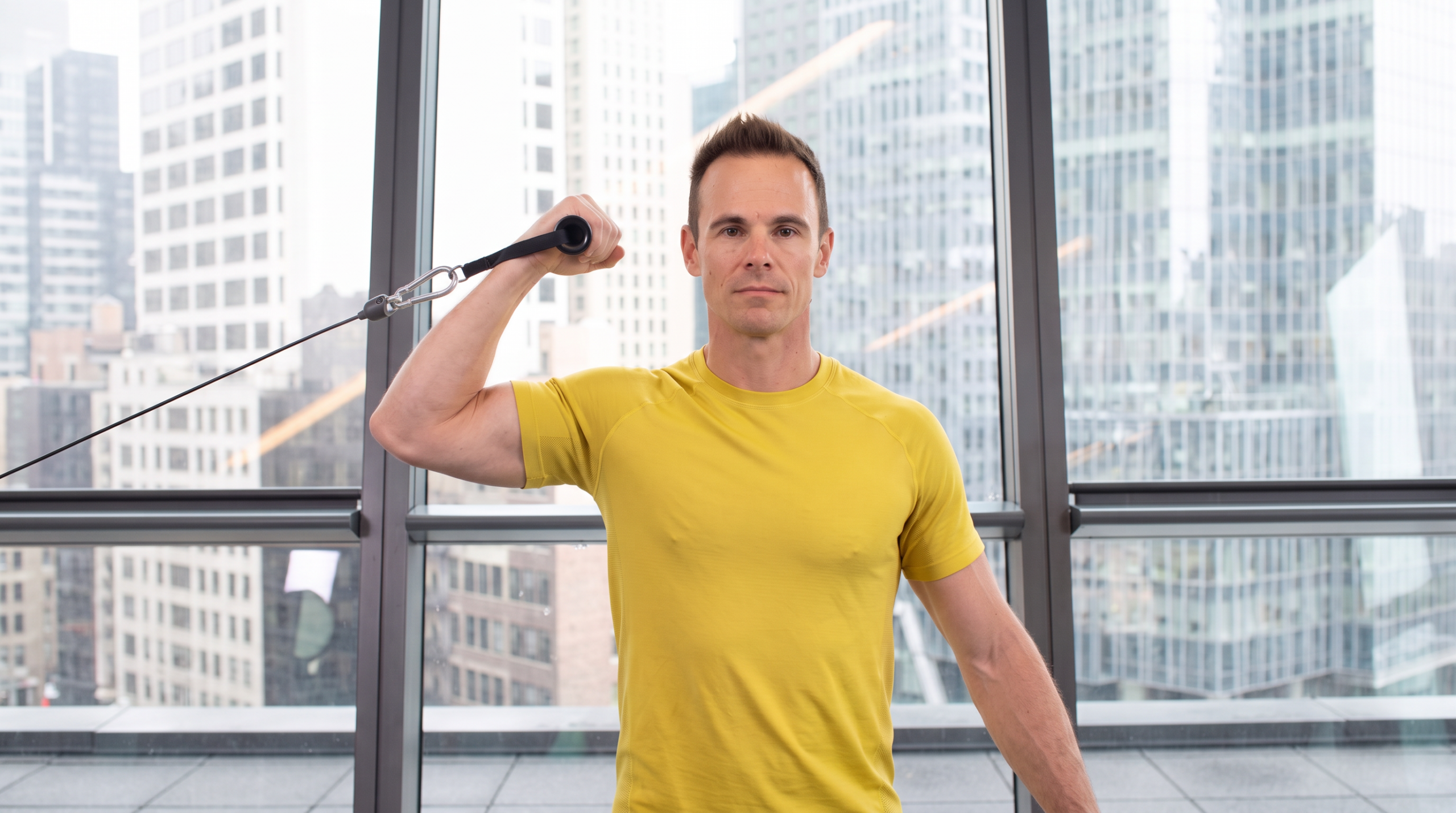
This movement offers a fresh approach to biceps training by emphasizing isolation, stability, and a different angle of resistance that dumbbells and barbells simply can’t replicate.
Whether you’re chasing a bigger pump or breaking through a plateau, this exercise deserves a spot in your rotation.
Jump to:
- Why Cable Work Matters for Biceps Growth
- Setting Up for Success: The Tall Kneeling Position
- Wrist Position: The Make-or-Break Detail
- The “Wall” Visualization Technique
- Execution: Curl, Squeeze, Control
- Programming the Crucifix Curl
- Who Benefits Most From This Exercise
- Common Mistakes to Avoid
- Variations and Progressions
- Building a Complete Biceps Arsenal
- Recovery and Frequency Considerations
- Nutrition’s Role in Arm Development
- Tracking Progress Beyond the Mirror
Why Cable Work Matters for Biceps Growth
Most lifters stick to what they know: standard dumbbell curls, barbell variations, and maybe some hammer curls thrown in for good measure.
But limiting yourself to free weights means missing out on unique training stimuli that cables provide. Constant tension throughout the entire range of motion is one of cable training’s biggest advantages.
Unlike dumbbells, where tension varies depending on arm position, cables maintain resistance from start to finish.
Every so often, you want to make sure to mix up your biceps training and get some isolation training in there, so you can get a very deep contraction, you can do it from a different angle, and with a lighter weight.
Samuel emphasizes that the crucifix curl does more than just work biceps. It challenges shoulder stability and core engagement in ways traditional curls don’t, making it a multi-dimensional movement despite its isolation focus.
Setting Up for Success: The Tall Kneeling Position
Proper positioning makes or breaks the crucifix curl. Samuel and Men’s Health fitness editor Brett Williams recommend performing this exercise from a tall kneeling position rather than standing.
This stance forces core activation while removing any temptation to use momentum or leg drive.
Cable height is critical. Set your cable so that when you grip the handle, your elbow sits slightly lower than shoulder level—not higher.
You’re going to see a lot of people wind up in this position where the elbow is higher than the shoulder—that is a very challenging stretch for your biceps and it’s also really starting to challenge that shoulder joint in a way that we don’t have to to get the most out of this curl.
Getting the angle wrong puts unnecessary stress on the shoulder joint without any additional biceps benefit. Keep that elbow at or below shoulder height to maximize muscle activation while minimizing joint risk.
Wrist Position: The Make-or-Break Detail
Maintaining a strong, neutral wrist throughout the movement is non-negotiable.
When the wrist collapses or bends excessively, the biceps can’t generate maximum force. Worse, shoulder involvement creeps in, stealing tension from the target muscle.
Think of your forearm and hand as one solid unit. Your elbow should remain in line with your shoulder throughout the entire repetition—no drifting inward, no compensation from the chest.
The biceps must do all the work. Any deviation means you’re recruiting other muscle groups unnecessarily.
The “Wall” Visualization Technique
Samuel offers a powerful mental cue to maintain proper form: imagine a wall directly in front of your body.
As you perform the curl, no part of your torso, shoulder, or elbow should move forward to “touch” that imaginary barrier.
This visualization keeps your body square and prevents compensatory movement patterns. Your torso stays locked, glutes engaged, shoulder blades retracted.
Only the elbow moves. Everything else remains completely still, forcing the biceps to handle the entire load without assistance.
Execution: Curl, Squeeze, Control
Once positioned correctly, the actual movement is deceptively simple—but that doesn’t mean easy.
Initiate the curl by bending only at the elbow, bringing your hand straight toward your shoulder. Avoid any inward drift or rotation.
At the top of the movement, emphasize the squeeze. Hold peak contraction for up to two seconds, really feeling the biceps working under constant cable tension.
Lower the weight with control, resisting the pull of the cable on the way down. This eccentric phase is where significant muscle damage—and subsequent growth—occurs.
Programming the Crucifix Curl
Because this exercise emphasizes isolation and deep contraction, it works best with moderate to lighter loads and higher repetitions.
Think 3-4 sets of 10-15 reps per arm, focusing on quality over quantity. The goal isn’t to move massive weight—it’s to create metabolic stress and achieve a serious pump.
Place the crucifix curl toward the middle or end of your arm workout, after heavier compound movements. Use it as a finisher to completely exhaust the biceps after barbell or dumbbell work has already pre-fatigued them.
Who Benefits Most From This Exercise
Intermediate and advanced lifters will get the most from crucifix curls. The exercise demands body awareness, stability, and mind-muscle connection that beginners may still be developing.
Athletes looking to break through biceps plateaus particularly benefit from the novel stimulus cables provide. If traditional curls have stopped producing results, changing the angle and resistance pattern can reignite growth.
Those with shoulder issues should approach carefully. While proper form minimizes joint stress, the arm-extended position may aggravate existing problems. Start conservatively and listen to your body.
Common Mistakes to Avoid
Several form breakdowns can sabotage the effectiveness of crucifix curls:
- Setting the cable too high: This creates unnecessary shoulder strain without additional biceps activation
- Allowing the elbow to drift forward: Brings the chest into the movement, reducing biceps isolation
- Using momentum: Rocking or twisting the torso defeats the purpose of strict isolation work
- Rushing the repetitions: Speed kills the constant tension advantage cables provide
- Neglecting the eccentric: Dropping the weight quickly wastes half the muscle-building potential
Each of these errors diminishes the exercise’s effectiveness. Perfect form matters more than impressive weight when isolation is the goal.
Variations and Progressions
Once you’ve mastered the basic crucifix curl, several variations can add variety:
Standing crucifix curls remove the kneeling position’s core demand, allowing you to focus purely on the arms. This works well for shorter workouts or when core fatigue is high.
Resistance band crucifix curls offer a travel-friendly alternative. Anchor bands to a sturdy post or door frame at the appropriate height and follow the same form cues.
Unilateral work allows you to address any strength imbalances between arms. Perform all reps on one side before switching, maintaining strict form throughout.
Building a Complete Biceps Arsenal
The crucifix curl shouldn’t replace your entire biceps routine—it should complement it.
A well-rounded arm program includes compound pulling movements like chin-ups and rows, traditional curling variations with different grips, and isolation exercises like the crucifix curl for complete development.
Vary your approach every 4-6 weeks to prevent adaptation. Rotate between different curl variations, adjust rep ranges, and manipulate tempo to keep muscles responding.
Progressive overload remains king. Whether you’re adding weight, increasing reps, or improving time under tension, consistent progression drives growth.
Recovery and Frequency Considerations
Biceps are relatively small muscle groups that recover faster than larger ones like legs or back. However, they’re involved in virtually all pulling movements, meaning they receive stimulus even on non-arm days.
Direct biceps work 2-3 times per week allows adequate recovery while providing enough frequency for growth. Space arm-focused sessions at least 48 hours apart to allow tissue repair.
Pay attention to elbow health. Chronic soreness or sharp pain signals overuse. Rest and recovery aren’t optional—they’re when actual muscle growth occurs.
Nutrition’s Role in Arm Development
No amount of crucifix curls will build bigger biceps without proper nutrition supporting your efforts.
Adequate protein intake—roughly 0.7-1 gram per pound of body weight—provides the building blocks for muscle repair and growth. Distribute this across 3-4 meals throughout the day for optimal protein synthesis.
Sufficient calories matter too. Building muscle in a significant calorie deficit is extremely difficult. A modest surplus of 200-300 calories above maintenance supports growth while minimizing fat gain.
Don’t neglect micronutrients. Vitamins and minerals support countless processes involved in muscle building, recovery, and overall performance.
Tracking Progress Beyond the Mirror
While biceps growth is visible, objective measurements provide clearer progress indicators.
Measure arm circumference at the same point—typically the peak of the biceps when flexed—every 2-4 weeks. Take measurements at the same time of day under similar conditions for consistency.
Track performance metrics: weight used, reps completed, sets performed. Strength gains often precede visible size increases, so log your workouts to recognize progress even when the mirror seems unchanged.
Progress photos taken monthly under identical lighting and poses reveal changes your daily mirror checks might miss. Visual documentation keeps you motivated during plateaus.