Resting heart rate might be one of the most underrated biomarkers of health—and one of the easiest to track.
For over a decade, one longevity-focused individual has maintained an elite resting heart rate between 35 and 39 beats per minute—a range that even surprises doctors.
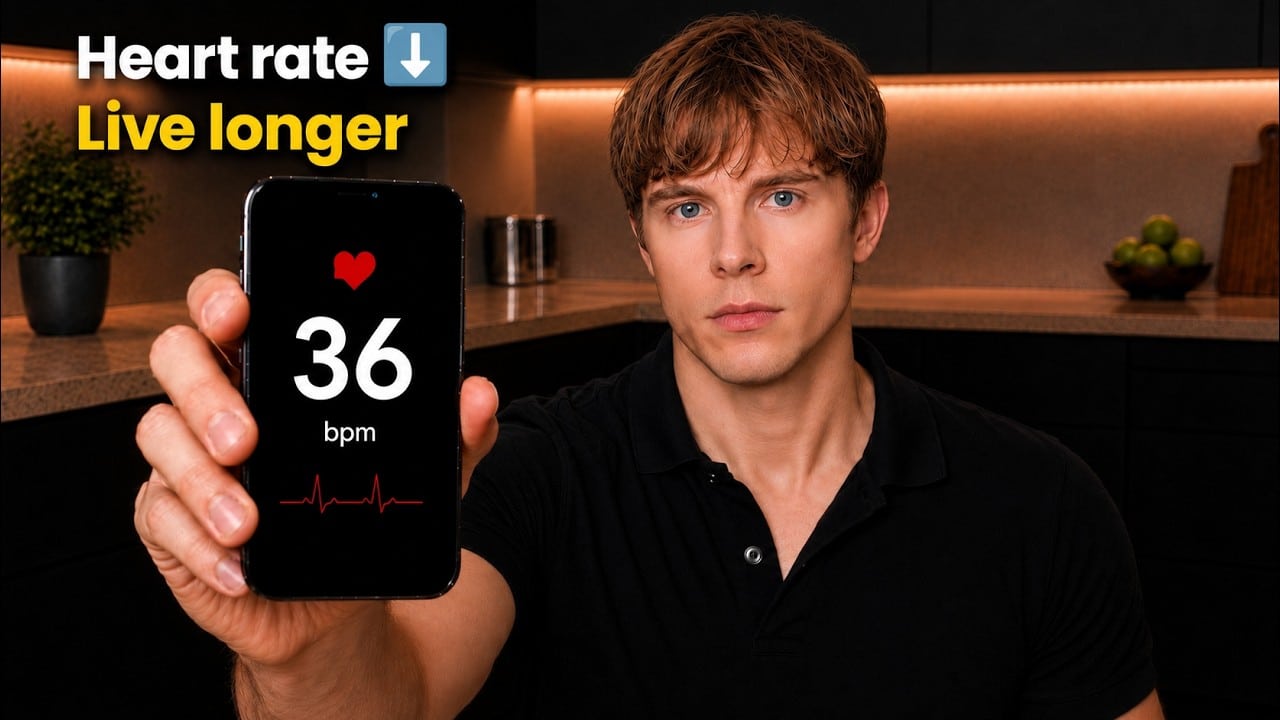
Through years of experimentation with different diets, exercise programs, and body weights, he’s identified the exact lifestyle factors that keep his heart rate in the top 0.5% of the population.
What he’s learned could help anyone improve their cardiovascular health and longevity—without expensive labs or complicated protocols.
Jump to:
- Why Resting Heart Rate Matters for Longevity
- The Critical Combination: Low Heart Rate Plus High HRV
- Exercise: The Foundation of Heart Efficiency
- Walking: The Underrated Heart Health Habit
- Intermittent Fasting’s Surprising Heart Benefits
- Body Weight’s Impact on Heart Rate
- Sauna: Passive Cardiovascular Training
- Practical Tracking and Implementation
- Important Caveats and Context
Why Resting Heart Rate Matters for Longevity
There’s an old proverb suggesting humans only have a certain number of heartbeats in life. While not literally true, research increasingly supports that resting heart rate serves as a powerful predictor of lifespan.
Nature provides some interesting clues. Whales, with their incredibly slow heart rates, live up to 200 years longer than mice despite similar total lifetime heartbeats—roughly 1 billion for mice versus 2-4 billion for whales.

If you want something simple that actually works, this is one of the most effective tools I’ve used to build strength, conditioning, and endurance without needing a full gym setup.
- Full-body training with one weight using swings, squats, and presses
- Solid cast iron build that feels stable and lasts for years
- Comfortable grip that makes high-rep workouts easier to handle
Human studies tell a compelling story too. A massive meta-analysis involving over 1.2 million people found striking correlations between heart rate and mortality risk:
- Every 10 beat-per-minute increase above 45 bpm associated with 9-10% higher risk of all-cause mortality
- Resting heart rate of 60-80 bpm linked to 12% higher all-cause mortality and 8% cardiovascular disease mortality
- Heart rate above 80 bpm connected to 45% higher all-cause mortality and 33% cardiovascular disease mortality
The mechanism isn’t mysterious. A higher resting heart rate reflects imbalanced nervous system function and poor vagal tone, which directly promotes atherosclerosis, myocardial ischemia, hypertension, and dangerous arrhythmias.
The Critical Combination: Low Heart Rate Plus High HRV
Lower isn’t always better when it comes to resting heart rate. Certain medications or underlying conditions can artificially suppress heart rate without improving health.
The ideal combination? Low resting heart rate paired with high heart rate variability (HRV). This duo reflects an efficient cardiovascular system and healthy autonomic nervous system function—the true markers of longevity.
With consistent HRV readings over 100 (considered elite level) and resting heart rate under 40, this biohacker has achieved what most doctors would consider exceptional cardiovascular fitness.
Exercise: The Foundation of Heart Efficiency
Exercise strengthens the heart and improves its efficiency at pumping blood. Yes, heart rate spikes during workouts—sometimes reaching 180-190 bpm—but the long-term effect dramatically lowers resting heart rate.
If you want something simple that actually works, this is one of the most effective tools I’ve used to build strength, conditioning, and endurance without needing a full gym setup.
- Full-body training with one weight using swings, squats, and presses
- Solid cast iron build that feels stable and lasts for years
- Comfortable grip that makes high-rep workouts easier to handle
Consider this thought experiment about lifetime heartbeats:
- Sedentary person averaging 70 bpm reaches 3 billion heartbeats in approximately 81 years
- Fit exerciser averaging 45 bpm—even accounting for 1 hour daily exercise at 155 bpm—reaches 3 billion heartbeats in 114 years
That’s a staggering 33-year difference in theoretical lifespan based purely on resting heart rate efficiency.
Which Exercise Works Best?
A comprehensive 2018 meta-analysis examining 191 studies found that while all exercise lowers resting heart rate, endurance training and yoga proved most effective.
Endurance training improves blood flow and cardiac pumping efficiency. Yoga likely works through stress reduction while providing aerobic stimulus and mindfulness benefits.
If I spend more time doing cardio, then my resting heart rate drops. It’s going to be around 35. If I do less cardio, it’s going to increase slightly, it’s going to be around 39, sometimes even 41, 42.
Zone two cardio—moderate intensity aerobic exercise—proved particularly effective for maintaining elite-level heart rate over the years.
Walking: The Underrated Heart Health Habit
Before incorporating structured cardio, years of averaging 15,000-20,000 daily steps maintained exceptional resting heart rate naturally.
If you want something simple that actually works, this is one of the most effective tools I’ve used to build strength, conditioning, and endurance without needing a full gym setup.
- Full-body training with one weight using swings, squats, and presses
- Solid cast iron build that feels stable and lasts for years
- Comfortable grip that makes high-rep workouts easier to handle
A 2020 study analyzing over 8 million Fitbit users revealed that daily step count correlated linearly with HRV across all ages. Higher step counts produced higher HRV, with benefits continuing up to 20,000 steps daily.
Walking isn’t intense, but it’s still aerobic exercise. It helps pump blood back to the heart and supports circulation, contributing to lower resting heart rate and increased HRV.
Now walking approximately 9,000-10,000 steps daily with dedicated zone two cardio sessions, the effect on resting heart rate remains consistent. The difference? Time efficiency. Structured cardio achieves similar benefits in less time than excessive daily walking.
Intermittent Fasting’s Surprising Heart Benefits
After practicing intermittent fasting for over 12 years, the cardiovascular benefits have become undeniable.
A 2025 study found that 8 weeks of 16:8 intermittent fasting reduced resting heart rate by almost 9% while simultaneously increasing HRV. Participants experienced an average 6.6 beat reduction in heart rate and 9-12 point HRV increase.
Whenever I’m eating slightly fewer calories and I’m doing a bit more controlled intermittent fasting or more structured intermittent fasting, then my heart rate is lower, my HRV is higher.
The mechanism likely involves metabolic downregulation during fasted states. Constant eating keeps metabolism elevated, which increases resting heart rate. A 16-hour daily fast gives the body extended recovery periods.
If you want something simple that actually works, this is one of the most effective tools I’ve used to build strength, conditioning, and endurance without needing a full gym setup.
- Full-body training with one weight using swings, squats, and presses
- Solid cast iron build that feels stable and lasts for years
- Comfortable grip that makes high-rep workouts easier to handle
However, longer fasts don’t appear superior. A 2021 study showed extended fasting can increase sympathetic nervous system activity, temporarily lowering HRV. Daily 16:8 fasting with approximately 7-hour eating windows—ending 5 hours before bed—provides optimal results.
Body Weight’s Impact on Heart Rate
Even muscle mass affects resting heart rate. More body mass—regardless of composition—requires the heart to pump more blood.
Personal experience revealed this clearly:
- At 74-75 kg (early 20s): Resting heart rate 35-38, HRV 120+
- At 85-86 kg (powerlifting phase): Resting heart rate increased to 45, HRV dropped to 90
- At 80-81 kg (current): Resting heart rate 35-38, HRV over 100
Research confirms resting heart rate increases linearly above BMI of 25, with the sweet spot between 18-25.
This means excessive muscle can negatively impact cardiovascular health, especially approaching BMI of 30 or higher. Most people struggle with excess body fat, not muscle, so this rarely applies. But lean men carrying significant muscle mass while maintaining elevated resting heart rate might benefit from either reducing weight or increasing cardio volume.
Sauna: Passive Cardiovascular Training
Sauna use elevates heart rate similarly to moderate cardio—typically keeping it in the low 100s during 15-30 minute sessions.
If you want something simple that actually works, this is one of the most effective tools I’ve used to build strength, conditioning, and endurance without needing a full gym setup.
- Full-body training with one weight using swings, squats, and presses
- Solid cast iron build that feels stable and lasts for years
- Comfortable grip that makes high-rep workouts easier to handle
Afterward, the cardiovascular system becomes more efficient and the autonomic nervous system shifts toward parasympathetic activity. Research demonstrates sauna use improves cardiovascular health, blood pressure, and vagal tone, with substantial data linking regular sessions to reduced heart disease and hypertension.
Practical Tracking and Implementation
Resting heart rate represents one of the simplest biomarkers to monitor. No expensive laboratory work required—most smartwatches and sleep trackers automatically measure it.
Watching trend lines reveals exactly how lifestyle choices affect cardiovascular function in real time.
Key implementation strategies:
- Prioritize endurance training or yoga for maximum heart rate reduction
- Maintain 9,000-20,000 daily steps depending on available time
- Practice daily 16:8 intermittent fasting with 5-hour pre-bed fasting window
- Maintain BMI between 18-25 for optimal heart rate efficiency
- Incorporate regular sauna sessions for passive cardiovascular benefits
- Track both resting heart rate AND HRV—the combination matters most
Important Caveats and Context
Don’t chase lower resting heart rate at any cost. Medications, breath-holding, or other artificial interventions don’t provide genuine health benefits.
Focus on the combination of improving (lowering) resting heart rate while simultaneously increasing HRV. Both trending in favorable directions signals genuine cardiovascular improvement.
If you want something simple that actually works, this is one of the most effective tools I’ve used to build strength, conditioning, and endurance without needing a full gym setup.
- Full-body training with one weight using swings, squats, and presses
- Solid cast iron build that feels stable and lasts for years
- Comfortable grip that makes high-rep workouts easier to handle
Remember that resting heart rate represents just one biomarker among many. Comprehensive health requires attention to VO2 max, inflammation markers, insulin sensitivity, lipid profiles, and kidney function.
But for accessibility, ease of tracking, and direct correlation with longevity outcomes, few biomarkers match the simplicity and power of resting heart rate paired with HRV. Getting into the 40s isn’t just for elite athletes—it’s recommended for anyone serious about optimizing heart health and extending lifespan.