Most athletes train blind, pushing hard without knowing if they’re building fitness or just collecting fatigue.
But what if there was a way to find that exact line between progress and burnout?
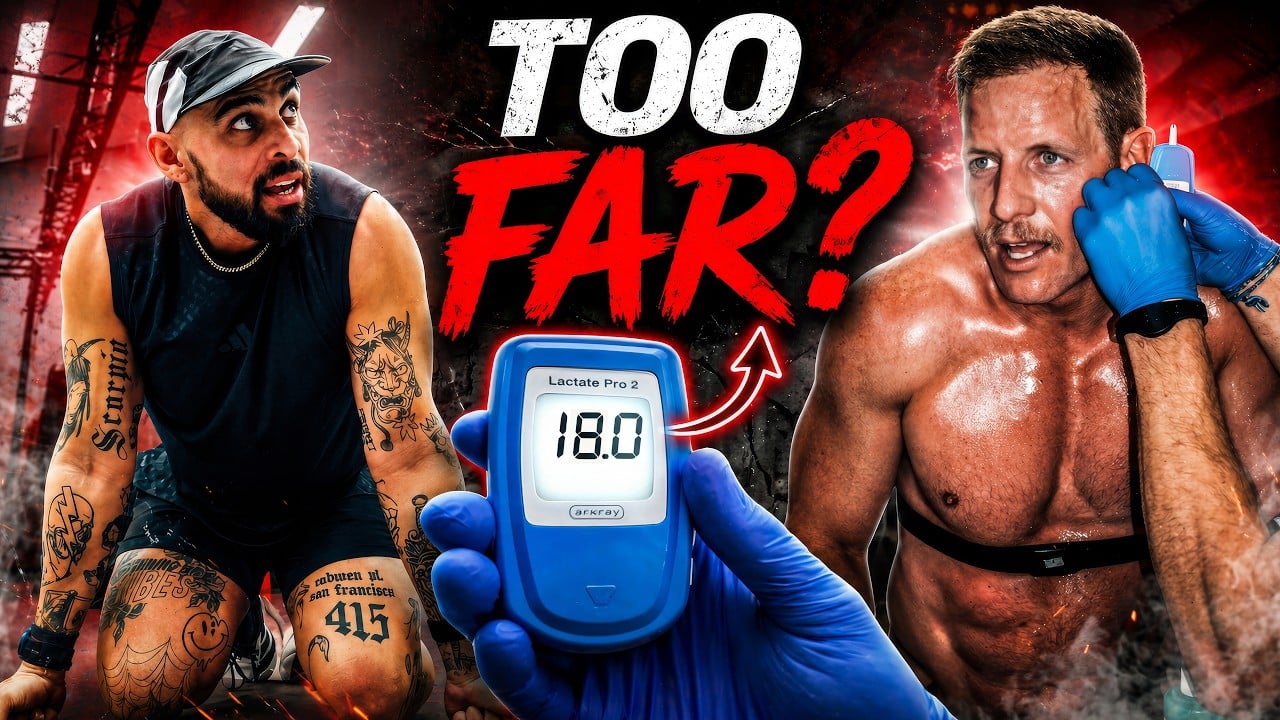
In a recent video at Adidas headquarters, fitness content creators Julian and Marcel from The Buttery Bros partnered with exercise scientist Gomer from Watt Science to undergo one of the most revealing fitness tests available: a lactic threshold assessment specifically designed for functional fitness athletes.
The results exposed not just their current fitness levels, but revealed a critical gap between everyday athletes and elite competitors that most people never see.
Jump to:
What Makes This Test Different From Traditional Methods
Traditional lactic threshold tests involve running on a treadmill with gradually increasing speed while technicians draw blood samples until exhaustion hits. Simple, but not exactly functional.
Gomer designed something better: the Hybrid Test.
This protocol mimics how functional fitness athletes actually train, combining burpee broad jumps, wall balls, and running in escalating intervals. Each round adds more reps and demands faster movement, creating a progressive overload that reveals precise metabolic thresholds.
The hybrid test is a ramp test. Like you increase the reps and also the speed of burpee broad jumps every minute on the minute. Then we do wall balls and then we do 2 minutes of running. So it’s always blocks of 5 minutes.
Between rounds, scientists measure blood lactate levels, tracking exactly when the body shifts from aerobic metabolism into lactate accumulation territory.
Understanding Lactate Threshold and Why It Matters
Lactate threshold represents the exercise intensity where lactate begins accumulating faster than the body can clear it. Below this point, athletes can sustain effort indefinitely. Above it, everything falls apart rapidly.
Lungs burn. Legs turn to concrete. The brain screams for relief.
But here’s what makes this threshold so valuable: it’s trainable. By identifying where that line sits, athletes can structure training to systematically push it higher, expanding their capacity for sustained high-intensity work.
For functional fitness competitors and Hyrox athletes, this translates directly to performance. Knowing threshold power output and corresponding heart rates allows precise training zone targeting.
How The Buttery Bros Performed
Both Julian and Marcel completed approximately eight rounds before their bodies could no longer maintain the required pace. Their maximum lactate levels told an impressive story about pain tolerance.
Julian peaked at 17.7 millimoles per liter. Marcel hit 18.8 millimoles.
Mine is the courage. This is almost irresponsible. I got that dog in me. You can’t measure that.
Those numbers demonstrate exceptional mental toughness and lactate tolerance. Most recreational athletes tap out well below 15 millimoles.
However, the power output analysis revealed something unexpected. Despite being smaller, Julian generated significantly more wattage than Marcel throughout the test.
The Movement Efficiency Factor
Julian’s higher power output didn’t reflect superior fitness. Quite the opposite.
According to Gomer’s analysis, Julian was working considerably harder than necessary, particularly during running and burpee broad jumps. His average power output reached 256 watts compared to Marcel’s 193 watts for essentially the same work.
He produces even more power because he’s not moving as efficiently. So, I have a lot of potential, is what you’re saying? You’re doing a lot more work than you have to.
Movement efficiency represents one of the most overlooked aspects of functional fitness. Athletes can grind through workouts with poor mechanics, but they’re leaving performance on the table while accumulating unnecessary fatigue.
The Gap Between Good Athletes and Elite Performers
When elite Hyrox athletes underwent the same protocol, the differences became starkly apparent.
Top performers like Tim completed nearly 11 rounds. More revealing than volume, however, was their metabolic efficiency throughout the test.
Elite athletes remained in Zone 2 (aerobic base training) through round six.
By that same point, Julian and Marcel were already deep into lactate accumulation, working at intensities sustainable for only minutes rather than hours. When the recreational athletes were struggling at 17+ millimoles of lactate, elite performers were cruising at 2-3 millimoles.
He was chilling at lactate three when you were failing the test. So, he has a massive aerobic capacity. He doesn’t produce that much lactate, but also clears it way better than you guys at very high intensity.
This gap doesn’t reflect courage or work ethic. It reveals a fundamental difference in metabolic machinery.
The Missing Piece in Most Training Programs
Gomer’s analysis identified a critical weakness in typical functional fitness training: inadequate aerobic base development.
Most CrossFit and functional fitness athletes spend the majority of training time at high intensity. These sessions build exceptional lactate tolerance and mental toughness, but they don’t optimally develop aerobic capacity.
If you want to improve that base, specifically for example for Hyrox training, you need to go long and lower intensity. You will hit a wall after two, three, four years of doing CrossFit if you always doing this high intensity stuff and basically never do anything low intensity.
Zone 2 training feels counterintuitive to athletes accustomed to suffering through every session. The intensity seems too easy, almost pointless.
But this lower-intensity work builds mitochondrial density, improves fat oxidation, and enhances lactate clearance mechanisms. These adaptations create the foundation that allows elite athletes to work harder before accumulating fatigue.
Practical Application of Threshold Data
After identifying threshold, athletes gain precise training targets. For Julian, threshold training would mean maintaining approximately nine burpees per minute during sustained efforts.
That pace represents maximum sustainable intensity for 40 minutes, not casual Zone 2 work. True aerobic base training would occur at even lower intensities.
This specificity allows intelligent program design:
- Zone 2 sessions: 60-90 minutes at conversational pace for aerobic base
- Threshold intervals: Repeats at identified threshold power for lactate clearance
- VO2 max work: Short, intense intervals above threshold for peak power
- Competition simulation: Mixed-modal workouts testing full capacity
What This Means for Everyday Athletes
Most recreational athletes will never access laboratory testing with blood lactate measurement. However, the principles remain universally applicable.
Heart rate provides a practical proxy for lactate threshold. Investing in quality heart rate monitoring equipment allows athletes to identify their personal zones through field testing or professional assessment.
The critical takeaway transcends specific numbers: balanced training across intensity zones produces superior long-term results compared to constant high-intensity work.
Athletes who exclusively chase intensity build impressive pain tolerance but limited capacity for sustained work. Eventually, progress stalls.
Incorporating substantial low-intensity volume feels like taking steps backward initially. Sessions don’t provide the same endorphin rush or sense of accomplishment.
But after several months, these athletes discover they recover faster between hard sessions, maintain higher power output during competitions, and continue progressing rather than plateauing.
Beyond the Numbers
While Julian and Marcel didn’t match elite Hyrox athletes’ performance, their willingness to undergo objective testing demonstrates mature athleticism.
Many athletes avoid assessment, preferring subjective feelings over objective data. Testing exposes weaknesses and forces confrontation with current limitations.
I think for some couple average Joes, some content fit content creators, it’s something like we did good.
The real value isn’t in how athletes perform during a single test. It’s in using that information to identify specific areas for improvement and track progress over time.
Lactate threshold testing provides a roadmap. Following that map requires patience with lower-intensity training and trust in physiological adaptation processes that occur beneath conscious awareness.
For athletes serious about long-term performance rather than short-term validation, understanding and training around metabolic thresholds represents one of the most powerful tools available.