Countless hours spent curling dumbbells, yet arms remain stubbornly thin.
Sound familiar?
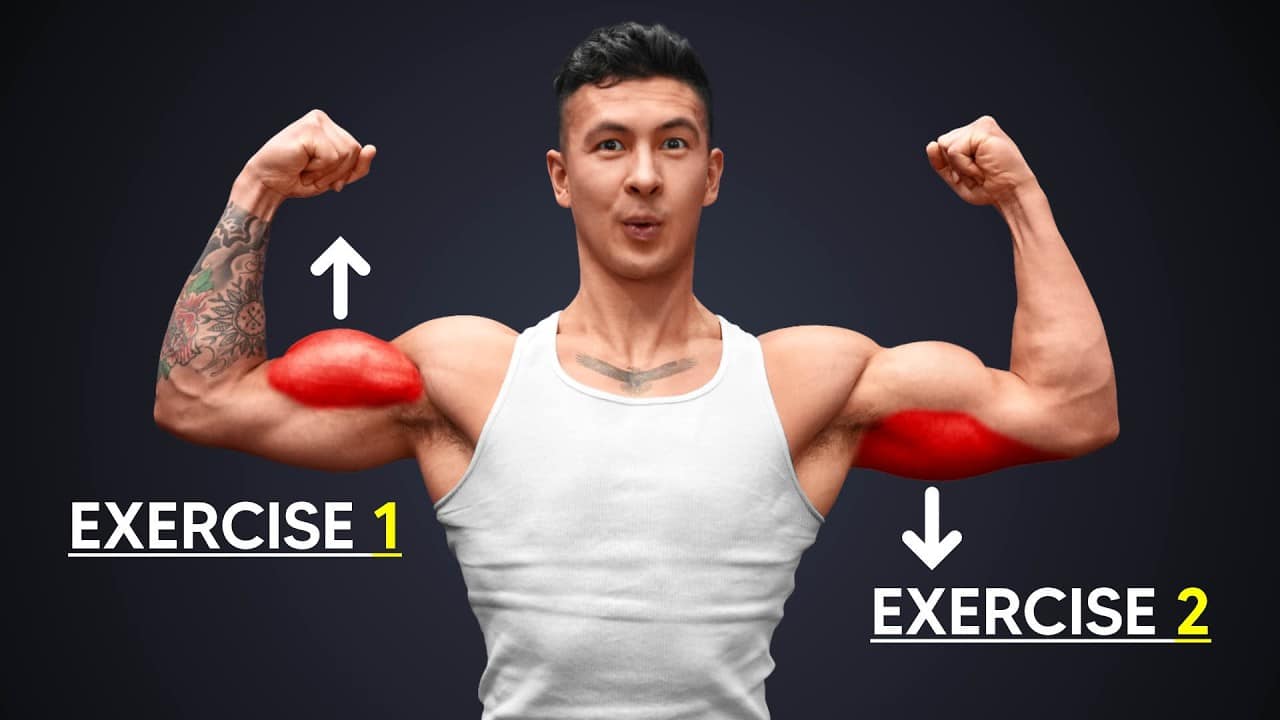
After digging deep into the latest research and interviewing top natural bodybuilders and muscle growth scientists, fitness expert Jeremy Ethier discovered something surprising: most people are wasting time on suboptimal arm exercises.
By switching to just two science-backed movements—one for biceps, one for triceps—his arms finally grew bigger and fuller than ever before.
Jump to:
Why Standard Bicep Curls Eventually Stop Working
Regular dumbbell curls work well initially, especially for beginners riding the wave of newbie gains. But there’s a catch.
Standard curls challenge biceps primarily in the middle position when arms are flexed. This creates redundancy because back exercises like rows and pull-ups already work biceps in that same range.
More importantly, standard curls miss a crucial growth trigger: the stretch position.
Because biceps cross over the shoulder joint, exercises where arms stay behind the body stretch them significantly more. Research on various muscle groups suggests this stretched position may be a powerful stimulus for growth.
The 2025 Study That Changed Everything
Scientists designed an experiment to settle the debate once and for all. They split participants into two groups for 8 weeks.
One group performed only incline curls. The other did preacher curls.
The key difference? Incline curls position arms behind the body, creating greater bicep stretch but remaining hardest in the middle range. Preacher curls place arms in front, reducing stretch but maximizing challenge at the bottom when arms are nearly extended.
Results were fascinating: incline curls grew the upper arm more, while preacher curls developed the lower arm better. An unreleased follow-up study using MRI confirmed similar findings.
The Weird Exercise Every Expert Recommends
To maximize bicep growth across all areas, the ideal exercise would challenge muscles hardest at the bottom while maintaining maximum stretch.
Enter the reverse preacher curl.
Pro natural bodybuilder and elite coach Alberto Nunes explained his preference:
For me personally, I really like those preacher curl benches or tables that are really wide where I can lean back and have my humerus in slight—it’s not full shoulder extension but they’re right at about my midline—and basically perform a curl like this.
Daniel Plotkin, science adviser who has designed and published several muscle growth studies, agrees on this variation’s effectiveness:
I’m going to have to go with a reverse preacher curl. It covers a lot of bases that wouldn’t be covered with those compound back movements where the exercises are typically hardest in the mid to shortened position.
By leaning back on a preacher bench, biceps remain challenged near the bottom like standard preacher curls. But arms position in more stretch because they’re not held forward.
Bonus benefit: arm stability.
I found it very beneficial to just have something on my arm when I’m curling. I really like the stability aspect of it. Arms can move all over the place—that’s something people forget. The bigger you get, probably the more strict form you need because it’s very easy to use your own body weight to contaminate an exercise.
The Even Weirder Alternative
Dr. Mike, PhD researcher and competitive bodybuilder, recommends something even more unconventional: flat bench dumbbell curls.
Flat bench dumbbell curl really puts that tension at the maximum stretch and length position of the muscles. It has that same feel for your biceps that stiff-legged deadlifts done properly have for your hamstrings. There’s just no replacement for that. Once you try it, it’s like the crystal champagne of bicep exercises.
Ethier admits skepticism initially, but the first attempt delivered the biggest pump and post-workout soreness he’d ever experienced. It quickly became a favorite.
The downside? Lack of stability can strain front deltoids. Solution: position sideways so arms rest against the bench, maintaining most stretch benefits while adding support.
The Cable Alternative
Not everyone has preacher benches or feels comfortable with lying dumbbell curls. For them, there’s a third option.
Set cables at wrist height, then curl with arms held behind the body. While lacking arm support from benches, this variation still checks boxes for stretch and resistance challenge.
Key takeaway: All three exercises accomplish similar biomechanical goals. Choose based on available equipment and what feels best on joints.
Important caveat: these exercises require good shoulder mobility and adaptation time. Start with light weights—Ethier uses 30-pound dumbbells for these versus 55 pounds for regular curls.
Why Your Triceps Aren’t Growing
Biceps contribute only one-third of arm size. The other two-thirds? Triceps.
Unfortunately, popular tricep exercises like push-downs, close-grip presses, and dips primarily work just two of three tricep heads: lateral and medial. These beef up arms from front and side views.
But the long head—the biggest tricep portion that creates that horseshoe look from behind—gets neglected.
The 2022 Study That Proved Overhead Wins
Scientists conducted a clever 12-week experiment. Subjects performed overhead extensions with one arm and push-downs with the other.
Because the long head crosses the shoulder, overhead positioning stretches this muscle significantly during tricep work.
Results were dramatic: all three tricep heads grew more with overhead extensions, producing 1.4 times overall tricep growth compared to push-downs.
Using gold-standard MRI measurements adds credibility, though researchers acknowledge needing confirmation studies to explain why the other two heads also benefited.
Every Expert’s Number One Tricep Exercise
Given the research, it’s unsurprising that every interviewed expert chose overhead extensions as their top tricep movement.
But each preferred different variations, revealing an important principle about training longevity.
This is where most people find their elbow issues over time. Very few people after the age of 30 do skull crushers. When you see a young man doing it you’re like, okay, you probably got five more years of that, then you’re going to be joining me over here in the cables. Pick the movement that you just feel like it’s custom made for you.
Expert recommendations included:
- Overhead tricep extension with rope cable – easy setup, joint-friendly
- EZ bar standing or seated behind-neck extensions – comprehensive tricep development
- Single-arm cable overhead extension – excellent elbow comfort, hits stretched position
- Standing single-arm dumbbell overhead extension – requires minimal equipment
While Dr. Mike loves barbell overhead extensions, Ethier finds them uncomfortable due to the fixed hand position, even causing injury when forced. Joint structure varies between individuals.
Currently, he favors either single-arm cable work or simple standing dumbbell overhead extensions for convenience.
Execution Keys for Maximum Growth
Regardless of chosen variation, proper execution matters tremendously:
- For cables: Position cable at hip height, stand close so challenge peaks near bottom when muscle is stretched
- For dumbbells: Keep upper arm locked straight up and down—don’t allow bending forward as fatigue sets in
- For all variations: Achieve full range of motion by letting hands descend completely behind neck for maximum tricep stretch
What to look for: minimal to zero elbow or shoulder pain during movement, combined with intense tricep pump afterward.
How to Actually Implement These Exercises
Other arm exercises aren’t useless, but these two movements likely provide the most bang for your buck.
Implementation protocol:
- Include both exercises somewhere in current routine
- Perform 3 sets of 10-15 reps for each
- Train arms 1-2 times per week minimum
- Prioritize exercise variations that feel best on your individual joint structure
- Start lighter than normal curls and extensions to allow adaptation
The beauty of focusing on these two movements is simplicity. Rather than cycling through endless arm exercises with marginal differences, concentrating efforts on biomechanically superior options accelerates progress.
For those seeking comprehensive programming that incorporates these principles while accounting for individual body structure and available equipment, structured guidance can eliminate guesswork. Progressive overload protocols—knowing exactly how much weight and how many reps to perform based on individual progress—optimize results further.
The research is clear: stretched-position training for both biceps and triceps appears superior for overall arm development. Whether choosing reverse preacher curls, lying dumbbell curls, or cable variations for biceps—and overhead extensions in whatever form suits joints best for triceps—the underlying principle remains constant.
Train muscles hardest when they’re longest. That’s the secret hiding in plain sight.