Traditional deadlift programming has lifters grinding through heavy singles and low-volume sets, chasing weight at the expense of recovery.
One strength coach flipped that approach on its head and pulled 661 pounds—without ever training to failure.
His strategy challenges everything old-school programs preach about getting strong.
And it might be exactly what’s missing from your training.
Jump to:
- Why Most Intermediate Deadlift Programs Fail
- The One Change That Unlocked a 661-Pound Pull
- Why “Too Light” Doesn’t Mean Ineffective
- The Two-Day Deadlift Protocol
- Progressive Overload Without Ego
- The Volume Advantage
- Strategic Pacing: Start Light, Finish Strong
- Maintaining Separation Between Training Days
- Why This Works When Others Don’t
Why Most Intermediate Deadlift Programs Fail
Most intermediate strength programs follow a predictable formula: deadlift once per week, keep volume low, and add weight every session until you stall. Lifters start with a 5×5 scheme, then drop to 3×5, then 2×5 as intensity climbs.
The problem? It doesn’t work.
A strength coach who has personally trained over 500 lifters—including multiple 700-pound pullers—explains why this model is fundamentally broken. Strength becomes wildly unpredictable. One week you hit a rep personal record; the next, you’re failing weights that previously felt easy.
Your strength is never really going up on a consistent basis. You never really know where your one rep max is because it fluctuates up and down so much because of the hard training fatigue.
Lifters end up perpetually fatigued, nursing lower back pain, and spinning their wheels. Every training block becomes a war of attrition rather than steady progress.
The One Change That Unlocked a 661-Pound Pull
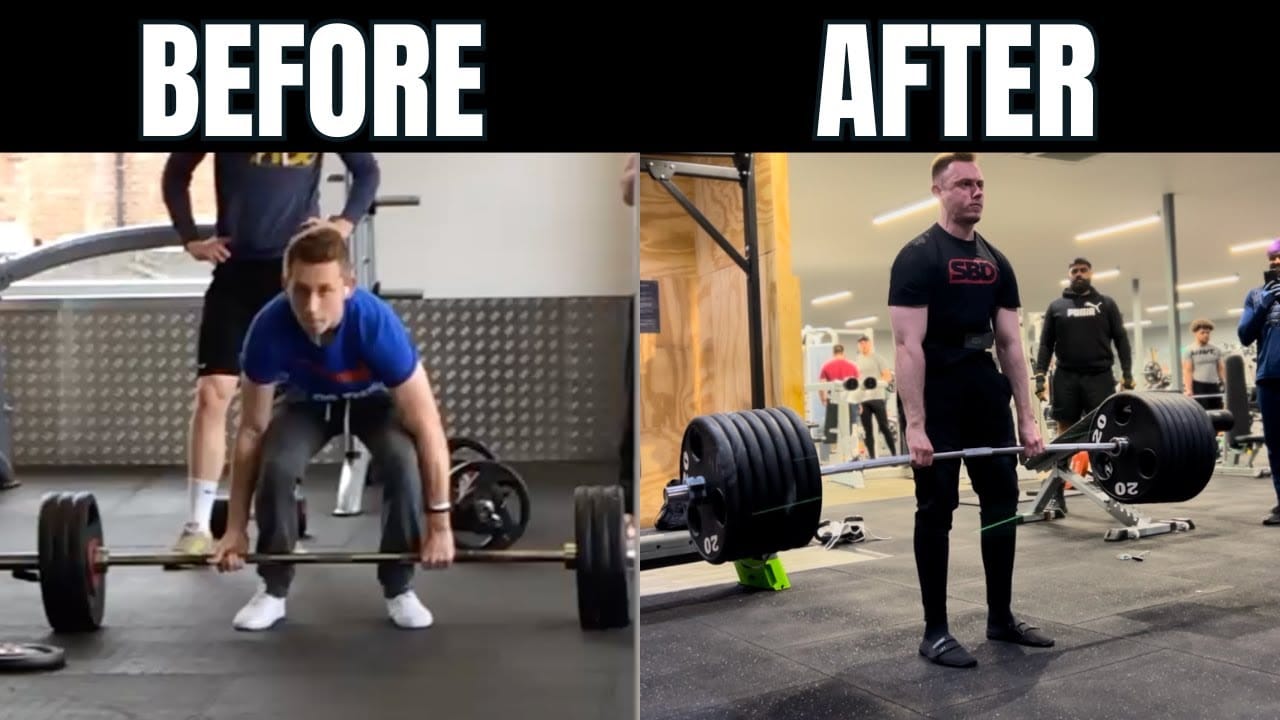
After years of struggling with traditional programming, this coach made one drastic change: he stopped training deadlifts to failure entirely.
Instead of grinding through heavy sets week after week, he significantly reduced training intensity. The results? He jumped from intermediate numbers around 405-455 pounds all the way to 661 pounds—with more in the tank.
During his first successful 661-pound attempt, his training block started with just 485 pounds for a double. He progressed through 507, 529, and 551 pounds before jumping straight to 661.
I made a 50 kilo jump in that final week, which shows you don’t have to be lifting close to your max to get stronger.
Even more surprising: his volume work stayed at 405 pounds for the entire block—a weight he could likely rep for 25-30+ repetitions. Yet he still increased his one-rep max substantially.
Why “Too Light” Doesn’t Mean Ineffective
Many lifters hear about using submaximal loads and immediately dismiss them as inadequate. The mental trap is simple: heavy equals better.
But this coach poses a compelling counter-question: if doing sets of four at 405 pounds increased his max deadlift, was it really too light?
Training volume should be viewed as stress application. Lifters apply stress, recover from it, adapt, then lift more weight. If lighter loads create sufficient stress to drive adaptation without excessive fatigue, adding unnecessary weight only increases recovery demands.
If I can get stronger doing my volume work at 405, why would I do my volume work at 500? It’s no more stimulus. It’s just coming with more fatigue.
Your body doesn’t care what number is written on the plates. It responds to the physiological stress imposed by training intensity and volume.
The Two-Day Deadlift Protocol
This strength coach recommends deadlifting twice weekly using a primary-secondary split that balances intensity with recovery.
Primary Deadlift Day
Choose your strongest stance—conventional or sumo. Perform your main work with these parameters:
- Top set: 1-2 reps at 80% and above
- Volume work: 3-4 sets of 3-5 reps at 60-75%
- Focus: Add weight to the top set every week
That volume range will feel surprisingly easy—leaving five or even ten reps in reserve. Resist the temptation to add weight just because it feels light.
Secondary Deadlift Day
Select a variation targeting your specific weakness:
- Romanian or stiff-leg deadlifts: Best for beginners to twice-weekly deadlifting
- Pause deadlifts: Address poor positioning off the floor
- Deficit deadlifts: Improve speed and strength off the floor
- Banded deadlifts: Strengthen lockout and create tactile cueing
Programming for secondary day:
- Top set: 3-5 reps at 75-78% and above
- Volume work: 3-5 sets of 3-6 reps at 60-75%
- Weight gap: Keep at least 45 pounds lighter than primary day
The coach emphasizes that bands provide more than variable resistance—they create a feedback loop that cues harder pulling as tension increases.
As the band stretches out, the lift starts to feel a bit more challenging as you get close to lockout. Because of that, it just cues mentally when I feel the band start pulling to pull harder and to pull faster.
Progressive Overload Without Ego
Add weight to top sets weekly—roughly 20 pounds on primary day, 10 pounds on secondary. But here’s the crucial part: keep back-off sets at the same weight if top sets continue progressing.
Only increase volume work weight if both conditions are met:
- You cannot add weight to top sets at the target rep range
- Back-off sets move like an empty bar
Even then, add just five to ten pounds and reassess how top sets respond.
Bar speed matters tremendously. Even with submaximal loads, focus on moving weight as explosively as possible. Lazy reps with light weight waste the opportunity to improve rate of force development.
The Volume Advantage
Compare traditional programming to this approach: instead of grinding through two hard sets of five reps once weekly, lifters can accumulate eight quality sets across two sessions.
Total deadlift volume quadruples, yet perceived stress remains similar—or even decreases—because intensity drops significantly. Recovery improves. Technique stays crisp. Consistency becomes achievable.
More practice with better movement quality inevitably builds better pullers.
Strategic Pacing: Start Light, Finish Strong
One critical mistake derails most training blocks: starting too heavy.
Lifters come out aggressively on week one, leaving no room for progression. By week three, they’ve stalled. Deloads become necessary. Momentum dies.
Instead, work backward from your block’s target weight. Planning to pull 405 pounds? Structure your progression in 20-pound jumps: 405, 385, 365, 345. This creates psychological and physiological momentum while ensuring consistent weekly progress.
You want to give yourself room to build momentum and to actually get weight on the bar rather than starting too heavy, gassing out by week two or three.
Maintaining Separation Between Training Days
Keep at least 45 pounds between primary and secondary deadlift sessions. Without sufficient separation, both days become heavy primary sessions—defeating the purpose of varied stimulus and manageable fatigue.
Secondary day should challenge technique and target weaknesses without creating excessive systemic stress. Primary day pushes absolute strength. Each serves a distinct purpose.
Why This Works When Others Don’t
Traditional approaches confuse intensity with effectiveness. Grinding through maximal weights feels productive, but accumulated fatigue masks true strength and prevents consistent progression.
This protocol prioritizes quality practice at submaximal loads. Lifters develop technical proficiency, accumulate volume without crushing recovery capacity, and create predictable strength gains.
The coach who developed this system has successfully implemented it with hundreds of lifters, producing multiple 700-pound deadlifters. His own 661-pound pull—achieved with volume work at weights he could triple or quadruple—proves the concept.
Getting stronger doesn’t require suffering through every rep. It requires intelligent stress application, adequate recovery, and consistent progressive overload.
Sometimes the smartest way to lift heavy is to train light.