Rice doesn’t have to be a blood sugar nightmare.
In fact, there’s a way to eat a substantial 10-12 ounce bowl of white rice without triggering the insulin spike most people assume is inevitable.
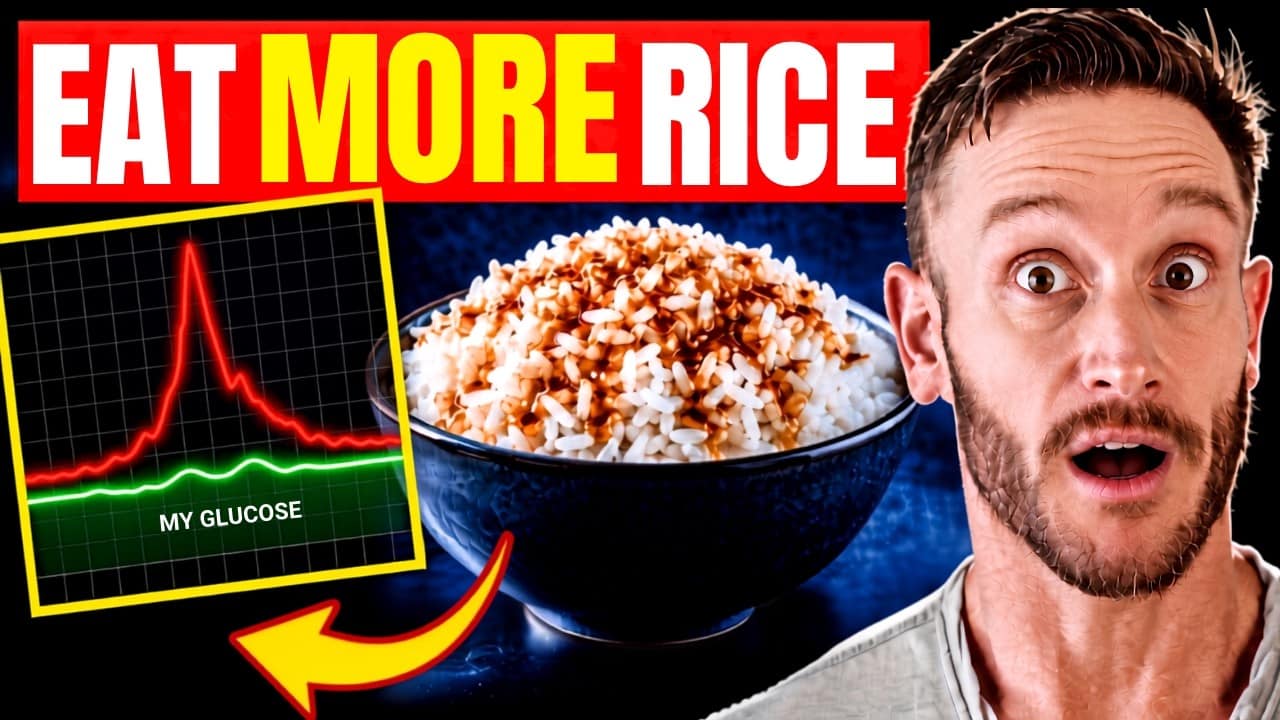
Health and fitness expert Thomas DeLauer recently shared a systematic approach that involves layering multiple evidence-based techniques, each independently proven to blunt glucose response.
When combined, these strategies don’t just make rice metabolically friendlier—they actually enhance its flavor.
Jump to:
The Crystal Structure Hack: Cooking Rice With Fat
Most people know about cooling rice to create resistant starch, but DeLauer points to a lesser-known mechanism that starts during cooking itself.
When rice cooks in the presence of certain fats, something remarkable happens at the molecular level. Amylose, a type of starch in rice, wraps itself around fatty acid chains, forming what scientists call V-type crystalline structures.
This crystalline structure, it’s not the resistant starch from cooling. People get that confused. This is a very distinct crystal formation. It’s an amylose lipid crystal complex and your digestive enzymes can’t get into it.
This mechanism mirrors what happens naturally in RD43 rice, a Japanese and Thai crossbred variety specifically engineered to form these protective complexes.
The practical application is simple: Add one tablespoon of olive oil or coconut oil directly to the cooking water. This provides the substrate needed for those glucose-shielding crystals to form while the rice is still on the stove.
Omega-3s: The Unexpected Blood Sugar Stabilizer
While cooking with fat builds beneficial crystal structures, the type of fat consumed alongside rice matters equally—though for entirely different reasons.
Omega-3 fatty acids work through dual mechanisms. First, they slow gastric emptying, meaning rice releases into the bloodstream more gradually. Second, they enhance insulin sensitivity and reduce inflammation that drives insulin resistance.
When you put a piece of like salmon or maybe some sardines or even fish oil capsules along with your rice, you’re doing two things. You’re actually slightly slowing how fast the rice hits your bloodstream, but you’re also feeding your body the fats that make your cells more responsive to insulin.
DeLauer recommends pairing rice with salmon, sardines, walnuts, or even three to four high-quality fish oil capsules. He emphasizes choosing triglyceride-form fish oil over ethyl esters, which are more prone to oxidation.
His personal choice is Purity fish oil, which third-party tests every batch for over 200 contaminants and publishes results via QR code. The formulation provides 1,250mg EPA and 500mg DHA in bioavailable triglyceride form.
The Enzymatic Brake: Adding Acid
Vinegar and lemon juice introduce a completely separate mechanism that stacks beautifully with the previous strategies.
Acetic acid from vinegar—including rice vinegar—slows amylase, the digestive enzyme responsible for breaking starch into sugar. This creates enzymatic resistance rather than structural resistance.
So, you’ve made the starch harder to digest, but now you’re slowing the digestive machinery itself. So, two different angles on the same problem, right?
Adding one to two teaspoons of rice vinegar or fresh lemon juice to cooked rice provides subtle flavor enhancement while throttling glucose response. For people with metabolic sensitivity, this small addition can mean the difference between enjoying rice comfortably or experiencing hours of metabolic disruption.
The Protein Pre-Game Strategy
Food sequencing matters. Eating protein and vegetables before carbohydrates demonstrably blunts glucose spikes by triggering gut hormones that slow digestion.
But DeLauer offers an even simpler approach: consuming half a scoop of whey protein powder 15-30 minutes before eating rice.
Whey protein is uniquely insulinogenic, creating a preemptive insulin spike paired with glucagon release. This primes muscles to absorb incoming glucose more efficiently while simultaneously blunting the overall glycemic response.
Key benefits of protein pre-loading:
- Accelerates glucose uptake into muscle tissue
- Reduces peak blood sugar levels
- Doesn’t require specific meal sequencing or food separation
- Takes less than one minute to implement
Of course, eating protein-rich foods and vegetables before rice during the meal itself provides additional benefits. Both strategies can work together.
Resistant Starch Through Retrogradation
Cooking rice, cooling it, then reheating creates resistant starch through a process called retrogradation. During refrigeration, starch molecules reorganize into forms that resist enzymatic breakdown.
Research shows refrigerated and reheated white rice contains approximately 2.5 times more resistant starch than freshly cooked rice, with significantly lower glucose response in human subjects.
The synergy becomes powerful when combined with the olive oil cooking method. The fat helps form amylose-lipid complexes during both cooking and cooling, creating dual structural barriers to digestion.
So you cook your batch with the olive oil, you refrigerate it overnight, and then you reheat it. Okay, meal prepped rice is metabolically better than fresh rice.
The Wall Squat: Turning Muscles Into Glucose Sinks
Walking after meals improves glucose clearance, but DeLauer advocates for something potentially more effective: isometric wall squats.
Muscle contractions activate AMPK, an energy-sensing enzyme that drives glucose transporters to muscle cell surfaces. These transporters pull glucose from blood directly into muscle tissue—completely independent of insulin.
Wall squats create sustained tension in the body’s largest muscle groups, transforming them into powerful glucose sinks. Research published in the Journal of Applied Physiology demonstrates that effectiveness isn’t about intensity but rather sustained tension.
The protocol is straightforward:
- Wait 15-30 minutes after eating (when glucose typically peaks)
- Position back against a wall
- Slide down until thighs are parallel to the floor
- Hold for 30-90 seconds
Meta-analyses show that just minutes per week of isometric exercise produces blood pressure reductions comparable to medication. The glucose-lowering effects appear equally impressive, particularly when timed strategically post-meal.
The Compound Effect
No single intervention represents a miracle solution. The power emerges from strategic layering.
Cooking rice in olive oil creates protective crystal structures. Pairing with omega-3s enhances insulin sensitivity and slows gastric emptying. Adding vinegar or lemon slows digestive enzymes. Pre-loading with protein primes muscles for glucose uptake. Cooling and reheating multiplies resistant starch. Wall squats intercept glucose at its peak.
Each has a blunting effect on its own. Call me a weirdo, but that’s how I would eat a big bowl of rice and barely move my insulin levels. I could actually do this and barely see a blip on my CGM.
This approach doesn’t require avoiding carbohydrates entirely or relying on artificial substitutes. It simply leverages biochemistry and food science to transform how the body processes real rice.
For those seeking an even simpler solution, RD43 rice—bred specifically to form these glucose-lowering crystal structures—is available at most Asian markets. But with these six evidence-based techniques, ordinary white rice becomes metabolically extraordinary.