Women who strength train just two to three times per week slash their risk of dying from cardiovascular disease by 30%—nearly triple the benefit men get from the same workout.
Yet only one in five women currently meets basic strength training guidelines.
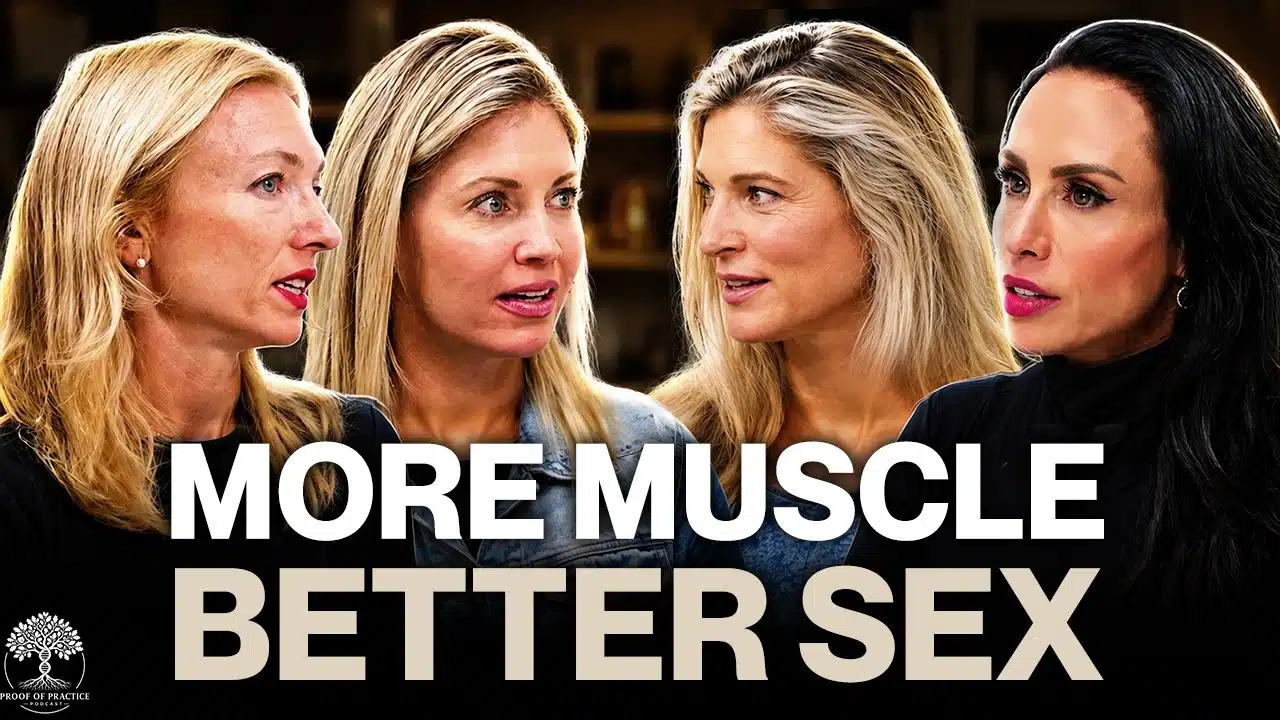
In a recent episode of Proof of Practice, host Gabby Reece sat down with Dr. Gabrielle Lyon, Dr. Abby Smith Ryan, and Amber Taylor to discuss why muscle isn’t just about aesthetics—it’s about longevity, brain health, hormones, mood, and sexual vitality.
What emerged was a powerful reframe: muscle is medicine, and women have the most to gain.
Jump to:
- Muscle Is an Endocrine Organ, Not Just a Vanity Metric
- Why Women Benefit More Than Men From Strength Training
- Muscle Quality Matters More Than Body Composition
- Strength Training Improves Sexual Function and Vitality
- Brain Health, Mood, and the Myokine Connection
- You Don’t Need Hours in the Gym
- How to Actually Get It Done
- Final Takeaways
Muscle Is an Endocrine Organ, Not Just a Vanity Metric
For decades, women were told exercise was about burning calories, losing fat, and getting smaller. That narrative kept millions away from strength training—the single most powerful intervention for long-term health.
Dr. Gabrielle Lyon, founder of muscle-centric medicine, explained why this shift matters so much.

If you want something simple that actually works, this is one of the most effective tools I’ve used to build strength, conditioning, and endurance without needing a full gym setup.
- Full-body training with one weight using swings, squats, and presses
- Solid cast iron build that feels stable and lasts for years
- Comfortable grip that makes high-rep workouts easier to handle
The idea of being concerned about building muscle and training because a woman would get too bulky is the equivalent of saying, ‘I don’t want to go to medical school because I don’t want to get too smart.’ It’s never going to happen.
Muscle isn’t just tissue that moves your body. It’s an endocrine organ—meaning it secretes hormones and signaling molecules called myokines.
These molecules cross the blood-brain barrier, regulate mood, protect cognitive function, and influence everything from metabolism to sexual health.
Muscle is not just a fitness organ. It’s an endocrine organ. It secretes molecules that cross the blood-brain barrier, regulate mood, protect cognitive function, and influence sexual vitality.
Lyon noted that scientists have identified hundreds of myokines, but understand only about 5% of what they do. Among the known players: interleukin-6, irisin, and brain-derived neurotrophic factor (BDNF), all linked to improved memory, reduced inflammation, and better mood.
Why Women Benefit More Than Men From Strength Training
A 2024 study published in the Journal of the American College of Cardiology followed over 412,000 adults and found something striking: women who strength trained two to three times per week reduced their cardiovascular mortality risk by 30%. Men? Just 11%.
Dr. Abby Smith Ryan, an exercise physiologist at UNC, pointed to vascular health as a key factor.
Our ability for our vessels to expand and get blood flow to where they need to go—it’s not just going to our muscles, it’s going to our brain, it’s going to our organs, it’s going to our sexual organs.
As women transition through perimenopause and menopause, cardiovascular disease risk skyrockets due to declining estrogen. Resistance training directly counteracts that by improving vascular tone, blood flow, and metabolic health.
If you want something simple that actually works, this is one of the most effective tools I’ve used to build strength, conditioning, and endurance without needing a full gym setup.
- Full-body training with one weight using swings, squats, and presses
- Solid cast iron build that feels stable and lasts for years
- Comfortable grip that makes high-rep workouts easier to handle
Translation: lifting weights protects women’s hearts in ways cardio alone cannot.
Muscle Quality Matters More Than Body Composition
Lyon shared a surprising insight from PCOS researcher Dr. Melanie Cree: it’s not total body fat percentage that drives polycystic ovarian syndrome—it’s fat inside the muscle.
It has nothing to do with body fat percentage. It was the percentage of fat in the muscle.
Even more encouraging: exercise improves muscle quality regardless of whether body composition changes. Women at 30% body fat who strength train consistently see better metabolic outcomes, lower inflammation, and improved hormone function—even if the scale doesn’t budge.
This is a critical message for anyone who feels discouraged by slow aesthetic progress. Your muscle is getting healthier on the inside, even when external changes take time.
Strength Training Improves Sexual Function and Vitality
One of the most unexpected—and underreported—benefits of building muscle? Better sex.
Lyon referenced peer-reviewed research linking muscle mass and strength to sexual function in both men and women. Older men with sarcopenia (muscle loss) have over 2.5 times the risk of erectile dysfunction. Women experience parallel benefits, though the research is less robust.
If you want something simple that actually works, this is one of the most effective tools I’ve used to build strength, conditioning, and endurance without needing a full gym setup.
- Full-body training with one weight using swings, squats, and presses
- Solid cast iron build that feels stable and lasts for years
- Comfortable grip that makes high-rep workouts easier to handle
Strength is just a proxy for having a better sex life. Strength is just a proxy for having better erections, for having better blood flow.
Blood flow is everything. Small arteries in sexual organs are among the first to show signs of vascular dysfunction. Resistance training improves nitric oxide production, which dilates blood vessels and enhances circulation—not just to muscles, but to all tissues.
Smith Ryan added that strong core and pelvic floor muscles directly support sexual pleasure and orgasm intensity.
If your muscles, if you are able to maintain a contraction longer, which you do by using it, that contraction will be maintained whether you’re lifting a weight or you’re in the bedroom.
Vaginal Atrophy and the “Use It or Lose It” Principle
Postmenopausal women often experience vaginal atrophy—thinning, dryness, and reduced elasticity due to declining estrogen. Lyon cited a landmark JAMA study showing that women who had intercourse more than three times per month had significantly less atrophy than those who were sexually inactive (defined as fewer than 10 times per year).
When you are young, you have this robust flower. Then you go to the desert and all of a sudden the flower, you know, like a dried rose.
While sexual activity alone helps, resistance training amplifies the effect by increasing blood flow, supporting testosterone maintenance, and improving mood—all of which contribute to arousal and tissue health.
Lyon also emphasized the importance of pelvic floor physical therapy, especially for women dealing with pain during sex, incontinence, or post-birth recovery.
Brain Health, Mood, and the Myokine Connection
When you contract muscle, it releases signaling molecules that influence the brain. BDNF (brain-derived neurotrophic factor), for example, supports memory, learning, and mood regulation.
If you want something simple that actually works, this is one of the most effective tools I’ve used to build strength, conditioning, and endurance without needing a full gym setup.
- Full-body training with one weight using swings, squats, and presses
- Solid cast iron build that feels stable and lasts for years
- Comfortable grip that makes high-rep workouts easier to handle
Smith Ryan noted this is especially important for women navigating perimenopause and menopause, when anxiety, depression, and brain fog often spike.
There’s really good data around these myokines that impact even brain anxiety, depression, and even overall feeling of vigor that can also translate into the bedroom.
Resistance training doesn’t just make you physically stronger—it rewires your nervous system to handle stress better, think more clearly, and feel more resilient.
You Don’t Need Hours in the Gym
One of the biggest barriers women cite is time. The panel dismantled that excuse with encouraging data.
Smith Ryan pointed to research showing that as little as 11 minutes per day of movement delays mortality. Amber Taylor, Chief Digital Officer at Les Mills, cited a British Journal of Sports Medicine study finding that just two strength workouts per week resulted in a 40% drop in mortality risk.
A little bit goes a long way. If you can do 60 seconds, run up the stairs, do something—a little bit of intensity, get your heart rate up a couple times a day can be really impactful.
The American College of Sports Medicine recently updated its guidelines to emphasize two days per week of resistance training. Critically, that doesn’t have to mean heavy barbells. Repetitions to fatigue with lighter weights, resistance bands, or bodyweight exercises all count.
Exercise Snacks Are Real
Smith Ryan introduced the concept of “exercise snacks”—short bursts of movement scattered throughout the day. Ten push-ups every hour. Squats while waiting for coffee. Lunges during a phone call.
If you want something simple that actually works, this is one of the most effective tools I’ve used to build strength, conditioning, and endurance without needing a full gym setup.
- Full-body training with one weight using swings, squats, and presses
- Solid cast iron build that feels stable and lasts for years
- Comfortable grip that makes high-rep workouts easier to handle
These micro-sessions add up, improve muscle quality, and keep metabolic pathways active—even if you never set foot in a gym.
How to Actually Get It Done
Knowing the benefits is one thing. Showing up consistently is another.
Each panelist shared how they make strength training non-negotiable:
- Gabby Reece: Protects training time ruthlessly. Has people show up at her house three days a week so she has to train. No emotion—just execution.
- Dr. Gabrielle Lyon: Trains with a coach four days per week because she hates training alone. Schedules it like a patient appointment. Models movement for her kids so they grow up knowing it’s normal.
- Amber Taylor: Treats workouts like meetings—schedules them in her calendar and lifts before big presentations for confidence.
- Dr. Abby Smith Ryan: Trains early (5 a.m.) to get it done before life intervenes. Embraces short sessions and “exercise snacks” during kids’ sports practices.
Common thread? Remove the decision. Make it automatic. Plan for your weak spots. Build scaffolding around your goals so you can’t fail.
Final Takeaways
Muscle is not vanity. Prioritizing exercise is not selfish. It’s the organ that determines how long you live, how clearly you think, how you feel in your body, and how you stay vital in every sense of the word.
Women have the most to gain from strength training—and the least representation in weight rooms. That needs to change.
If you want something simple that actually works, this is one of the most effective tools I’ve used to build strength, conditioning, and endurance without needing a full gym setup.
- Full-body training with one weight using swings, squats, and presses
- Solid cast iron build that feels stable and lasts for years
- Comfortable grip that makes high-rep workouts easier to handle
Start somewhere. Start now. Two days a week. Eleven minutes a day. Push-ups before a meeting. Squats while brushing your teeth.
The research is clear: strength training is longevity. And for women, it might be the single most underutilized tool for health, happiness, and vitality.