Your low back pain isn’t just a random misfortune — it’s likely the result of a misunderstood, neglected, and undertrained area of the body.
And when someone tells you “your low back is s—-,” it’s more than an insult — it’s an acronym. S stands for Sensitive, H for Hidden in imbalance, I for Incredibly weak, and T for Tight.
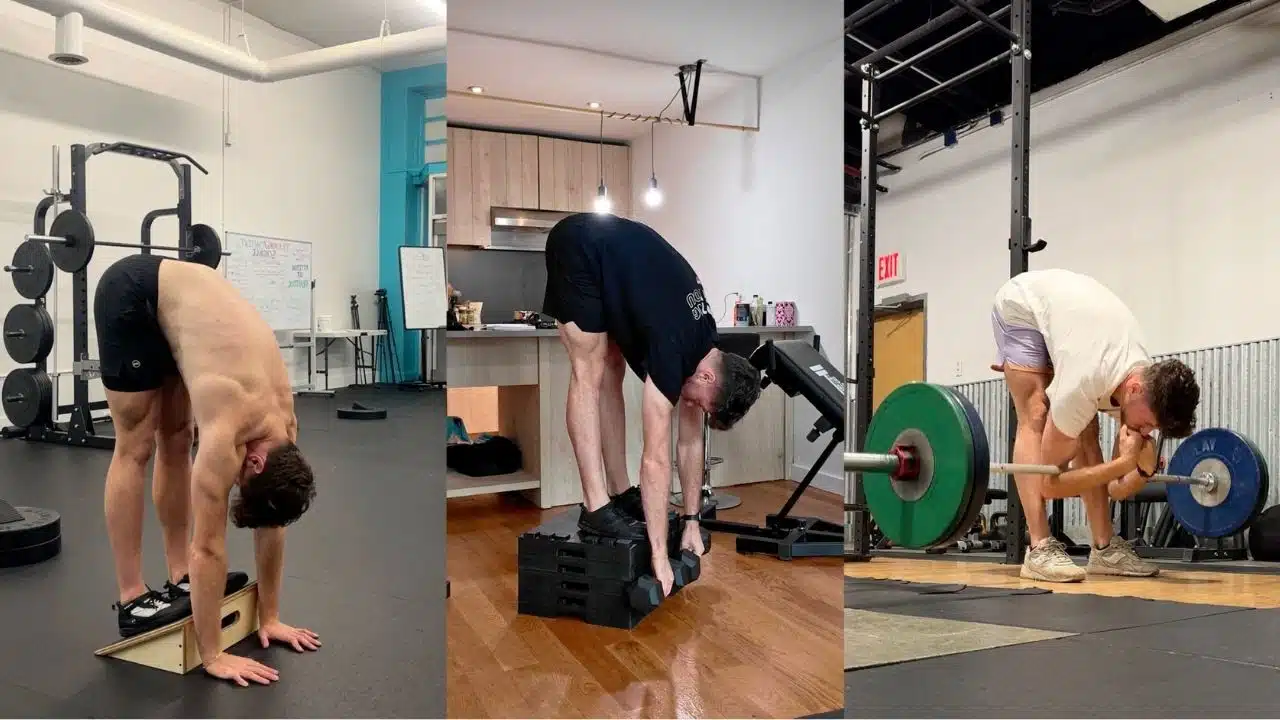
In a recent viral video, back coach and creator of Low Back Ability, Brandon, breaks down his journey from years of recurring injuries (including throwing out his back tying his shoes) to now doing back-isolated lifts most people consider dangerous.
He argues that much of what we’ve accepted as standard back rehab — like the popular McGill Big 3 — may only be the beginning. And that if you’re still stuck in pain, you’re likely missing a big piece.
Jump to:
- We’ve Been Misled About Low Back Pain
- Understanding the Core: What’s Missing?
- S is for Sensitive: Desensitizing the Low Back
- H is for Hidden: The Full-Body Imbalances Back Pain Creates
- I is for Incredibly Weak: The Untested Back
- T is for Tight: Why Stretching Alone Fails
- Prevent Don’t Protect: Building a Resilient Back
- What to Do Next: Your Practical Roadmap
- Train Your Back Like Your Favorite Muscle
We’ve Been Misled About Low Back Pain
If you’re dealing with a chronically “bad back,” you’re not alone — but you may have been led astray. According to Brandon, the entire rehab approach has been narrowly focused on symptoms without addressing the full picture, especially the back itself.
“I did the bird dogs, dead bugs, clamshells — everything you’re supposed to do. My back felt better… until I went back to living,” he says. “I would reinjure myself jumping, squatting, even sneezing.”
This cycle of false healing left him — and thousands of others, based on his feedback — in a frustrating loop: a program that helps short term, but never makes the back resilient enough for real life.
Understanding the Core: What’s Missing?
Current rehab wisdom treats the core like a “pressurizing barrel,” emphasizing braced breathing, abs, obliques, pelvic floor, and the diaphragm.
But, as Brandon explains with a drawing that’s “more kindergarten sketch than anatomical chart,” we almost never train the one area that matters most: the spinal muscles.
These include:
- Spinal erectors
- Multifidus
- Quadratus lumborum (QL)
- Psoas major
These muscles don’t just help you stand tall — they stabilize each vertebra, protect discs, and respond to direct load. Yet traditional rehab often avoids loading the spine entirely.
S is for Sensitive: Desensitizing the Low Back
Spinal sensitivity is a learned response. After repeated injury or fear-based movement patterns, your nervous system begins to associate spinal use with threat.
“Sensitive isn’t just sore,” Brandon clarifies. “It’s that grey, ‘uh-oh’ pain that flares up even when nothing goes wrong.”
Step one is to teach your body that movement doesn’t equal danger. He recommends beginning with an isometric hold on a back extension bench — just holding the extended position without movement for 30 seconds. Over time, aim for 2 minutes.
This graded exposure helps rewire your nervous system to trust your back again.
Trap 3 Raise: Training the Upper Chain
The Trap 3 Raise is another strategy Brandon recommends to reinforce mid-back stability and posterior chain strength with precision.
Start extremely light (even half-pound increments), squeeze tightly at the top, and avoid any jerking. Aim for clean, high-tension sets of 15 reps twice a week.
H is for Hidden: The Full-Body Imbalances Back Pain Creates
Back pain rarely stays in its lane.
Over time, unilateral disc issues can lead to hip hikes, pelvic rotation, and hip impingements — and these imbalances can persist even after the original injury heals.
Physical therapist protocols often overlook how back pain distorts posture, gait, and squat mechanics over months or years.
Key Imbalance Fixes
Brandon suggests two simple mobility drills to restore pelvic and hip balance:
- Split Squat Hold: One minute per leg focusing on back leg hip extension.
- Squat Hold on Heels-Elevated Surface: One minute at the bottom position to stretch adductors and restore squat depth without butt-wink.
I is for Incredibly Weak: The Untested Back
How many push-ups can you do? Most people have an answer.
But ask how many back extensions they can do, and you’ll get silence.
“We’ve never tested our low back,” Brandon says, “It’s no surprise it breaks the fastest.”
He proposes a foundational metric: work up to 30 controlled full-range reps on the back extension. This gives you a tangible goalpost for low back strength.
Begin with isometric holds. Move to partial reps. Eventually progress to full range, deliberate flexion-extension. This movement floods the spine with blood, helping regenerate fatigued muscle fibers and neglected tissue.
“When you feel your low back get a pump,” he says, “hope comes back.”
T is for Tight: Why Stretching Alone Fails
Tightness is a reaction, not a root cause.
The body tightens defensively — just like clenching your jaw under stress. Stretching these tight tissues may feel good temporarily, but it doesn’t fix the problem. It often prolongs it.
Instead: squeeze, then stretch.
Outer Hip Drop Set
This 3-phase drill restores lateral glute activation which is often weak and tight after back injury:
- Seated internal rotation hold (30 seconds)
- Seated internal rotation with lift (30 seconds)
- Lying abduction raise (30 seconds)
This sequence pumps up the muscle before stretching, building both strength and flexibility. This can often resolve persistent symptoms like outer glute tightness, piriformis pain, and sciatica triggers.
Prevent Don’t Protect: Building a Resilient Back
If your entire strategy is to avoid tweaky movements, never round your spine, and bend like a robot — you’re playing defense for life.
And sooner or later, you’ll lose.
Jefferson Curls and other deep flexion exercises have long been demonized by physical therapists for being dangerous.
But Brandon argues: done with a strong base, low load, and control, these movements retrain the small stabilizers like multifidus and rotatores — the same ones responsible for vertebral integrity under load.
“Avoidance can prevent your debt from growing,” he says, “but it can never pay it off.”
What to Do Next: Your Practical Roadmap
Here’s a simplified starter plan Brandon recommends for anyone with a “sensitive, weak, tight” back:
Twice a Week:
- Back Extension Hold: 1–2 sets of 30 to 60 seconds
- Trap 3 Raise: 2 sets of 15 reps
- Outer Hip Drop Set: 30s x 3 steps per leg
- Split Squat Hold: 1 min per leg
- Squat Hold (heels elevated): 1 minute
Once your back can sustain 2-minute holds and 30+ full range reps, you can layer deeper movements, flexion strategies, and real-life unpredictability without constant flare-ups.
Your back doesn’t need to be avoided — it needs to be trained.
Train Your Back Like Your Favorite Muscle
Most people never treat their back like they do their biceps or chest.
Biceps tight? Train them. Chest weak? Bench more. Low back hurts? Avoid everything.
That mindset needs to shift. You train your back like any other muscle — carefully, consistently, and over time.
“Your low back being s—- isn’t an insult,” Brandon ends with. “It’s just feedback. Now go build the proof it isn’t anymore.”
If you’re looking for guided help, Brandon’s full community-led program is available at lowbackability.com as a pay-what-you-can service, alongside protocols, coaching, and progression plans to rebuild your spine’s trust, strength, and resilience.