Strength coach Jud Leinart is making bold predictions about where fitness is headed—and it’s not what most people expect.
In a recent podcast, the former Army Ranger and performance specialist with over 15 years of experience laid out six training methods he believes will define the future of fitness, especially for older adults.
These aren’t your typical gym trends.
They’re evidence-based approaches that prioritize safety, sustainability, and measurable results—without sacrificing effectiveness.
Jump to:
- Concentric-Only Training: The Overlooked Powerhouse
- Flywheel Training: Eccentric Overload Made Safe
- Isometrics: Neural Strength Without the Fatigue
- Velocity-Based Training: Tracking What Really Matters
- Speed Interval Training: Maximum Benefits, Minimal Misery
- Weighted Incline Walking: The Underrated Essential
- Leinart’s Vision: The Gym of Tomorrow
Concentric-Only Training: The Overlooked Powerhouse
Most people associate muscle growth and strength with the lowering phase of an exercise—the eccentric contraction. But Leinart argues that concentric-only training, where you lift without controlling the descent, deserves far more attention.
When intensity and volume are equated for, concentric exercise results in near equal hypertrophy as eccentric exercise, near equal.
The benefits are compelling. Concentric movements produce less muscle soreness, reduce injury risk, and allow for more frequent training—all critical factors as we age.

If you want something simple that actually works, this is one of the most effective tools I’ve used to build strength, conditioning, and endurance without needing a full gym setup.
- Full-body training with one weight using swings, squats, and presses
- Solid cast iron build that feels stable and lasts for years
- Comfortable grip that makes high-rep workouts easier to handle
Strength gains from concentric training are largely neural. The movement trains muscles to contract in unison, improves neural pathway efficiency, and activates more fast-twitch fibers.
Strength is a very important factor as we age.
Practical examples include trap bar deadlifts where you drop the weight instead of lowering it, sled pushes, and high-resistance bike sprints. Leinart is particularly enthusiastic about sled work.
Can you imagine if sled pushing was as popular as jogging? he asks. The cardiovascular benefits would remain, but without the repetitive joint stress that plagues many runners.
Flywheel Training: Eccentric Overload Made Safe
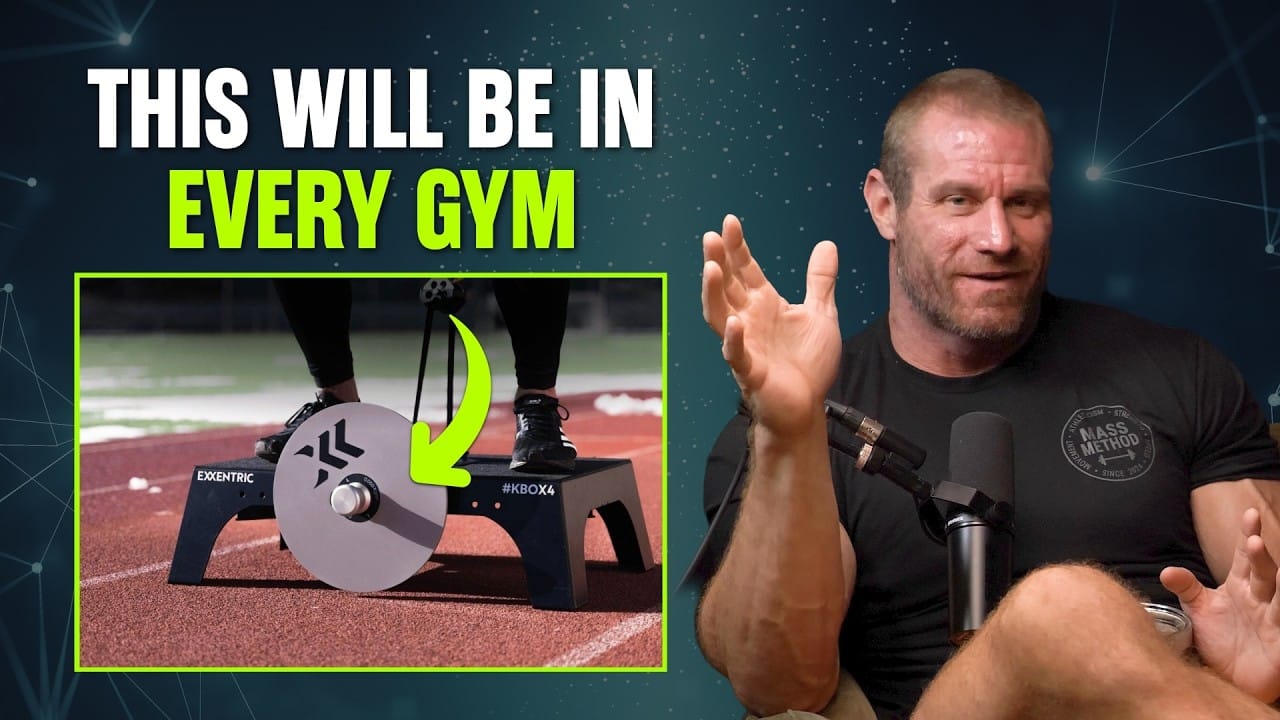
Leinart’s second prediction centers on flywheel devices, which flip traditional resistance training on its head.
In conventional lifting, your ability to control the eccentric phase limits how much weight you can lift concentrically. Flywheel training reverses this dynamic.
As the flywheel spins, it builds inertia. The harder you pull or push during the concentric phase, the more resistance you face on the way back. This creates automatic eccentric overload without the guesswork or injury risk.
If you want something simple that actually works, this is one of the most effective tools I’ve used to build strength, conditioning, and endurance without needing a full gym setup.
- Full-body training with one weight using swings, squats, and presses
- Solid cast iron build that feels stable and lasts for years
- Comfortable grip that makes high-rep workouts easier to handle
It’s a self-limiting way to do eccentric overload.
Technology has made these devices smaller, more affordable, and capable of providing instant feedback on power output. For older adults with joint concerns, flywheel training offers the muscle-building benefits of eccentric work with dramatically reduced risk.
Imagine a 50-year-old training with just three tools: a flywheel for resistance work, a sled for lower body power, and a medicine ball for explosive movements. This person would be in exceptional shape, Leinart argues, with minimal joint stress.
Isometrics: Neural Strength Without the Fatigue
Isometric training—holding tension without movement—has been dismissed by many as ineffective for building size and strength. But Leinart sees tremendous untapped potential, especially for aging populations.
We’re starting to understand that strength is largely neural.
Overcoming isometrics, where you push or pull against an immovable object with maximal effort, create massive neural recruitment with minimal tissue damage. This means older adults can maintain strength without accumulating the fatigue that limits recovery.
Modern force measurement technology allows precise tracking in Newtons, providing objective data on:
- Day-to-day strength readiness
- Left-right limb imbalances
- Recovery from injury
- Longitudinal strength progression
The safety profile is excellent for soft tissue injuries, though those with high blood pressure should exercise caution due to cardiovascular strain during maximal isometric efforts.
If you want something simple that actually works, this is one of the most effective tools I’ve used to build strength, conditioning, and endurance without needing a full gym setup.
- Full-body training with one weight using swings, squats, and presses
- Solid cast iron build that feels stable and lasts for years
- Comfortable grip that makes high-rep workouts easier to handle
Velocity-Based Training: Tracking What Really Matters
Traditional strength training measures progress in pounds lifted. But Leinart believes the future lies in directly measuring bar speed and power output.
Small magnetic devices that attach to barbells now provide real-time feedback on movement velocity and wattage. This technology enables velocity-based training, where sets end not at a predetermined rep count but when bar speed drops below a target threshold.
The protocol is straightforward: Select 40-60% of your one-rep max, move the weight as explosively as possible, and continue until velocity decreases. When you can maintain speed for additional reps, increase the load.
Power training has a lot to do with rate of force production, muscular coordination, and neural firing strength.
This approach is safer than constantly testing one-rep maxes and more specific to the power demands of real-world movement. Power, not just strength, determines functional capacity as we age.
Speed Interval Training: Maximum Benefits, Minimal Misery
While zone-two cardio dominates current fitness discourse, Leinart champions speed interval training as a superior conditioning method for most people.
Speed intervals involve 10-30 seconds of all-out effort followed by extended rest periods. This brief work window depletes ATP stores and forces the body into glycolytic metabolism without the prolonged suffering of traditional high-intensity interval training.
If you want something simple that actually works, this is one of the most effective tools I’ve used to build strength, conditioning, and endurance without needing a full gym setup.
- Full-body training with one weight using swings, squats, and presses
- Solid cast iron build that feels stable and lasts for years
- Comfortable grip that makes high-rep workouts easier to handle
The benefits are remarkable:
- Improved stroke volume from alternating high-intensity contractions with deep, slow beats during recovery
- Lower resting heart rate
- Increased VO2 max
- Enhanced mitochondrial and capillary density
- Muscular power endurance
- Time efficiency—one to two sessions weekly produce significant adaptations
Perhaps most importantly, you spend substantial time in zone two during the recovery periods, accumulating those benefits without extended moderate-intensity sessions.
It’s very intense for 10-30 seconds, but you don’t spend a lot of time above your lactate threshold, so there’s just not that horrible burn or gasping for air.
Any cardio equipment works—assault bikes, rowing machines, or stationary bikes. The key is genuine maximal effort during work intervals.
Weighted Incline Walking: The Underrated Essential
Leinart’s final prediction is refreshingly simple: more people will discover weighted incline walking.
This exercise checks multiple boxes simultaneously. It builds bone density through progressive loading, burns substantial calories, depletes muscle glycogen stores, and strengthens the glutes, hamstrings, feet, and lower legs.
The forward lean on an incline emphasizes posterior chain muscles critical for functional movement and injury prevention. Unlike running, it’s joint-friendly and easily progressed by adjusting incline, speed, or load.
If you want something simple that actually works, this is one of the most effective tools I’ve used to build strength, conditioning, and endurance without needing a full gym setup.
- Full-body training with one weight using swings, squats, and presses
- Solid cast iron build that feels stable and lasts for years
- Comfortable grip that makes high-rep workouts easier to handle
Most people doing incline walking lean on the handrails without added weight, missing the full benefit. Adding a weighted vest or holding dumbbells transforms this accessible movement into a powerful training tool.
The glycogen depletion effect deserves special mention. Concentric-dominant movements like weighted walking consume more muscle glycogen than eccentric work, increasing storage capacity and improving metabolic flexibility. This helps control appetite and directs dietary carbohydrates toward muscle replenishment rather than fat storage.
Leinart’s Vision: The Gym of Tomorrow
Leinart paints a picture of his ideal training facility a decade from now.
If I had a dream scenario and I walk into this gym in 10 years, I’m going to see some people over there with all ages using a bar speed tracker and getting excited over their wattage output. This is the utopic future I’d always dreamed of.
In one corner, people of all ages track bar velocity and celebrate power output improvements. Another area features isometric stations measuring force in Newtons for readiness assessment and limb symmetry. A flywheel section provides safe eccentric overload with instant wattage feedback.
The turf area bustles with sled pushing and speed drills. Treadmills host weighted incline walkers building bone density and burning calories. Echo bikes and rowing machines facilitate speed interval sessions.
Most of these methods are already accessible. Bar speed trackers are affordable and available online. Nearly every gym has sleds, cardio equipment, and treadmills. Weighted vests cost less than most monthly gym memberships.
If you want something simple that actually works, this is one of the most effective tools I’ve used to build strength, conditioning, and endurance without needing a full gym setup.
- Full-body training with one weight using swings, squats, and presses
- Solid cast iron build that feels stable and lasts for years
- Comfortable grip that makes high-rep workouts easier to handle
The barrier isn’t equipment—it’s awareness. These training modalities remain on the periphery while the fitness industry continues promoting methods that, while effective, carry higher injury risks and recovery demands.
For the 50-year-old dealing with arthritis, the 40-year-old noticing longer recovery times, or anyone prioritizing long-term functional capacity, these six approaches offer a safer, more sustainable path forward without sacrificing results.
The technology exists. The science supports it. Now it’s simply a matter of shifting perspective from how much weight we lift to how powerfully we move it—and how consistently we can train without breaking down in the process.