A Croatian freediver just shattered what many thought was near the outer limit of human breath-holding capacity.
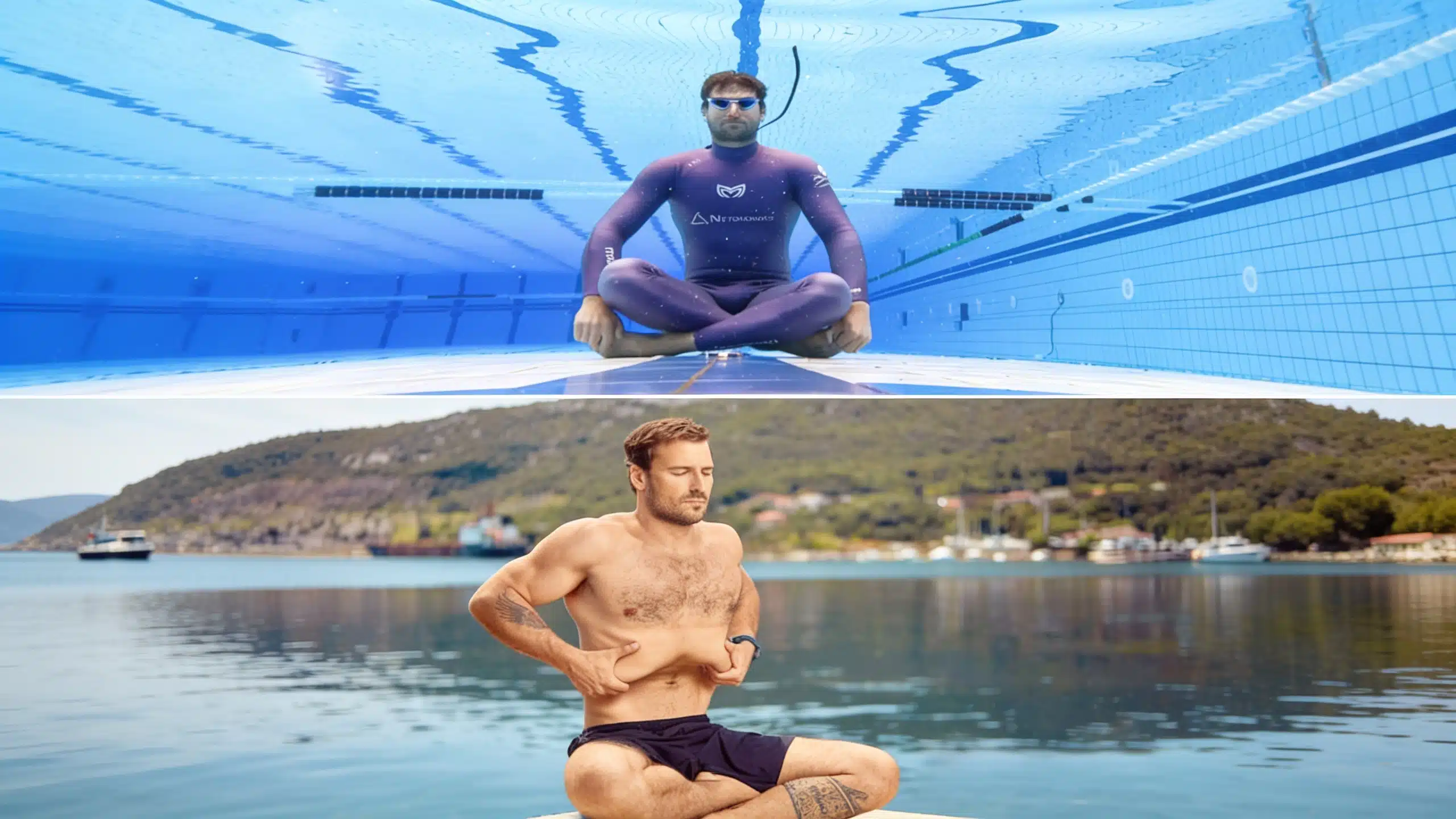
On June 14, 2025, Vitomir Maričić held his breath underwater for an astonishing 29 minutes and 3 seconds, setting a new Guinness World Record in Opatija, Croatia.
The feat obliterated the previous record by nearly five minutes—a margin considered extraordinary in freediving circles.
And according to the pulmonologist who monitored him, what happened during those 29 minutes is “something completely unknown to modern medicine.”
Jump to:
- The Record That Rewrote Medical Understanding
- The Science Behind 29 Minutes Without Air
- Air vs. Oxygen: Two Very Different Records
- A Career Built on Pushing Boundaries
- Could This Change Medicine?
- The Debate Over Oxygen Pre-Breathing
- From David Blaine to Hollywood Training
- What This Means for Freediving’s Future
- A Record That Redefines Possibility
The Record That Rewrote Medical Understanding
Maričić, a 40-year-old who heads Croatia’s branch of AIDA—one of freediving’s two international governing bodies—lay motionless at the bottom of a three-meter-deep circular pool inside the ballroom of Opatija’s Bristol Hotel.
His hands rested behind his head. One hundred spectators watched in silence. Five AIDA judges and his personal physician, pulmonologist Igor Barkovic, monitored every second.
No products found.
The previous record of 24 minutes and 37 seconds had been held by fellow Croatian Budimir Šobat since 2021. Before Šobat, American magician and endurance artist David Blaine famously held the mark at 17 minutes and 4 seconds, set during a live appearance on The Oprah Winfrey Show in 2008.
Maričić didn’t just edge past these legends. He obliterated them.
The Science Behind 29 Minutes Without Air
How does someone hold their breath for half an hour?
Before submerging, Maričić spent 10 minutes inhaling pure oxygen—a technique called denitrogenation. This process replaces nitrogen in the lungs with oxygen, increasing usable oxygen reserves from approximately 450ml to nearly 3 liters.
It’s a controversial method. Some critics argue pre-breathing pure oxygen constitutes artificial enhancement, akin to blood doping, since it dramatically inflates oxygen stores beyond what normal breathing achieves.
But within Guinness World Records categories, it’s perfectly legal—and the results speak for themselves.
No products found.
What Happens Inside the Body
Under normal circumstances, rising carbon dioxide levels trigger diaphragmatic contractions and an overwhelming urge to breathe within minutes. Most people can’t suppress this reflex beyond two or three minutes.
Elite freedivers train their bodies and minds to override this response through:
- Meditative focus to calm the nervous system
- Highly controlled diaphragmatic breathing during preparation
- Extremely low resting heart rates that conserve oxygen
- The mammalian dive reflex, which slows heart rate and redirects blood to vital organs
- Spleen contraction, releasing oxygen-rich red blood cells into circulation
Maričić himself described a strange turning point during his record attempt.
After the 20-minute mark, the effort became easier mentally.
Dr. Barkovic, who observed Maričić’s vitals throughout, called the feat something that could “open new possibilities in hyperbaric and maritime medicine.”
Air vs. Oxygen: Two Very Different Records
It’s important to distinguish between breath-holding with pre-oxygenation and static apnea using only regular air.
The official AIDA static apnea record using only air—no oxygen pre-loading—stands at 11 minutes and 35 seconds, set by France’s Stéphane Mifsud in 2013. Serbian freediver Branko Petrovic also shares this air-only record time.
No products found.
Maričić’s 29-minute dive falls into Guinness’s separate category: “longest breath held voluntarily underwater (male),” which permits oxygen pre-breathing.
Both feats require extraordinary physiological control. But the gulf between 11 and 29 minutes illustrates just how transformative denitrogenation can be.
A Career Built on Pushing Boundaries
This isn’t Maričić’s first brush with world records.
In 2021, he set the Guinness World Record for longest underwater walk on one breath—a staggering 107 meters.
His mastery of breath control has made him a prominent figure in freediving circles, and his leadership role within AIDA Croatia positions him as both athlete and advocate for the sport.
Maričić has also used his platform to advocate for ocean conservation, framing his extreme dives as opportunities to draw attention to marine ecosystems under threat.
No products found.
Could This Change Medicine?
Dr. Barkovic’s comments hint at a tantalizing possibility: that insights from elite freedivers could revolutionize fields like hyperbaric medicine, underwater rescue operations, and even surgical procedures requiring extended breath-hold states.
Understanding how Maričić’s body managed oxygen distribution, carbon dioxide tolerance, and neurological suppression of panic responses could inform treatment protocols for drowning victims and improve safety standards for commercial divers.
The physiological adaptations freedivers develop—spleen contraction, bradycardia (slowed heart rate), and blood shunting—mirror evolutionary traits seen in marine mammals like seals and whales.
Studying these mechanisms in humans may unlock new frontiers in our understanding of survival physiology.
The Debate Over Oxygen Pre-Breathing
Not everyone celebrates records achieved with pure oxygen pre-breathing.
Critics argue that dramatically inflating oxygen reserves artificially distances these feats from “natural” human performance. Some liken it to performance-enhancing drugs in athletics—technically legal within certain contexts, but ethically murky.
No products found.
Sports scientists continue debating whether pre-oxygenation should be classified separately or whether it represents a legitimate extension of human capability.
For now, Guinness maintains distinct categories. And Maričić’s name sits atop the oxygen-assisted leaderboard by a historic margin.
From David Blaine to Hollywood Training
Breath-holding records have long captivated public imagination.
David Blaine’s 2008 record attempt became a cultural moment, broadcast live on Oprah and watched by millions. His 17-minute feat introduced mainstream audiences to static apnea and inspired a generation of freedivers.
More recently, breath-hold training entered Hollywood. During production of Avatar 2, actress Sigourney Weaver trained extensively in freediving techniques, eventually holding her breath underwater for 6.5 minutes to film her scenes.
While still far from elite competitive standards, Weaver’s achievement demonstrated how breath-hold training can unlock performance capabilities most people assume are beyond reach.
No products found.
What This Means for Freediving’s Future
Maričić’s record raises an inevitable question: where does the ceiling lie?
Robert Foster set an early benchmark of 13 minutes and 42.5 seconds back in March 1959. Blaine more than doubled that. Šobat pushed past 24 minutes. Now Maričić has crossed 29.
Each leap seemed unimaginable before it happened.
As training methods evolve, physiological understanding deepens, and athletes continue testing limits, records that once seemed untouchable fall.
But with each new record comes heightened risk. Brain hypoxia and long-term cognitive effects remain legitimate concerns for freedivers who repeatedly push their bodies into extreme oxygen deprivation.
Balancing ambition with safety will define freediving’s next chapter.
No products found.
A Record That Redefines Possibility
Vitomir Maričić didn’t just break a record on June 14, 2025.
He expanded what medical science believed possible, offered new pathways for research into human survival physiology, and reminded us that human potential remains largely uncharted.
Whether his 29-minute dive stands for years or falls to another determined athlete, one thing is certain: we’re witnessing an era where humans are rewriting the rules of endurance, one breath at a time.