Running might be one of the most effective forms of cardio, but it comes with a terrifying reputation among lifters: it’ll kill your gains.
That’s exactly what fitness influencer Jeremy Ethier set out to test when he committed to running every single day for 30 days.
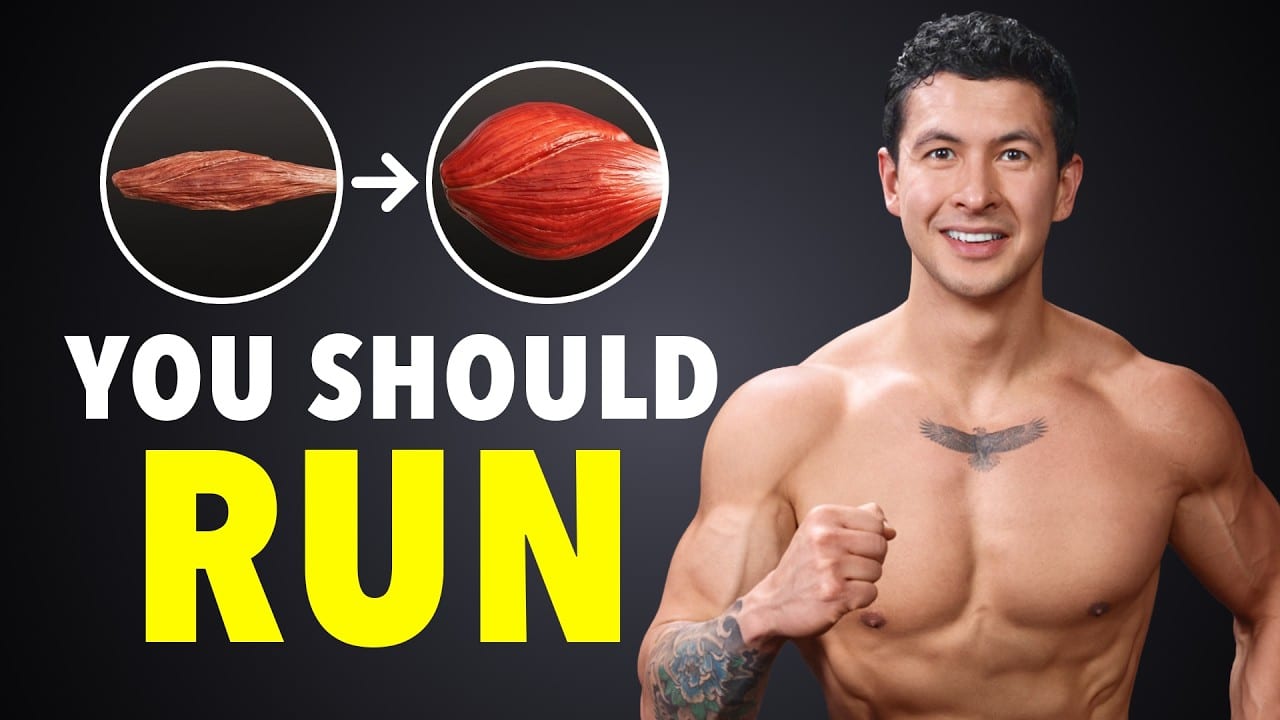
Using MRI scans, VO2 max testing, and multiple body composition measurements, he tracked exactly what happened to his muscles, performance, and overall fitness.
But this wasn’t just a casual experiment—Ethier was preparing to compete in Hyrox, one of the world’s toughest fitness races, representing Team Canada in front of a live audience of over 400,000 people.
Jump to:
- Starting Point: Testing Baseline Cardio Fitness
- The Training Plan: Zone Two and Norwegian Methods
- Day One Disaster: Immediate Injury
- Will Cardio Kill Your Gains? What the MRI Revealed
- What Is Hyrox? Understanding the Race Format
- The Unexpected Benefits: Runner’s High and Strength Gains
- Final Week Crisis: Partner Drops Out
- Race Day Results: The Final Test
- Key Takeaways for Lifters Who Want to Add Cardio
Starting Point: Testing Baseline Cardio Fitness
Before diving into daily runs, Ethier needed to know where he stood with a VO2 max test—the gold standard for measuring cardiovascular fitness.
The average gym-goer typically scores in the mid-30s to 40s, while elite athletes like Cristiano Ronaldo reportedly reach as high as 75. Ethier’s day one result? 58.3—landing him in the top 2% for his age group despite rarely running.

If you want something simple that actually works, this is one of the most effective tools I’ve used to build strength, conditioning, and endurance without needing a full gym setup.
- Full-body training with one weight using swings, squats, and presses
- Solid cast iron build that feels stable and lasts for years
- Comfortable grip that makes high-rep workouts easier to handle
So your VO2 peak was 58.3. It’s really good results.
But when researchers dug deeper into the data, they uncovered two serious problems that would haunt him throughout training.
Problem #1: Poor Fat-Burning Efficiency
Ethier’s body had become overly reliant on burning carbohydrates for energy instead of fat. Since carb stores are limited and deplete quickly, this meant his “engine” was big but couldn’t last long.
Problem #2: Sky-High Lactate Levels
Twenty minutes after finishing his treadmill test, Ethier’s blood lactate measured an alarming 10.5 mmol/L.
Pretty high. It’s very high. Right after a treadmill test, your body is still clearing the lactate that you produced during the test.
When lactate accumulates faster than your body can clear it, hydrogen ions build up, causing intense muscle burn. In extreme cases, this can lead to vomiting, nausea, or worse.
The Training Plan: Zone Two and Norwegian Methods
To fix these weaknesses, Ethier designed a training protocol combining zone two cardio with high-intensity interval work inspired by elite Norwegian endurance athletes.
Zone two training involves keeping heart rate at 60-70% of maximum—between 120 and 140 beats per minute for Ethier. This teaches your body to burn fat efficiently and improves lactate clearance.
If you want something simple that actually works, this is one of the most effective tools I’ve used to build strength, conditioning, and endurance without needing a full gym setup.
- Full-body training with one weight using swings, squats, and presses
- Solid cast iron build that feels stable and lasts for years
- Comfortable grip that makes high-rep workouts easier to handle
The downside? Sessions need to last 45-60 minutes to deliver full benefits, and they’re painfully boring.
A good rule of thumb is that you should be able to hold a conversation without too much heavy breathing.
For higher-intensity work, Ethier adopted the Norwegian training method: four rounds of four minutes at maximum effort followed by three minutes of recovery.
Norway, despite having just 5.5 million people, consistently produces world-class endurance athletes using this brutal but effective protocol.
Day One Disaster: Immediate Injury
After his very first run, Ethier woke up with sharp pain on the outside of his foot—so severe he could barely take a step.
Every time I take a step on my foot, there’s like a super sharp pain right on the outside. It literally feels like I fractured my bone.
Emergency visit to physiotherapist Rajan revealed a likely inflamed joint or tendon at the base of his fifth metatarsal. Best case scenario? A couple weeks of recovery—leaving only two weeks to actually train hard before race day.
Ethier seriously considered backing out entirely.
If you want something simple that actually works, this is one of the most effective tools I’ve used to build strength, conditioning, and endurance without needing a full gym setup.
- Full-body training with one weight using swings, squats, and presses
- Solid cast iron build that feels stable and lasts for years
- Comfortable grip that makes high-rep workouts easier to handle
I’m feeling really down right now. At this point, I’m honestly considering backing out from the event. I just don’t want to embarrass myself.
To keep conditioning going without aggravating his foot, he swapped running for cycling and assault bike work during recovery.
Will Cardio Kill Your Gains? What the MRI Revealed
On day one, Ethier underwent full upper and lower body MRI scans measuring muscle thickness and cross-sectional area. After 30 days, he’d repeat the scan to see exactly where—and if—he lost muscle.
A 2021 meta-analysis of 27 studies investigated whether combining cardio with strength training hurts muscle growth. For beginners, adding cardio had virtually no negative impact on muscle gains.
For trained lifters like Ethier, however, researchers found a slightly negative effect—unless three critical rules were followed.
Rule #1: Never Do Cardio Before Weights
Long or intense cardio sessions drain energy and tax your nervous system, compromising strength performance. Ethier scheduled all cardio after lifting or later in the day.
Rule #2: Refuel Properly
Protein intake remained high to protect muscle, but Ethier needed significantly more carbohydrates to fuel his increased training volume.
If you want something simple that actually works, this is one of the most effective tools I’ve used to build strength, conditioning, and endurance without needing a full gym setup.
- Full-body training with one weight using swings, squats, and presses
- Solid cast iron build that feels stable and lasts for years
- Comfortable grip that makes high-rep workouts easier to handle
He prioritized quick carbs like bananas and rice cakes before workouts, then complex carbs like potatoes and rice immediately after.
Rule #3: Protect Leg Day
Long runs tax legs similarly to heavy squats. Since legs were already Ethier’s weak point, he needed them as fresh as possible for strength training.
What Is Hyrox? Understanding the Race Format
Hyrox is widely considered one of the toughest fitness competitions in existence. Competitors alternate between running 1 kilometer and completing brutal strength or cardio stations—eight times total.
Stations include ski erg, sled push, sled pull, burpee broad jumps, rowing, farmer’s carries, sandbag lunges, and finally, 100 wall balls—where many athletes’ legs simply stop working.
Elite athletes finish in under 60 minutes. Ethier’s goal? Just avoid total embarrassment.
The Unexpected Benefits: Runner’s High and Strength Gains
Despite the grueling training, Ethier discovered something surprising: cardio made him feel incredible.
If you want something simple that actually works, this is one of the most effective tools I’ve used to build strength, conditioning, and endurance without needing a full gym setup.
- Full-body training with one weight using swings, squats, and presses
- Solid cast iron build that feels stable and lasts for years
- Comfortable grip that makes high-rep workouts easier to handle
Something about pushing yourself with cardio just gives you a high that you can’t replace with weights. I now know what people mean about the runner’s high. Feels incredible.
During moderate to high-intensity cardio lasting 20-40 minutes, your body releases anandamide—often called the “bliss molecule.” It binds to the same brain receptors as THC from cannabis, creating euphoria.
You don’t get this from lifting because short bursts followed by rest never sustain effort long enough to trigger significant anandamide release.
Even more surprising? Ethier set a volume PR during week three—his highest rep count at a given weight.
I actually managed to set a PR today. That was a volume PR, which is totally unexpected given all the extra cardio that I’m doing.
Cardio, especially high-intensity work, trains muscles to clear lactate more efficiently. It also boosts cellular energy production, helping muscles work harder and recover faster between sets—potentially enhancing rather than hindering muscle gains.
Final Week Crisis: Partner Drops Out
One week before competition, fellow Canadian YouTuber Will Tennyson—Ethier’s original partner—had to withdraw due to scheduling conflicts.
I just heard from Will’s team, and apparently he has a scheduling conflict and he’s not going to be able to make it to the race. I’m honestly pretty frustrated right now.
Making matters worse, Ethier had lost three pounds despite eating 2,600 calories daily—a dangerous sign he might be losing muscle.
If you want something simple that actually works, this is one of the most effective tools I’ve used to build strength, conditioning, and endurance without needing a full gym setup.
- Full-body training with one weight using swings, squats, and presses
- Solid cast iron build that feels stable and lasts for years
- Comfortable grip that makes high-rep workouts easier to handle
His Built With Science Plus app detected rapid weight loss and automatically increased his calorie target to 2,800 per day—mimicking what a real coach would do.
Fortunately, organizers allowed Ethier’s best friend Jeff—who had competed in Hyrox four times—to join as his teammate.
Race Day Results: The Final Test
Before flying to London, Ethier retested his VO2 max. His new score? 61.32 ml/kg/min—99th percentile and a significant improvement from day one.
Your VO2 peak was 61.32 ml per kg per minute. You did great job. 61 is in the 99th percentile. You did excellent.
Even better, his body’s ability to burn fat instead of relying solely on carbs had dramatically improved—crucial for avoiding mid-race burnout.
As for muscle loss? The MRI revealed no change in upper or lower body muscle mass. He didn’t gain muscle, but he didn’t lose any either.
His DEXA scan showed body fat dropped by 1%—impressive considering he ate more calories than ever while still losing fat.
If you want something simple that actually works, this is one of the most effective tools I’ve used to build strength, conditioning, and endurance without needing a full gym setup.
- Full-body training with one weight using swings, squats, and presses
- Solid cast iron build that feels stable and lasts for years
- Comfortable grip that makes high-rep workouts easier to handle
On race day, competing against elite athletes including winners from Physical 100 (Team Korea) and a Hyrox champion (Team France), Ethier and Jeff executed their strategy perfectly.
When you’re scared of failing, when everything in your mind is telling you to just quit, keep going.
Despite starting slow and falling behind early, they steadily climbed the rankings. South Korea took first, France second—and Team Canada secured third place.
Key Takeaways for Lifters Who Want to Add Cardio
- Cardio won’t kill your gains if you follow three rules: do it after weights, refuel properly with extra carbs, and protect leg day recovery
- Zone two training (60-70% max heart rate for 45-60 minutes) improves fat burning and lactate clearance
- High-intensity intervals like the Norwegian method (4 minutes hard, 3 minutes easy, repeat 4x) boost VO2 max efficiently
- Runner’s high is real—anandamide released during sustained cardio acts on the same brain receptors as cannabis
- Cardio can enhance strength by improving lactate clearance and cellular energy production
- Joints need adaptation time—don’t ramp up running volume too quickly or risk injury
- Track your weight—if dropping more than 1% body weight per week, increase calories to prevent muscle loss
Ethier’s 30-day experiment proved that running and lifting aren’t mutually exclusive. With proper programming, nutrition, and recovery, you can build exceptional cardiovascular fitness without sacrificing muscle mass—and maybe even improve your strength in the process.