Foot pain affects one in three people over 45, rivaling back pain in prevalence.
Yet most of us never think about foot health until something goes wrong.
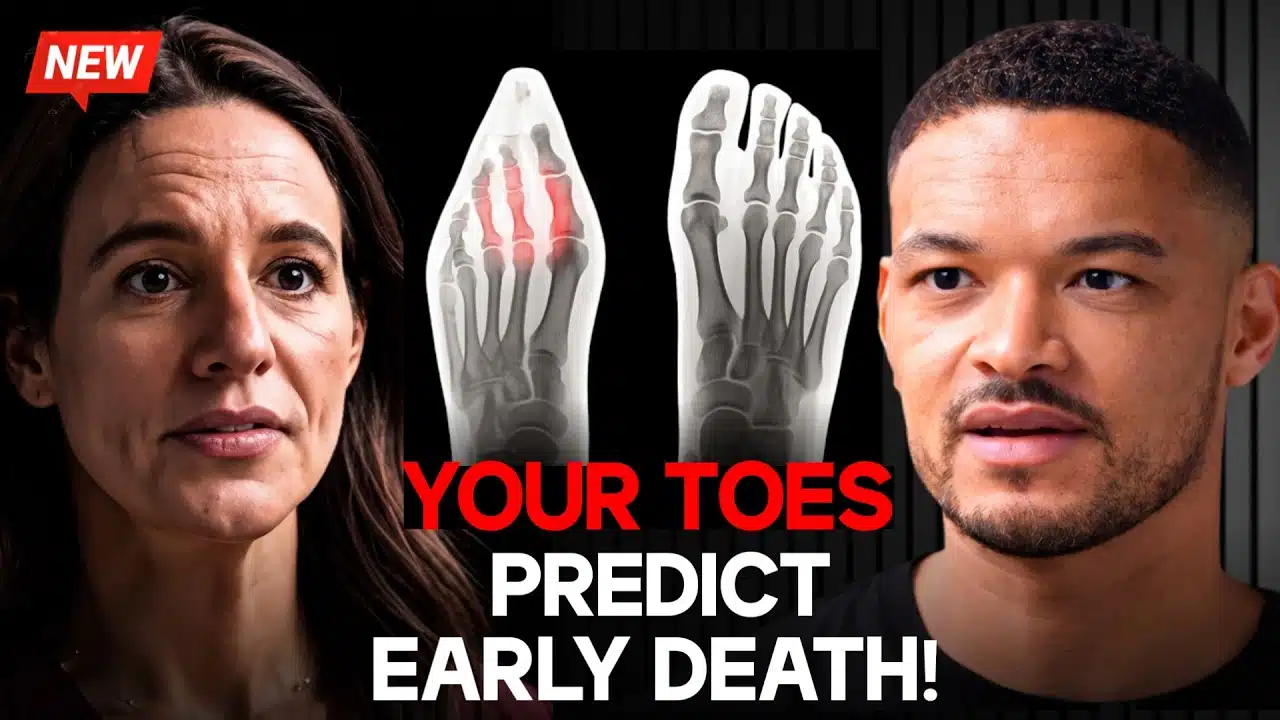
In a recent podcast conversation, chiropractor and foot health expert Dr. Courtney Conley revealed how our footwear choices from childhood are quietly sabotaging our mobility, strength, and long-term wellness.
Her message is clear: weak feet create weak bodies, and it all starts with what we put on them.
Jump to:
- The Foundation Problem Nobody’s Talking About
- Why Foot Pain Changes Everything
- The Underrated Power of Walking
- What Makes Footwear “Functional”
- The Orthotic Trap
- Common Foot Conditions Explained
- Building Stronger Feet: Practical Exercises
- The Super Shoe Debate
- The Connected Body: From Feet to Back Pain
- Running Form Essentials
- Ankle Mobility and Strength
- The Transition Problem
- Debunking Common Myths
- Standing Desks and Movement Snacks
- Sport-Specific Considerations
- The Lowest Hanging Fruit
- Why This Matters Beyond Athletic Performance
- The Foundation for Everything
The Foundation Problem Nobody’s Talking About
Conley doesn’t mince words about modern footwear.
I always say that if we started with our children and put them in the right footwear, I’d be out of a job. Because that’s when it starts.
Research shows approximately 70% of girls wear shoes that are too narrow, fundamentally altering foot structure from an early age.
The consequences extend far beyond aesthetics. When feet can’t function properly, neither can the rest of the body.
Why Foot Pain Changes Everything
Conley emphasizes that foot pain isn’t just about discomfort—it’s about quality of life.
When you have severe foot pain, you can’t walk to the mailbox. So it really starts to deter your physical health, your emotional health, your mental health.
She shared the story of a 27-year-old patient with chronic heel pain who was told to limit himself to 2,500 steps daily.
Living in his father’s basement, watching his quadruplet siblings enjoy active lives, he fell into depression.
Through gradual exposure—starting with just 5-minute “micro walks”—and foot strengthening exercises, he eventually reached 5,000-6,000 steps daily.
He said to me, I haven’t cried. I can’t tell you the last time I cried. He’s going to church. He’s spending time with his dad.
The Underrated Power of Walking
Conley calls walking “the most underrated, underutilized, easily accessible activity” most people aren’t doing.
Global average step count sits around 4,500 daily, meaning many fall well below that.
The benefits of incremental increases are substantial:
- 500 additional steps can reduce cardiovascular mortality risk by 7%
- 1,000 extra steps reduce all-cause mortality by 15%
- 5,000 daily steps can reduce symptoms of depression
- 7,500 steps can reduce the prevalence of depression diagnosis
- 9,800 steps can reduce dementia risk (with 50% of maximal benefit at just 3,800 steps)
What Makes Footwear “Functional”
Conley identifies three non-negotiable features for healthy footwear:
Wide Toe Box
The widest part of your foot should be your toes. Most conventional shoes taper at the front, forcing toes into unnatural positions.
When you put your foot in there, it’s doing this. It changes the structure of the foot.
Important distinction: a “wide shoe” isn’t the same as a “wide toe box shoe.” Width needs to extend into the toe area, not just the midfoot.
Zero Drop (Flat Heel-to-Toe)
When heels are elevated, even slightly, it creates cascading problems:
- Shortens calf muscles and Achilles tendon
- Places excessive pressure on the forefoot
- Alters posture throughout the kinetic chain
- Affects hip, back, and knee mechanics
Thin, Flexible Sole
Minimal cushioning allows sensory feedback from thousands of receptors in the foot.
Conley explains that excessive cushioning feels comfortable initially but creates problems:
The more stuff that’s between your foot and the ground, the less you feel. There’s a loss of sensory acuity.
The Orthotic Trap
Inserts and orthotics have become the default prescription for foot pain, but Conley warns against relying on them long-term.
The part of the conversation that’s being missed is the ‘and’ conversation. It’s wear this insert AND strengthen your foot.
Orthotics can provide temporary relief for acute issues, but the goal should always be an exit strategy.
Building foot strength is essential for long-term function.
Common Foot Conditions Explained
Conley treats a range of conditions, all visible manifestations of deeper dysfunction:
- Bunions (hallux valgus): The bump on the inside of the big toe, often bilateral when pelvic issues are involved
- Neuromas: Nerve irritation between toes, commonly Morton’s neuroma between the third and fourth toes
- Hammer toes: Clawing of toes due to muscle imbalances
- Plantar fasciitis/fasciopathy: Heel pain, often from weak foot muscles unable to handle increased load
- Achilles tendinopathy: Tendon issues in the back of the ankle
- Hallux limitus/rigidus: Arthritis limiting big toe mobility
These conditions don’t just appear randomly. They signal aberrant loading patterns and mechanical dysfunction.
Building Stronger Feet: Practical Exercises
Conley’s foot health toolkit includes simple but effective interventions:
Toe Spacers
Worn daily to restore natural toe splay. Conley wears them constantly and emphasizes all her footwear accommodates them.
Toe Strengtheners
Resistance bands for toes that work like finger strengtheners for rock climbers, building intrinsic foot muscle strength.
Resistance Band Work
Target specific muscles:
- Flexor digitorum brevis: Four-toe press into band (4 sets of 12 reps shows clinical benefit)
- Flexor hallucis longus: Big toe press (critical for ankle sprain recovery)
- Posterior tibialis and soleus: Ankle inversion exercises with band around ankles
Toe Yoga
Learning to isolate big toe from four smaller toes, then spreading all toes wide—simple movements that reveal profound weakness.
Ball Rolling
60-90 seconds daily to wake up plantar receptors and improve sensory feedback.
The Super Shoe Debate
High-tech running shoes like Nike Alphafly offer 2-4% improved running economy through carbon plates and extreme cushioning.
But Conley warns about the toe spring—the upward curve at the front.
There is research that shows when you put your foot in a position with toe spring, you will weaken the intrinsic muscles of the foot.
Her recommendation: use minimalist shoes for training to build strength, then save super shoes for race day.
Interestingly, plyometric training (jumping exercises) also improves running economy by 2-4%.
The Connected Body: From Feet to Back Pain
Conley sees numerous patients whose back, knee, and hip issues trace directly to foot dysfunction.
She demonstrates how pelvic tilt directly affects arch height—tilting forward drops arches, tucking lifts them.
When I see patients that have bilateral symptoms at their feet, you have to ask yourself, where is this abnormal load coming from?
Bilateral bunions, for example, often indicate issues at the pelvis or hips, not just local foot problems.
Running Form Essentials
Conley identifies overstriding as the enemy in running form.
Landing with your foot far ahead of your center of mass creates excessive impact forces.
The problem: thick cushioning masks this issue, allowing harmful patterns to continue unnoticed.
Minimalist footwear provides immediate feedback—overstride hurts, prompting natural correction.
Ankle Mobility and Strength
Adequate ankle dorsiflexion (20-30 degrees) is essential for squatting, stair climbing, and walking.
The soleus muscle, which controls this motion, can generate eight times body weight through the forefoot.
Return-to-running standards include:
- Seated single-leg calf raise: 1.5x body weight for 6 reps
- Standing calf raise: 0.5x body weight for 6 reps
Most people dramatically undertrain the lower leg compared to other body parts.
The Transition Problem
Conley repeatedly emphasizes: you must earn your right to minimalist footwear.
You can’t go from wearing an aggressive high cushion shoe with an insert and say, ‘Oh, this stuff makes sense. I’m going to wear this 24 hours a day.’ You won’t like me.
Start with 10 minutes daily in minimalist shoes while doing strengthening exercises.
Gradually increase wearing time as foot strength improves.
Think of it as developing a shoe spectrum—different footwear for different contexts and phases of development.
Debunking Common Myths
Hiking Boots Protect Ankles
Conley calls this “a neurological hug”—they feel protective but don’t actually stabilize ankles.
Worse, they restrict necessary ankle mobility, transferring loads to knees instead.
Flat Feet Need Orthotics
She observed barefoot construction workers in Belize with wide, flat, incredibly strong feet that could handle extreme loads without support.
Towel Scrunches Build Functional Strength
This common physical therapy exercise has limited value because toes never perform this motion during normal gait.
It may help initially to wake up the foot, but functional exercises mimicking actual movement patterns are superior.
Standing Desks and Movement Snacks
Rather than standing statically, Conley advocates for movement snacks—frequent 5-minute walks throughout the day.
A 5-minute walk equals roughly 500 steps. Two or three daily can significantly impact total step count and keep tissues loaded appropriately.
Sport-Specific Considerations
Some sports require stiff, restrictive footwear—cleats, ice skates, ski boots, cycling shoes.
Conley’s advice: do the foot work before and after these activities.
Roll the foot, wear toe spacers afterward, and maintain strength work to counteract the restrictive environment.
The Lowest Hanging Fruit
If strengthening exercises feel overwhelming, Conley offers simple starting advice:
Just wear a shoe where your foot can feel the ground and your foot can be in its functional position. Start there. Because the research will tell you just doing that you will start to improve the strength of your foot.
Commenters on her previous work frequently report dramatic improvements—one 65-year-old lost all pain in feet, ankles, knees, and hips within months of switching to zero-drop wide toe box shoes.
Why This Matters Beyond Athletic Performance
Conley’s personal journey fuels her passion. As a former ballet dancer and triathlete, movement became her survival mechanism during difficult times.
Movement was survival for me. And the problem is when you have foot pain, you can’t do that. When you tag on day after day of not being able to walk and not being able to move, you can go to some pretty dark places.
Strong feet enable consistent movement, which supports not just physical health but emotional resilience and mental wellness.
The ability to walk connects us socially, combats isolation, and maintains independence as we age.
The Foundation for Everything
Conley uses powerful imagery to drive home her point:
You cannot build a jet engine on a paper airplane. This is what we walk on.
Athletes are getting bigger, stronger, and faster, yet injury rates at the foot continue climbing.
All the squats, deadlifts, and “sexy” exercises mean little without addressing the foundation supporting everything above.
Foot health isn’t just about preventing falls in old age—it’s about maintaining quality of life, mobility, and independence at every stage.
The encouraging news: simple changes to footwear choices and consistent strengthening exercises can reverse years of dysfunction.
Start small, transition gradually, and build strength from the ground up.