Building strong glutes isn’t just about aesthetics—it’s about filling critical gaps in athletic performance that traditional lifts often miss.
Even elite powerlifters who can move serious weight on deadlifts and squats discover they have underdeveloped glutes and limited rotational strength.
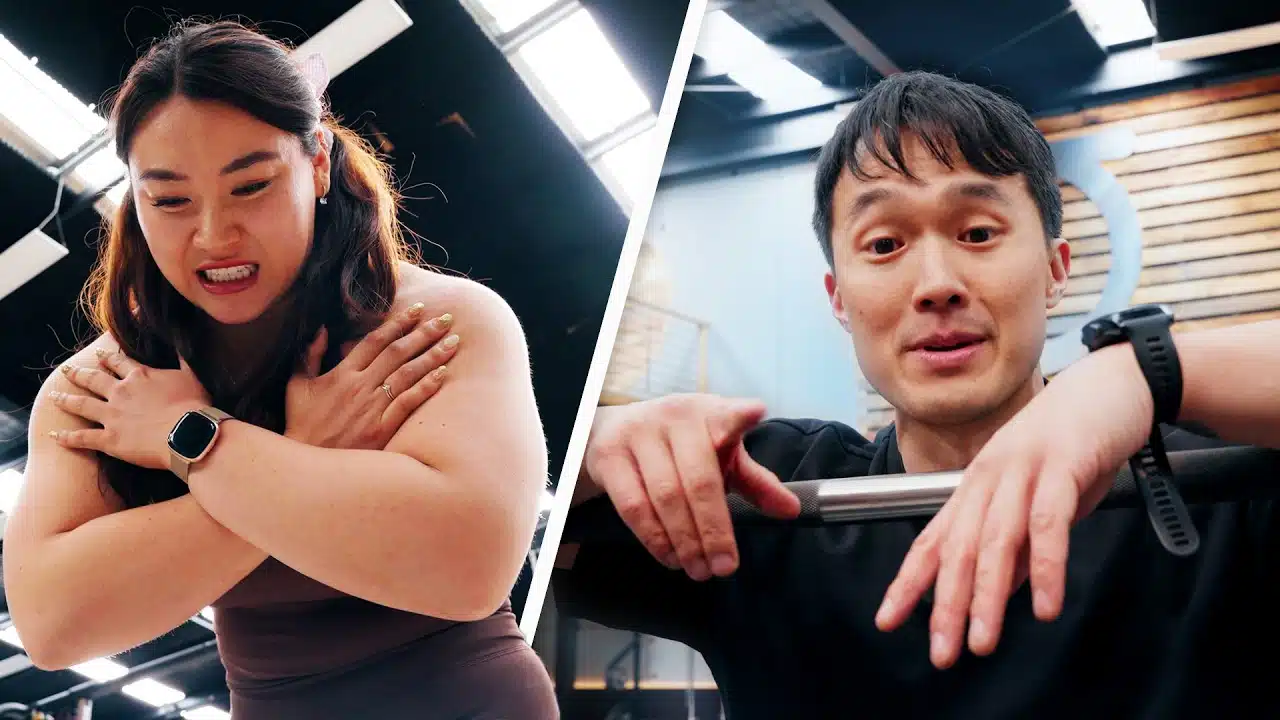
In a recent training session, strength coach and Olympic weightlifter Zack Telander introduced powerlifter Eugeniya Misura to an unconventional single-leg exercise that exposes these weaknesses while building true hip extension power.
The movement looks deceptively simple but delivers what Telander calls “the purest isolated hip extension you can get.”
Jump to:
- The Bulgarian Split Squat Variation That Targets Glute Weaknesses
- Why Powerlifters Struggle With Hip Extension
- Adding Rotational Elements for Maximum Glute Stretch
- The Heel Lift Modification That Intensifies Glute Activation
- Progressive Loading: From Bodyweight Humility to Heavy Dumbbells
- Programming Strategies for Maximum Benefit
- Why “Prehab” Exercises Fail and How to Fix Them
- The Specialization Paradox in Strength Sports
- Integrating Specialized Glute Work With Coach Programming
The Bulgarian Split Squat Variation That Targets Glute Weaknesses
This isn’t your standard Bulgarian split squat. Telander’s version emphasizes specific positioning landmarks that transform the exercise into a targeted glute and hamstring builder.
The setup requires three critical alignment points: knee positioned over the big toe, sternum stacked over the knee, and sit bone pulled upward toward the ceiling while maintaining that knee-over-toe position.

If you want something simple that actually works, this is one of the most effective tools I’ve used to build strength, conditioning, and endurance without needing a full gym setup.
- Full-body training with one weight using swings, squats, and presses
- Solid cast iron build that feels stable and lasts for years
- Comfortable grip that makes high-rep workouts easier to handle
That’s a position you don’t really get into much. And what I see is this knee toe, and then your knee is back here. Knee forwards more.
The counterintuitive element? Keeping the knee pushed forward throughout the entire movement rather than allowing it to drift backward during the ascent.
Why Powerlifters Struggle With Hip Extension
Misura’s initial difficulty with the exercise revealed a common pattern among strength athletes. Despite impressive deadlift numbers, she lacked isolated hip extension strength—the ability to drive the hips forward while keeping the knee position stable.
Okay, that’s why you can deadlift so well. This is all that pure hip extension.
Telander explained the distinction between knee extension dominance—which powers big leg strength—and hip extension capacity, which requires disproportionate glute development.
The movement pattern focuses on two simple cues: butt back and up for the descent, then butt forward for the ascent, all while maintaining forward knee pressure.
Adding Rotational Elements for Maximum Glute Stretch
Understanding glute function reveals why this exercise proves so effective. Glutes perform three primary actions: hip extension, external rotation, and abduction.
To maximally lengthen them requires the opposite movements: adduction, flexion, and internal rotation.
If you want something simple that actually works, this is one of the most effective tools I’ve used to build strength, conditioning, and endurance without needing a full gym setup.
- Full-body training with one weight using swings, squats, and presses
- Solid cast iron build that feels stable and lasts for years
- Comfortable grip that makes high-rep workouts easier to handle
We know from literature to be scientific. Biggest stretch on a muscle tends to come with more potential to grow.
But Telander emphasized that hypertrophy wasn’t the primary goal for Misura. The rotational component addresses a mobility limitation common in powerlifting circles—lack of femoral rotation.
This rotational capacity could enhance every other movement pattern she performs.
The Heel Lift Modification That Intensifies Glute Activation
When Misura initially struggled to feel glute engagement, Telander introduced a simple modification: lifting the heel to shift pressure onto the forefoot.
We can do a slight float, and that makes it disgusting on that glute.
This adjustment—combined with the “bum back and up” cue—immediately produced the desired muscle activation. The forefoot pressure forces greater glute recruitment throughout the range of motion.
The key technical points include:
- Maintaining contact between knee and a vertical surface (wall, pole, or partner’s hand)
- Driving pressure through the big toe area
- Elevating the sit bone rather than simply dropping into hip flexion
- Keeping the knee position stable during hip extension
Progressive Loading: From Bodyweight Humility to Heavy Dumbbells
Despite requiring minimal load initially, this exercise scales effectively. Telander emphasized that the low starting weights shouldn’t relegate this movement to permanent “prehab” status.
If you want something simple that actually works, this is one of the most effective tools I’ve used to build strength, conditioning, and endurance without needing a full gym setup.
- Full-body training with one weight using swings, squats, and presses
- Solid cast iron build that feels stable and lasts for years
- Comfortable grip that makes high-rep workouts easier to handle
There’s literally no reason why eventually you can’t be doing 90-lb dumbbells per hand and just going for it.
The progression path moves quickly. What feels impossible with bodyweight often doubles in load within days as the motor pattern becomes established.
Telander’s own journey with the exercise began with isometric holds—simply learning to maintain the position without movement. After approximately one month of daily practice, he incorporated it as a warm-up before every training session.
Eventually, the movement became a loaded accessory exercise he actively tried to progress.
Programming Strategies for Maximum Benefit
The versatility of this exercise allows multiple programming approaches depending on current training phase and individual needs.
Recommended implementation options:
- Initial motor learning phase: Daily practice with 2-3 sets per side, focusing purely on position and muscle feel
- Warm-up application: 2-4 sets of 10 reps per side before main training sessions
- Accessory work: Progressive loading with 3 sets of 8-12 reps, treating it like any strength exercise
Because the exercise doesn’t create significant systemic fatigue despite intense local muscular tension, it won’t interfere with primary lifts like squats or deadlifts.
If you want something simple that actually works, this is one of the most effective tools I’ve used to build strength, conditioning, and endurance without needing a full gym setup.
- Full-body training with one weight using swings, squats, and presses
- Solid cast iron build that feels stable and lasts for years
- Comfortable grip that makes high-rep workouts easier to handle
It’s great exercise cuz you don’t have to use a lot of weight, but you can really load up your muscles.
Why “Prehab” Exercises Fail and How to Fix Them
Telander identified a critical flaw in how many athletes approach corrective and preparatory exercises—they never progress the load or intensity.
Movements get dismissed as “cute-y things” rather than treated as legitimate strength builders. The principle remains sound, but execution lacks progression.
The problem with a lot of these prehab-y things is in principle they’re great. No one just knows how to load them.
His recommendation? Progress these movements exactly like primary lifts. Add weight, track performance, push intensity within appropriate fatigue management.
Rehabilitation and prehabilitation exercises deserve the same respect as competition movements.
The Specialization Paradox in Strength Sports
The training session highlighted an important reality about athletic specialization. Misura’s inability to perform rotational movements doesn’t represent a flaw—it demonstrates successful adaptation to powerlifting demands.
Powerlifting requires rigidity and stability, not rotation. A heavily loaded squat with rotational freedom would be catastrophic, not beneficial.
If you want something simple that actually works, this is one of the most effective tools I’ve used to build strength, conditioning, and endurance without needing a full gym setup.
- Full-body training with one weight using swings, squats, and presses
- Solid cast iron build that feels stable and lasts for years
- Comfortable grip that makes high-rep workouts easier to handle
You’re so specialized for the intended purpose. But now that you’re not doing that and want some accessories to help you build up a bit of chunk, maybe some prehab on the side, this is perfect.
This creates an interesting disconnect. External markers of fitness—impressive physiques or massive lifts—don’t necessarily indicate complete athletic development.
Bodybuilders may look powerful but lack functional movement capacity. Powerlifters move enormous weights but miss fundamental movement patterns.
Integrating Specialized Glute Work With Coach Programming
Telander’s approach to supplemental work provides a template for athletes working with specialized coaches. His Olympic lifting coach programs only the competitive lifts and their direct variations.
Accessory work addressing specific weaknesses becomes the athlete’s responsibility to identify and implement.
The conversation between coach and athlete focuses on movement quality rather than muscle development. When hip extension appeared limited during cleans, the discussion centered on functional capacity—the ability to perform the movement—rather than aesthetic concerns.
We are only as strong as our weakest links. If we can strengthen those up, everything else goes up, too.
This self-directed accessory work addresses:
If you want something simple that actually works, this is one of the most effective tools I’ve used to build strength, conditioning, and endurance without needing a full gym setup.
- Full-body training with one weight using swings, squats, and presses
- Solid cast iron build that feels stable and lasts for years
- Comfortable grip that makes high-rep workouts easier to handle
- Movement patterns absent from primary training
- Muscle groups underdeveloped relative to overall strength
- Mobility limitations that could eventually limit performance
- Injury prevention through balanced development
The Bulgarian split squat variation demonstrates how simple positional adjustments transform familiar exercises into targeted solutions for specific weaknesses. By emphasizing forward knee position, rotational elements, and progressive loading, it builds genuine hip extension strength that translates beyond the gym.