In a groundbreaking attempt that electrified fans and shattered limits, Faith Kipyegon clocked 4:06.42 at Nike’s Breaking4 event in Paris—setting a new women’s mile world record, yet narrowly missing the elusive sub-four-minute barrier.
But focusing on what she “didn’t do” misses the point. Kipyegon didn’t just run the fastest mile in women’s history—she changed the game entirely.
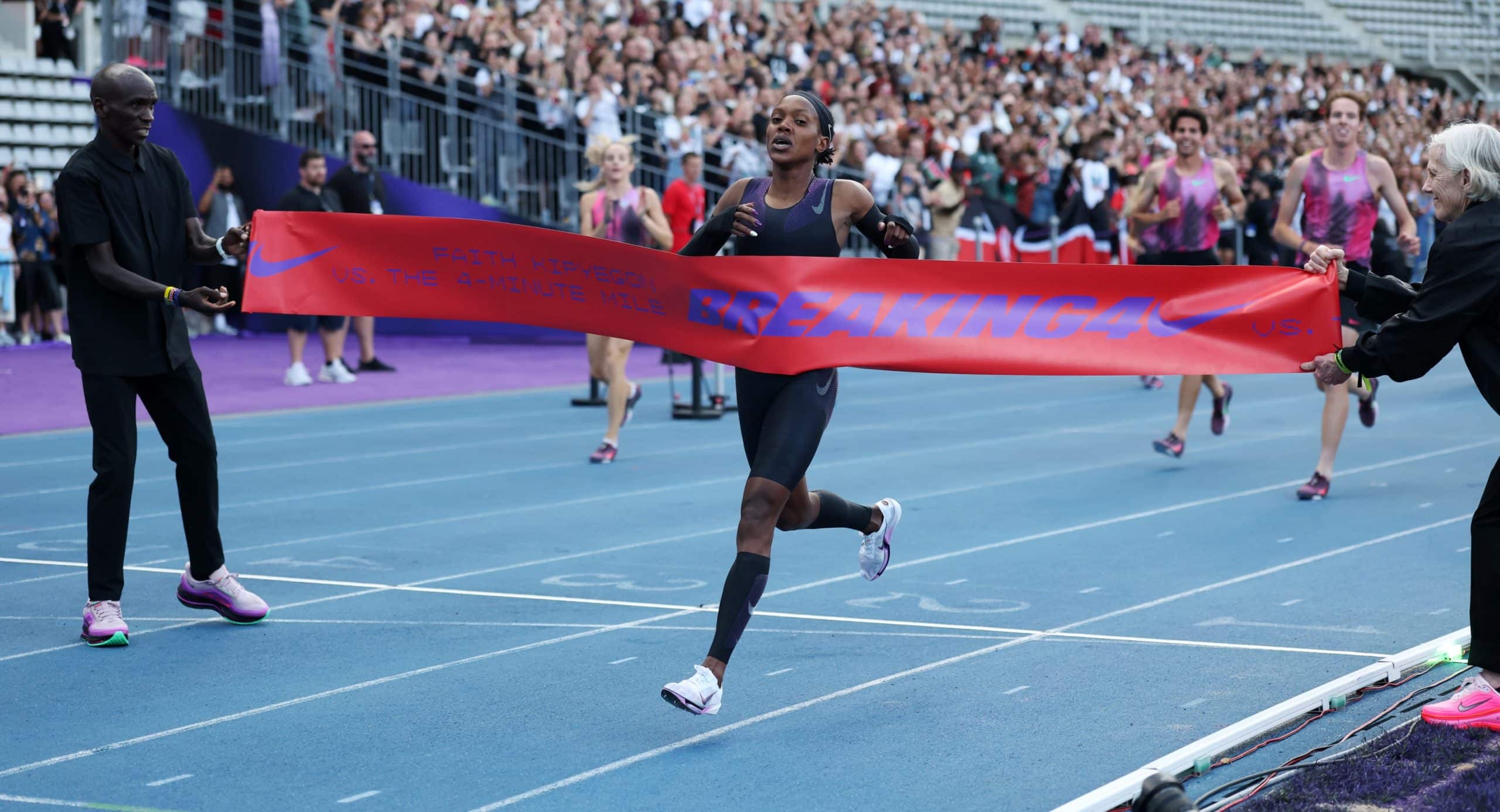
Here’s how her performance redefined human potential, inspired a generation, and proved once again that barriers exist to be broken.
Jump to:
- A Moonshot Effort that Rewrote the Record Books
- The Science Behind the Speed: Spikes, Drafting, and Strategy
- More Than a Race: A Message to Mothers, Girls, and the World
- The Weight of History—and the Future it Inspired
- A New Era of Exhibition Events?
- What Comes Next for Kipyegon?
- Final Thoughts: When the Attempt Becomes the Achievement
A Moonshot Effort that Rewrote the Record Books
Held at the Stade Charléty on June 26, the Breaking4 exhibition was engineered specifically to give Kipyegon every possible edge to become the first woman to run a sub-4:00 mile.
While the attempt used male pacers and high-tech, non-regulation gear—meaning the time doesn’t qualify as an official record—the feat was historic. She shattered her own previous world best of 4:07.64 by more than a second.
“I would say I got what I wanted,” Kipyegon told Unbothered, “To execute as fast as I did yesterday was the best I wanted.”
She averaged an astonishing 14.6 mph, completing each 400 meters in 61.3 seconds—a blistering pace few humans can match, even briefly, on a treadmill.
The Science Behind the Speed: Spikes, Drafting, and Strategy
Kipyegon’s performance was anything but random.
She wore custom Nike Victory Elite FK spikes with an upper that weighed just 3 grams—the weight of three paper clips. Paired with an aerodynamic suit and surrounded by 13 pacers, the design was meticulous.
Yet, many experts noted the drafting strategy wasn’t perfect. According to Nike lead scientist Brett Kirby, Kipyegon didn’t need to run directly behind her pacers because most of them were broad-shouldered and offered sufficient wind-blocking even with a few meters of distance.
Still, analysts like Alex Hutchinson noted inconsistencies in pacing formation, comparing it to Kipchoge’s more disciplined Breaking2 setup. Despite minor flaws, Nike estimated the combined aerodynamic benefit at 3%—a major assist in a sport where seconds define greatness.
More Than a Race: A Message to Mothers, Girls, and the World
Kipyegon’s mile wasn’t just a race—it was a movement.
At 31 and a mother to 7-year-old Alyn, Kipyegon continues to shatter outdated narratives about motherhood and athleticism.
“This was a message to young women out there… to know that we are limitless in this world,” she told Refinery29. “You have a baby, yes, but you still have to go there and do what you have to do.”
Her words resonate far beyond the track. In a sporting culture where women often face setbacks after becoming mothers—whether in sponsorship, recovery, or perception—Kipyegon’s record sends a powerful rebuttal: motherhood isn’t a limitation; it’s fuel.
The Weight of History—and the Future it Inspired
Roger Bannister broke the men’s four-minute barrier in 1954. At that time, women weren’t even allowed to run the mile in the Olympics. Now, 71 years later, Kipyegon has brought the women’s mark within six seconds of the same historic milestone.
But her accomplishment also raised questions: Why does public discourse so often highlight what female athletes don’t achieve?
“It’s a sad but common story for women,” wrote L’Oréal Blackett in Refinery29, “to be the best in the world yet find the focus aimed at what you didn’t achieve.”
That narrative is shifting—because of performances like Kipyegon’s. Her attempt gave young girls and aspiring runners worldwide a vision of what’s possible. According to Women in Sport, nearly half of Black girls in the UK drop out of sports by their teens. A feat like Kipyegon’s could be the inspiration they need to stay.
A New Era of Exhibition Events?
The Breaking4 attempt may have bent the rules, but it brought new eyes to the sport and reimagined the boundaries of competition.
Track historian Lauren Goss likens the event to other landmark moments—like Diane Leather’s unofficial sub-five-minute mile in 1954. Back then, no record was awarded because women’s mile times weren’t sanctioned.
Today, it’s the opposite: public recognition and historical impact can outweigh official record status.
What Comes Next for Kipyegon?
The Paris race was an all-or-nothing bid—sub-four or bust.
“If I was to hold back, I could run like 4:02 or 4:03,” Kipyegon admitted. But that wasn’t the goal. She went all-in, and that’s what made it remarkable.
Next, she’ll compete under record-legal conditions at the Prefontaine Classic on July 5, where she’ll target her own 1500m world record of 3:49.04. That’s roughly equivalent to a 4:06.5 mile—strikingly close to what she just ran.
“I think I’ve shown the world it’s possible,” she said.
Final Thoughts: When the Attempt Becomes the Achievement
Faith Kipyegon may not have broken four—but she broke new ground.
She gave the world a reason to believe in barriers falling. She inspired countless women, mothers, and young athletes. And she reminded everyone that chasing the impossible is sometimes more powerful than achieving it.
As she said, “If it’s not me, it’ll be somebody else. One day, one time, a woman will run under four.”
Faith dared to try—and in doing so, she brought us all one step closer.