CrossFit veteran Noah Ohlsen has spent over a decade competing at the highest level, carving out a name as one of the sport’s most consistent and respected athletes.
But in a recent Men’s Health podcast, Ohlsen offered a rare moment of vulnerability—and a surprising admission.
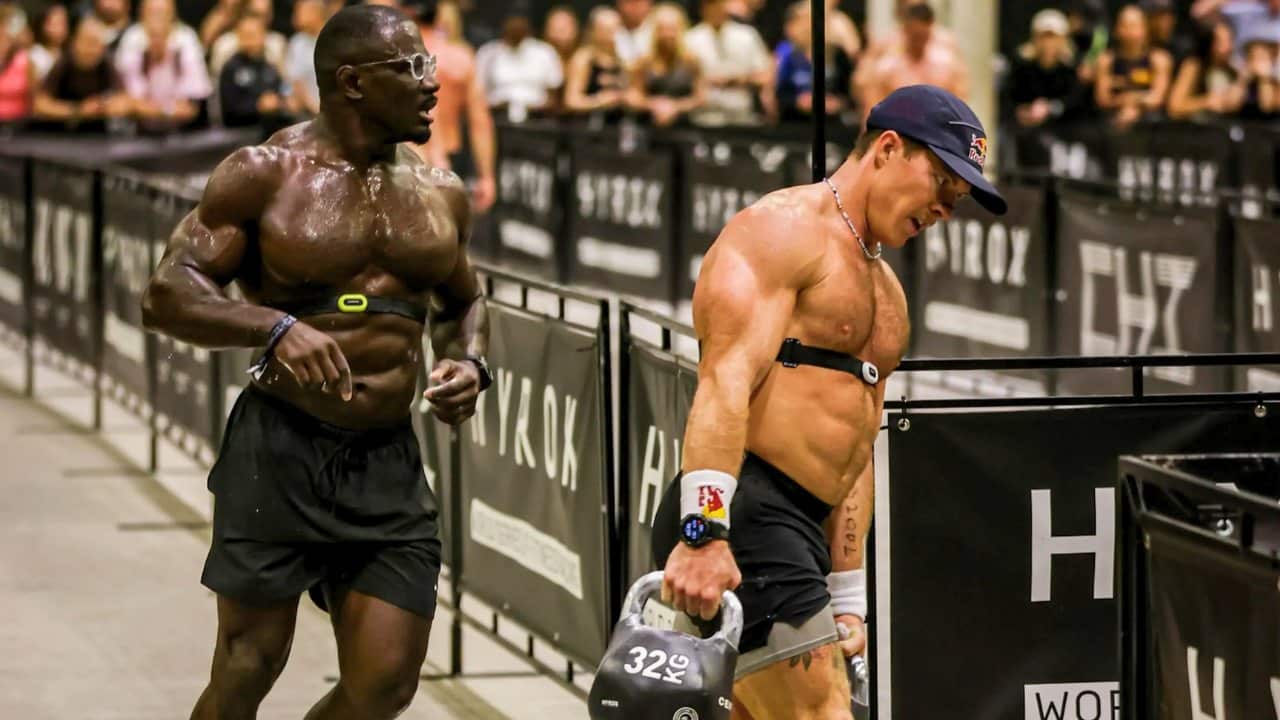
Despite the CrossFit Games’ reputation for producing the “fittest on earth,” Ohlsen says elite CrossFitters may not be as prepared as people think to dominate in the fast-growing fitness competition known as Hyrox.
“When I watched those dudes run, I was like, wow—we’re so far off,” Ohlsen confessed. “There’s no way that top CrossFit athletes are gonna be able to hang with the top Hyrox guys. They’re just such high-level endurance speed athletes.”
For a sport often heralded for its breadth, that’s a bold take. But it might just explain the widening performance gap between the two worlds.
Jump to:
- Why Hyrox Is a Different Kind of Fitness Test
- The CrossFit-to-Hyrox Crossover: Rare, but Not Impossible
- Why CrossFit Strength Doesn’t Automatically Translate
- Hybrid Training: The New Normal?
- The World Fitness Project: A New Frontier
- The Reality of Adding Running to a CrossFit Lifestyle
- Nutrition: Loosening the Reins
- Final Takeaway: There’s No One Definition of Fitness
Why Hyrox Is a Different Kind of Fitness Test
At first glance, CrossFit and Hyrox share a similar DNA. Both blend strength, endurance, and functional movement. Both are grueling. But that’s where the similarities end.
Hyrox competitions consist of eight 1-kilometre runs, each followed by a brutal station: think sled pushes, sandbag lunges, wall balls, and rowing. It’s long, steady, grinding work—favoring aerobic efficiency and muscular endurance over raw explosiveness.
That distinction matters, Ohlsen says, especially for athletes built on a foundation of barbell-heavy power.
“It seems much more likely to me that if you’re a good runner that gets just strong enough to handle all the other stuff, you’re gonna be a lot more successful than the other way around.”
Ohlsen’s first Hyrox test came in April, where he and fellow Games athlete Chandler Smith competed in Miami. Despite years of Games experience, they finished 10th in their age group with a solid 54:12—impressive by most standards, but far from elite in the Hyrox world.
The CrossFit-to-Hyrox Crossover: Rare, but Not Impossible
Not every CrossFitter struggles with the switch. Tia-Clair Toomey-Orr, six-time CrossFit Games champion, has made the leap with unprecedented success.
She debuted at Hyrox Brisbane 2025 in the Mixed Doubles division with James Newbury, finishing 2nd overall. But she didn’t stop there. In Houston, she shattered the Women’s Pro Doubles world record with partner Joanna Wietrzyk, clocking a staggering 54:24.
Her performance proves elite crossover is possible—but rare.
Most Games athletes, Ohlsen included, aren’t wired for Hyrox’s endurance-first demands. While CrossFit emphasizes constantly varied high-intensity work, Hyrox rewards sustained, predictable output over a longer duration.
Why CrossFit Strength Doesn’t Automatically Translate
One major misconception is that building endurance on top of a CrossFit base is easy. Just add mileage, right?
Not so fast.
“Historically, people thought if you’re strong already, it’s easier to build endurance than the other way around,” Ohlsen said. “But at the elite level of Hyrox, that just doesn’t hold up.”
That’s because strength takes years to build, but aerobic endurance at pace requires specialized training. Ohlsen found this out firsthand after completing his first Ironman in late 2024.
Despite months of long-distance training, he struggled in subsequent shorter, faster running events. His takeaway? The energy systems—and muscular demands—are completely different.
“Running 26 miles at a 9-minute mile pace is nothing like running 1K repeats at six-minute mile pace between sled pushes.”
Hybrid Training: The New Normal?
The rise of hybrid training—combining strength and endurance into one performance model—is reshaping what it means to be fit.
Athletes like Nick Bare, Fergus Crawley, and now Ohlsen himself are challenging the old-school dichotomy between lifters and runners. The goal isn’t to be the best at one thing, but highly capable at both.
“It used to be about specializing. Now people want to be well-rounded. Strong, fast, resilient—and able to compete across multiple domains.”
That ethos is driving more athletes into events like Hyrox, Ironman, and Tactical Games—blurring the lines between traditional disciplines.
The World Fitness Project: A New Frontier
With CrossFit in flux and the brand once again up for sale, Ohlsen is shifting some of his focus to the newly launched World Fitness Project (WFP). A multi-stop competitive tour aiming to reimagine functional fitness events, WFP offers a season-long structure with cumulative points—rather than CrossFit’s all-or-nothing weekend finale.
Ohlsen says he’s excited to be part of something new.
“It’s cool to be involved from the beginning. Maybe it becomes a platform for younger athletes to build a life the way I’ve been fortunate enough to.”
The WFP currently has three scheduled events (Indianapolis, Arizona, Denmark), with more expected in 2026. The format rewards consistency over the season—potentially offering a more sustainable model for both pros and fans.
The Reality of Adding Running to a CrossFit Lifestyle
Ohlsen knows not everyone has the time or desire to train like a full-time hybrid athlete. But for those looking to add endurance to their strength base, his advice is simple: start slow and be patient.
“Your joints will hurt at first. My hips and knees were wrecked when I started long runs. But your body adapts—it just needs time.”
He recommends short, low-intensity runs added before or after strength sessions. One mile at a time. Five miles a week. No pressure.
His own hybrid week includes:
- 1-hour CrossFit class daily
- 2–3 extra strength sessions
- 3 days of focused running or Hyrox-style conditioning
This flexible, intuitive approach is a sharp contrast from the rigid training plans of his competitive peak.
Nutrition: Loosening the Reins
Surprisingly, Ohlsen isn’t tracking macros right now. After over a decade of dialed-in nutrition, he’s allowing himself to eat intuitively.
But he acknowledges how vital fueling becomes when endurance is in play. During his Ironman prep, he consumed 1,000g of carbs during the race—an eye-opening shift from typical CrossFit fueling strategies.
“Endurance athletes are so dialed in with nutrition. CrossFitters could learn from that—especially with intra-event fueling.”
Final Takeaway: There’s No One Definition of Fitness
Ohlsen’s journey from CrossFit to Ironman to Hyrox shows how diverse and personal fitness can be. He’s proof that even elite athletes have blind spots—and that stepping outside your comfort zone is where real growth happens.
“Fitness doesn’t have to mean maxing out every day,” he says. “It can just mean going for a walk. Or adding a short run. Or lifting twice a week. Whatever keeps you moving and makes you happy.”
As he prepares to become a father, compete in WFP, and test himself in more Hyrox events, one thing’s clear: Ohlsen isn’t done evolving—and neither is the definition of fitness.