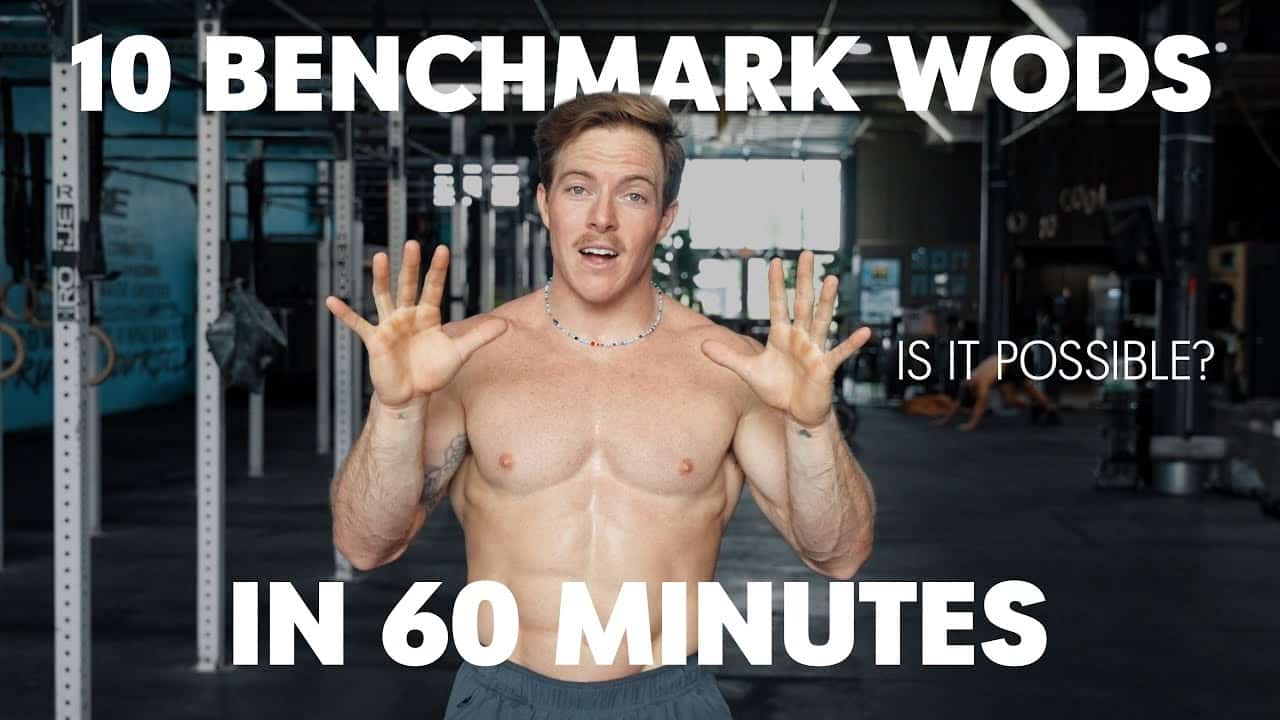
Ten of CrossFit’s toughest benchmark workouts in just under an hour, each starting every five minutes. It sounds borderline impossible — but that’s exactly what elite athlete Noah Ohlsen set out to attempt.
The goal was simple: complete 10 classic WODs (Workout of the Day) with minimal rest, maximum grit, and strategic pacing. What followed was part experiment, part entertainment, and a full display of human resilience under fatigue.
Whether you’re a CrossFit fan, a fitness professional, or someone fascinated by pushing physical limits, there’s plenty to take away from this challenge — including what it takes to mentally and physically manage this kind of volume and intensity back-to-back.
Here’s how Noah executed this high-stakes fitness test, what worked, what didn’t, and the lessons hidden in every rep.
Jump to:
- Attempting the Impossible: 10 CrossFit Benchmarks in 50 Minutes
- Mastering the Metcon Math: Noah’s Strategy Breakdown
- What Went Right (and What Didn’t)
- The Role of Fatigue, Sleep, and Life Outside the Gym
- What Makes This Challenge So Difficult?
- So… Could Anyone Do It?
- Takeaways for Everyday Athletes
- Final Thoughts: A Win, Even Without Finishing
Attempting the Impossible: 10 CrossFit Benchmarks in 50 Minutes
Noah Ohlsen, a perennial CrossFit Games athlete, set out to do something he knew might be out of reach: 10 benchmark CrossFit workouts, each beginning at the top of a five-minute window.
The WOD lineup he chose featured some of the most iconic — and intense — CrossFit workouts ever created:
- King Kong
- Grace
- Nasty Girls
- Isabel
- Fran
- Diane
- Ingrid (planned but swapped)
- Elizabeth (swapped in)
- Gretel
- Amanda
To complete them all, Noah needed to not only modify his intensity, but also treat the workouts more like intervals than full send events. “Individually, some of these take under two minutes at max effort,” he said. “So I figured, if I scale my intensity, maybe I can still finish each in about three and a half minutes. That leaves 90 seconds to rest and transition.”
Mastering the Metcon Math: Noah’s Strategy Breakdown
For this challenge, pacing was everything. Rather than attacking each WOD at 100%, Noah planned to move at about 50–60% of his max to avoid spiking his heart rate or hitting muscular failure.
Smart Scaling: Adjusting Pace, Not Workload
Consider “Grace” — 30 clean and jerks at 135 lbs. Noah stated he could do it unbroken in about 1:18. For the challenge, he opted for smooth singles, completing it in closer to 3 minutes. Same for Fran: normally a fast-and-furious couplet of thrusters and pull-ups, he spaced out the reps to regulate output. “I can hit Fran at sub 1:50, but here I went closer to double that.”
This wasn’t about PRs; it was about volume survival under fatigue.
Strategic Rearrangement Mid-Challenge
Originally, his plan was to do Ingred (30 snatches for time + 30 burpees over the bar) as workout seven. Instead, he pivoted to Elizabeth (21-15-9 of cleans and ring dips). It was a metabolic decision. “I just didn’t think I could handle the snatches and burpees at that level of fatigue,” he admitted. “The dips were more manageable.”
What Went Right (and What Didn’t)
Noah completed the first six workouts, pushing through King Kong, Grace, Nasty Girls, Isabel, Fran, and Diane. He transitioned into Elizabeth and reached the final set before time expired, finishing 6.5 out of 10 workouts.
Key reasons for his partial success:
- Technique over intensity: He moved efficiently to conserve energy.
- Front-loaded with heavy lifts: By doing King Kong (loaded with deadlifts and cleans) first, he ensured strength didn’t suffer late in the challenge.
- Mental composure: Even while gasping for air, Noah remained analytical about how far he could push without tipping over the edge.
However, fatigue compounded. Around Isabel and Fran — inherently short, metabolic workouts — he began flaring into the red zone. “I thought I was going to fail the Fran cap,” he said. “Cardiovascular fatigue was way more of a limiter than muscular endurance.”
The Role of Fatigue, Sleep, and Life Outside the Gym
One overlooked factor: Noah’s recent shift into fatherhood. “I haven’t gotten much sleep this week with our newborn baby,” he confessed. “Not using it as an excuse, but adaptation is part of this new life.”
That speaks volumes to the balancing act many face. Even the fittest athletes in the world aren’t immune to the real-world demands of time, rest, and recovery.
What Makes This Challenge So Difficult?
Each of the benchmark WODs is already demanding by itself. Combining them creates an avalanche of:
- High-volume barbell cycling
- Bodyweight gymnastics under fatigue
- Minimal recovery through compounding metabolic stress
There’s also the psychological grind. Five-minute windows might seem long on paper, but there’s no true respite. “If you take just one 30-second break too long,” Noah said, “the whole domino effect starts, and you’re racing the clock harder and harder.”
So… Could Anyone Do It?
Noah believes it’s possible. “I really think someone out there could complete all 10 if they’re a freak athlete with perfect pacing,” he mentioned in the video.
To pull it off would likely require:
- Elite capacity in both strength and aerobic recovery
- Exceptional WOD management skills
- Minimal transition time
- Perfect nutrition and sleep leading up to the attempt
- Likely some customization in workout order
Takeaways for Everyday Athletes
For most people, this type of challenge isn’t just exhausting — it’s inadvisable.
However, there are valuable lessons in Noah’s bold attempt:
1. Find Your Limits by Testing Them
Noah openly admitted he had no clue if this was even possible. But trying allowed him to find the edge of capacity and identify where fatigue set in. That mindset — where effort is data — is key for growth.
2. Strategic Scaling Isn’t Weakness, It’s Wisdom
He scaled intensity, not reps. He swapped workouts when needed. These are real-time decisions that allowed maximal effort with minimal risk.
3. Conditioning Comes in Layers
Doing one benchmark is a sprint. Doing ten is an endurance test. If you’re looking to build next-level capacity, consider stringing two or three shorter workouts together with controlled pacing.
But don’t jump into something like this without a deep base of both experience and aerobic fitness.
Final Thoughts: A Win, Even Without Finishing
Although he didn’t reach Amanda — the final benchmark — Noah doesn’t consider the effort a failure.
“You’ve got to try things in order to learn whether they’re possible,” he said, reflecting on the attempt. “I had fun. I learned a lot. And I’m honestly kind of motivated to try again.”
This experiment — part grit, part science — is just another step forward in uncovering the full spectrum of human performance.
And if you’re wondering whether there’s a better workout order to pull it off? Noah’s all ears. “Drop a comment,” he encouraged viewers, “and let me know how you’d arrange it.”
One thing’s for sure: with a little caffeine, a lot of heart, and just five minutes at a time — greatness can be attempted.