A Paralympic medalist just completed something that has never been done before — and the way he did it will stop you in your tracks.
Mohamed Lahna, a two-time Paralympic medalist who competes in para-triathlon, has completed a 3,300-mile Triathlon Across America, becoming what is believed to be the first amputee athlete to complete a triathlon across the United States in this format.

The journey stretched from New York to Venice Beach, covering a Manhattan swim, a coast-to-coast bike ride through 16 states, and a brutal 300-mile run through the Mojave Desert — all on a prosthetic leg.
Here’s how he pulled off the seemingly impossible.
Jump to:
From Manhattan to the Mojave: The Scale of the Challenge
Lahna kicked things off on June 13 in New York with a 28.5-mile swim around Manhattan, completing it in 7 hours, 44 minutes, and 58 seconds.
From there, he mounted his bike and rode approximately 3,000 miles westward, crossing 16 states and climbing more than 100,000 feet of elevation before arriving in Las Vegas — where the hardest stretch was still waiting for him.

If you want something simple that actually works, this is one of the most effective tools I’ve used to build strength, conditioning, and endurance without needing a full gym setup.
- Full-body training with one weight using swings, squats, and presses
- Solid cast iron build that feels stable and lasts for years
- Comfortable grip that makes high-rep workouts easier to handle
About two weeks into the cycling leg, Lahna glanced at a map and felt the full weight of what he had taken on.
It was daunting and scary. I was tired and exhausted, and I still had so far to go. It felt like I had barely scratched the surface.
That was the moment everything changed mentally. Rather than measuring himself against the full route, Lahna made a critical decision — he stopped looking at the big picture entirely and focused only on the day ahead.
Two Miles at a Time Through the Desert
The final 300-mile run from Las Vegas to Los Angeles presented a completely different kind of challenge — one measured not just in distance, but in pain management.
One particularly punishing section traced power lines for 116 miles through off-road terrain in extreme heat across the Nevada-California border. Running through that kind of environment on a prosthesis is far more complex than it might appear from the outside.
Running with a prosthesis is very difficult. Blisters can stop the journey, and if you get an infection, it is over.
To stay ahead of those risks, Lahna and his crew developed a tight, disciplined rhythm. Every two miles, the support car would pull forward, and the team would clean the prosthesis, inspect his skin, hydrate, and apply protective creams or BodyGlide.
Two miles. Stop. Check. Repeat. That was the formula that carried him all the way to the finish line.
If you want something simple that actually works, this is one of the most effective tools I’ve used to build strength, conditioning, and endurance without needing a full gym setup.
- Full-body training with one weight using swings, squats, and presses
- Solid cast iron build that feels stable and lasts for years
- Comfortable grip that makes high-rep workouts easier to handle
I battled boils and constant pain. There were times when we had to stop, treat the wounds, adjust the prosthesis, and find a way to continue.
Even with extra time banked, his crew kept him from pushing too hard too fast. The priority was always finishing safely over finishing quickly.
The smart choice was to use the extra time to finish the challenge safely rather than be irresponsible and run too fast.
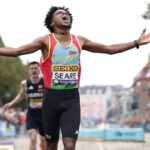
On July 29, just after 1 p.m., Lahna crossed into Venice Beach and made history.
The Athlete Behind the Achievement
Lahna was born in Morocco with proximal femoral focal deficiency, a condition affecting limb development. He didn’t receive his first functional prosthesis until the age of 20 — and didn’t ride a bike until he was 25.
What followed is one of the most remarkable athletic trajectories in para-sport history. He claimed a Paralympic bronze medal for Morocco at the Rio Games and a Paralympic silver medal for Team USA in Paris, while also completing the grueling Marathon des Sables, the Ironman World Championship, and the notoriously demanding Norseman Xtreme Triathlon.
The Triathlon Across America is, by any measure, the crown jewel of that résumé — and it came with a message Lahna felt compelled to share.
What He Wants the World to Understand
For Lahna, this wasn’t just about crossing a finish line. It was about pulling back the curtain on what adaptive athletes navigate before a race even begins.
If you want something simple that actually works, this is one of the most effective tools I’ve used to build strength, conditioning, and endurance without needing a full gym setup.
- Full-body training with one weight using swings, squats, and presses
- Solid cast iron build that feels stable and lasts for years
- Comfortable grip that makes high-rep workouts easier to handle
For many people, running means putting on a pair of shoes, training, and seeing how far they can go. For us, there is much more involved.
The logistics, the wound care, the equipment adjustments — they are part of the reality. But Lahna is careful to make clear that those challenges don’t define the whole story.
Adaptive athletes, he emphasizes, are not just people managing adversity. They are competitors driven by ambition, fueled by a desire to push limits, and hungry to achieve something bigger than themselves.
Ambitions, a competitive side, and the desire to achieve bigger things.
After 3,300 miles, through desert heat, open water, mountain climbs, and relentless pain, Mohamed Lahna proved that point beyond any doubt.