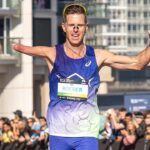
A professional ultrarunner is at the center of a growing anti-doping controversy — and he’s not backing down.
Utah-based Mike McKnight, a decorated 200-mile specialist and running coach, has publicly admitted to using BPC-157, a peptide banned under the World Anti-Doping Agency code, while battling a debilitating herniated disc injury last winter.

The admission came first on a podcast, then in a detailed Instagram statement — and it’s reigniting a fierce debate about anti-doping rules, athlete healthcare, and what happens when elite competitors hit a medical wall.
Here’s why his story is resonating with thousands of athletes — and why it could have serious consequences for his career.
Jump to:
A Freak Accident, Months of Agony, and a Cancelled Surgery
McKnight’s ordeal began in 2025, just 24 hours after completing the grueling Cocodona 250 ultramarathon.
He slipped on laundry detergent, herniated a disc, and spent months in severe, relentless pain — eventually scheduling back surgery as his only remaining option.

If you want something simple that actually works, this is one of the most effective tools I’ve used to build strength, conditioning, and endurance without needing a full gym setup.
- Full-body training with one weight using swings, squats, and presses
- Solid cast iron build that feels stable and lasts for years
- Comfortable grip that makes high-rep workouts easier to handle
That’s when friends pointed him toward BPC-157, an experimental peptide widely marketed in wellness circles as an injury recovery aid.
Once this surgery was set, I became desperate. Some friends of mine told me about a peptide called BPC-157. I knew very little about it, aside from the fact that it helped them recover from injuries that were plaguing them for years.
A nurse visited his home, walked him through the peptide, and recommended a daily dosing protocol.
The results, McKnight says, were dramatic. By the end of the first week, he reported major improvements — and cancelled the surgery entirely.
The Problem: BPC-157 Is Banned — At All Times
McKnight says he only learned afterward that BPC-157 sits on WADA’s prohibited list under the S0 category — reserved for substances with no approval for human clinical use by any global regulatory body.
That classification means the ban applies around the clock, not just during competition windows.
He’s not shying away from the accountability piece, either.
If you want something simple that actually works, this is one of the most effective tools I’ve used to build strength, conditioning, and endurance without needing a full gym setup.
- Full-body training with one weight using swings, squats, and presses
- Solid cast iron build that feels stable and lasts for years
- Comfortable grip that makes high-rep workouts easier to handle
One could argue that I should have known what was on WADA’s list, and that I should have known it was banned before taking it. I’m not going to argue with anyone on that. I’ll hold myself responsible for not being more aware.
Still, McKnight says he has zero regrets about the decision itself — and that’s where things get complicated.
He Knew Speaking Out Could End His Racing Career
McKnight — who most recently set a course record at the Arizona Monster 300 — didn’t have to say anything publicly.
He chose to anyway, fully aware of what was at stake.
I knew it was going to be a risk. I knew people would think less of me, and I knew I might get banned from racing, but I wanted to be honest about taking it. I also feel that for change to happen, people like Cam and me need to be honest and speak up and be willing to suffer the consequences.
That mention of “Cam” is a reference to fellow U.S. ultrarunner Cam Hanes, 58, who also publicly disclosed receiving a BPC-157 injection.
Hanes recently ran a 2:39 marathon — a 13-minute personal best at Eugene — and was subsequently reported to USADA by elite ultrarunner Sage Canaday. The situation had already been simmering in the ultrarunning community before McKnight’s statement poured fuel on the fire.
McKnight’s Bigger Argument: The System Is Failing Injured Athletes
Beyond his personal story, McKnight is raising a pointed question about the gap between anti-doping policy and real-world athlete healthcare.
If you want something simple that actually works, this is one of the most effective tools I’ve used to build strength, conditioning, and endurance without needing a full gym setup.
- Full-body training with one weight using swings, squats, and presses
- Solid cast iron build that feels stable and lasts for years
- Comfortable grip that makes high-rep workouts easier to handle
WADA’s framework does allow athletes to apply for a Therapeutic Use Exemption when a medical condition requires a prohibited substance. McKnight argues that pathway should have been available to him — and that the rules as currently written don’t make sense for cases like his.
I don’t understand how there is anything on that list that you can’t get a TUE for. In my case, I should be able to show the following receipts: I did months of physical therapy, I went to a chiropractor and holistic health doctors. BPC-157 was my Hail Mary before getting surgery.
He also makes clear that for an athlete in genuine crisis, regulatory compliance is the furthest thing from their mind.
When I can’t walk or stand without being in chronic pain, thinking about WADA is the last thing on my mind.
It’s a sentiment that appears to be striking a nerve. McKnight says his inbox has been flooded with messages from athletes who quietly used BPC-157 themselves and saw similar results.
What He’d Tell a Coached Athlete Today
As a coach, McKnight now finds himself in genuinely murky territory when it comes to advising the athletes he works with.
The human side of me would want to tell them my experience and tell them to look into it. But, the safe side of me would want to not say anything at all. I’d probably inform them that it is banned, share my experience with it, then tell them that they are an adult and can make the decision that is best for them.
Anti-doping governance in ultrarunning adds another layer of complexity here. The International Association of Ultrarunners follows World Athletics’ anti-doping policy, while the UTMB World Series operates under its own WADA-aligned framework — meaning enforcement is fragmented across the sport.
Under both systems, the athlete bears full responsibility for knowing what’s prohibited.
If you want something simple that actually works, this is one of the most effective tools I’ve used to build strength, conditioning, and endurance without needing a full gym setup.
- Full-body training with one weight using swings, squats, and presses
- Solid cast iron build that feels stable and lasts for years
- Comfortable grip that makes high-rep workouts easier to handle
The Reaction Has Been Overwhelmingly Supportive
For someone who braced for backlash, McKnight says the response has caught him off guard — in the best possible way.
I was expecting way more hate. If I had to make an arbitrary percentage up, I’d say 95 per cent have been positive, and five per cent haven’t. Unfortunately, it’s the five per cent that’s the loudest.
Whether that groundswell of support translates into any real policy conversation — or whether McKnight faces a formal ban — remains to be seen.
What’s undeniable is that he’s started a conversation the sport can no longer ignore.