Some exercises never seem to leave gym routines — not because they work, but because they feel like they should.
They’re often holdovers from old-school training, perpetuated by habit, not science. The reality? These exercises often burn time, energy, and recovery bandwidth without delivering meaningful results.
According to Dr. Mike Israetel, sport scientist and co-founder of Renaissance Periodization, “Some exercises survive because they look good on Instagram or feel hard, but the real question is, do they actually stimulate the muscles in a way that leads to growth or strength? Often, the answer is no.”
Here are five exercises that might be wasting your time — and the smarter swaps that will actually help you build muscle, strength, and athleticism.
Jump to:
Planks: The Most Stationary Way to Waste Time
Planks are widely considered a core-training staple — they require no equipment, seem challenging, and give off the impression of productivity. But looks can be deceiving.
Planks are an isometric movement, meaning your muscles contract without changing length. You feel the burn, but your abs aren’t going through any actual motion. This is a problem for muscle growth and function.
“Planks are like pressing pause on your core training,” says Dr. Israetel. “Yes, your abs are working, but only in one static way — you’re missing the eccentric and concentric actions that are critical for hypertrophy and performance.”
While isometric holds can have a role in rehab or stability training, they don’t offer the mechanical tension or range of motion needed for most people’s goals — especially if the goal is stronger, more visible abs.
Why planks fall short:
- Only activate one aspect of muscle contraction
- No dynamic movement
- Limited progression or overload
- Minimal abdominal hypertrophy
- Boring and often painful without reward
Do This Instead: Ab Rollouts

The ab rollout is everything the plank isn’t — dynamic, challenging, and hypertrophy-friendly.
Whether you’re using an ab wheel, a barbell, or a cable machine, the goal is the same: control your body as you extend forward and resist spinal extension using your core. The further you roll out, the harder your abs work to stabilize.
“Ab rollouts crush your core through a full range of motion,” explains Dr. Israetel. “You get peak tension in the most stretched position — that’s where the magic happens for growth and transfer to sports or life.”
Bonus: Ab rollouts also engage your lats, triceps, and even rear delts, giving you more muscle-building return for your time.
Superman Exercise: Weak Range, Weird Vibes

The Superman looks like something from a kids’ fitness DVD: lying face-down on the floor, arms and legs raised like you’re flying. In theory, it’s meant to activate your posterior chain. In reality, it activates mostly nothing.
“The Superman is one of those exercises that looks like it might be doing something, but when you break down the biomechanics, it’s just a few inches of low-load motion,” Israetel says.
This movement barely challenges the muscles it targets. There’s almost no load, and the range of motion is laughably small. Plus, lying in the middle of a dirty gym floor pretending to fly isn’t exactly inspiring.
Why the Superman exercise fails:
- Negligible tension or resistance
- Limited range of motion
- Doesn’t scale or progress
- Unclear transfer to real-life performance
- Feels more embarrassing than effective
Do This Instead: Flexion Rows

The flexion row — a bent-over row performed with controlled spinal flexion — loads the posterior chain with actual resistance and full range of motion. It challenges your lats, traps, rear delts, and spinal erectors all at once.
“You can use dumbbells, a barbell, or cables. Flexion rows allow for real eccentric loading, actual muscle stretch, and a hard contraction at the top,” says Israetel.
Compared to the Superman, the flexion row offers:
- Real loading
- Large dynamic range
- Muscle-building potential
- Scalable progression
- A position that doesn’t make you look like a broken action figure
If you’re trying to train your posterior chain, don’t lay on the floor. Pick up a weight and actually move it.
Rack Pulls: Peak Ego, Minimal Gains

Rack pulls are the deadlift’s showboating cousin — the one who loads the bar with seven plates, moves it two inches, and drops it with a bang loud enough to wake the cardio crowd.
The idea is to focus on the top half of the deadlift to overload the traps and back. But here’s the problem: the top half of the deadlift is the easiest part — not where the real strength and growth come from.
“Rack pulls from above the knees remove the hardest and most beneficial part of the lift,” says Dr. Israetel. “You’re just leveraging your way through a motion with barely any stretch, which limits stimulus and increases injury risk.”
Why rack pulls suck:
- Short, ineffective range of motion
- No real eccentric loading
- Encourages ego lifting
- Hard on the back, light on gains
- Often performed with questionable technique
Do This Instead: Snatch-Grip Deficit Deadlifts

A snatch-grip deficit deadlift is essentially a deadlift with two added elements:
- You stand on a platform (deficit)
- Your hands are placed wide (snatch grip)
This setup increases the range of motion and challenges the posterior chain through deeper, more effective angles.
“This movement absolutely smokes your upper and lower back, glutes, and hamstrings,” Israetel says. “You’re forced to control the lift from a mechanically disadvantaged position, which is exactly what stimulates growth.”
Benefits include:
- Full range of motion
- Extreme posterior chain recruitment
- Eccentric control
- Hypertrophy and strength stimulus
- Brutal but effective
Forget rack pulls. If you want to actually build your back instead of your ego, grab a wide grip, stand on a plate, and suffer in a good way.
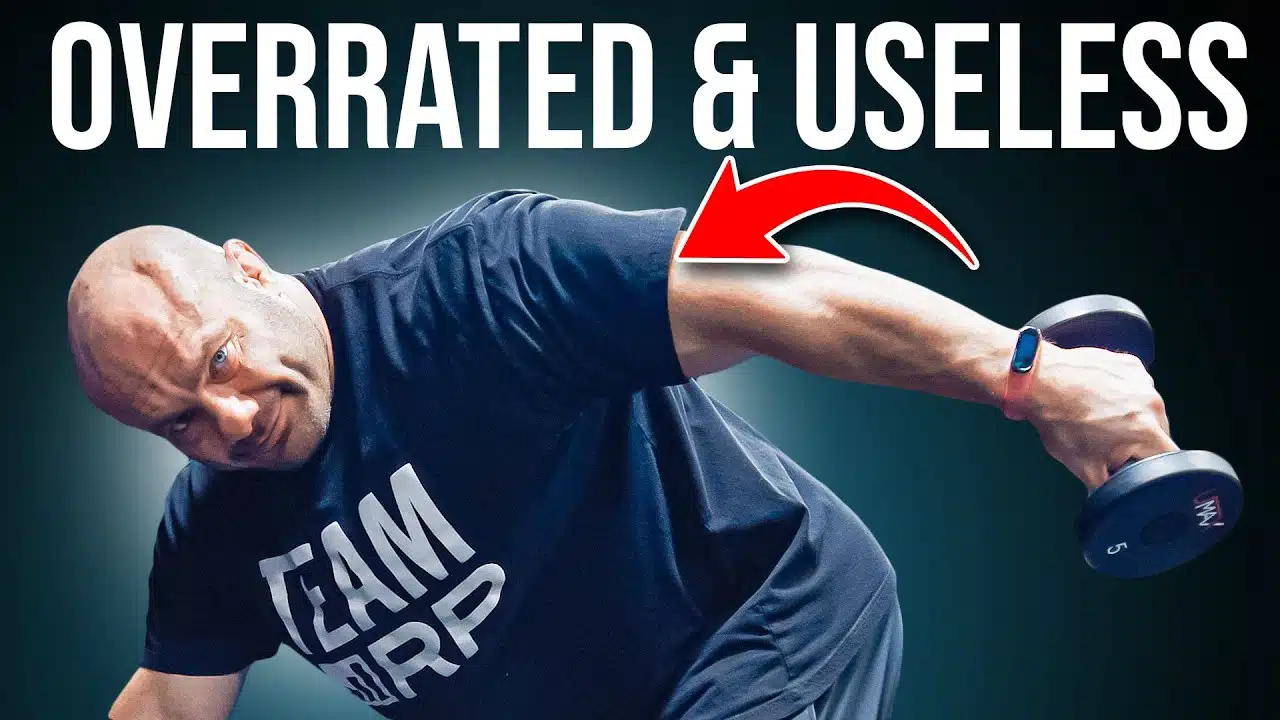
Tricep Kickbacks: Small Effort, Small Results

Tricep kickbacks look like they belong in a 1980s aerobics video — all style, no substance.
They involve extending a light dumbbell behind you, supposedly targeting the triceps. But the mechanics of this exercise work against muscle growth.
“The kickback loads the triceps hardest when they’re in their most shortened position,” Israetel explains. “But for muscle growth, you want high tension in the stretched position — that’s where the real hypertrophy signal happens.”
Why tricep kickbacks are a mistake:
- Ineffective resistance curve
- No stretch in the working muscle
- Minimal load = minimal growth
- Overly reliant on perfect form
- Zero scalability
Do This Instead: Dumbbell Skull Crushers

If you’ve already got dumbbells and a bench — which you do if you’re doing kickbacks — then just use them more intelligently.
Dumbbell skull crushers put your triceps under high tension in the stretched position, especially if you allow your elbows to drift slightly back behind your head. The force curve favors growth, not frustration.
“You’re putting the triceps under the kind of load that causes real adaptation,” says Israetel. “And it’s safer and more effective over time.”
What you get:
- Strong eccentric stretch
- Smooth concentric push
- More load = more growth
- Easy to progress
- Much better ROI for the same equipment
Kickbacks are for warm-ups. Skull crushers are for building arms that stretch your shirt sleeves.
One-Arm Dumbbell Presses: Pointlessly Complicated
The one-arm dumbbell bench press looks cool. It also looks like it should challenge your core while building your chest. But when you press with one arm and hold the other dumbbell out for balance, you’re actually sabotaging your own performance.
“This is one of those moves that makes you feel like you’re doing more, but you’re just draining one arm while the other is trying to work,” Israetel says. “By the time you switch, the stabilizing arm is already fatigued — which means lower output, lower load, and less growth.”
Why this method is inefficient:
- One arm is doing unnecessary work
- Core engagement is minimal
- Reduces overall training volume
- Increases fatigue with no added benefit
- Overcomplicates a simple movement
Do This Instead: Regular Dumbbell Press or Unilateral Machine Press
Two better options:
- Regular dumbbell press — you get full output from both arms, balanced effort, and more total work.
- Unilateral machine press — machines stabilize you so you can train one side at a time without energy waste.
“There’s nothing wrong with unilateral pressing,” says Israetel. “But do it in a way that maximizes the working arm, not one that sacrifices performance for the illusion of complexity.”
Bottom line:
- Train both arms efficiently
- Or isolate with purpose using machines
- Don’t waste time balancing a dumbbell like it’s an acrobat act
Stop Wasting Time, Start Training Smarter
There’s nothing wrong with simplicity — but there is something wrong with doing ineffective movements just because they’re popular. The truth is, some exercises stick around out of habit, not science.
“Don’t just copy what you see online or in group classes,” Israetel says. “If a movement doesn’t train a muscle through a meaningful range of motion, with sufficient load and progression, then it’s probably not worth your time.”
Trade out the fluff. Build your workouts around movements that:
- Challenge muscles through stretch and contraction
- Provide progressive overload
- Deliver more return for your effort
- Actually lead to size, strength, or function improvements
The fix is simple. Replace the five overrated moves above with better, smarter choices — and you’ll feel (and see) the difference.