When Dr. Mike Israetel of Renaissance Periodization teamed up with IFBB Pro Regan Grimes for a back workout, they faced an interesting challenge: training an elite bodybuilder’s back using only a squat rack.
The result? A masterclass in maximizing minimal equipment for maximum gains.
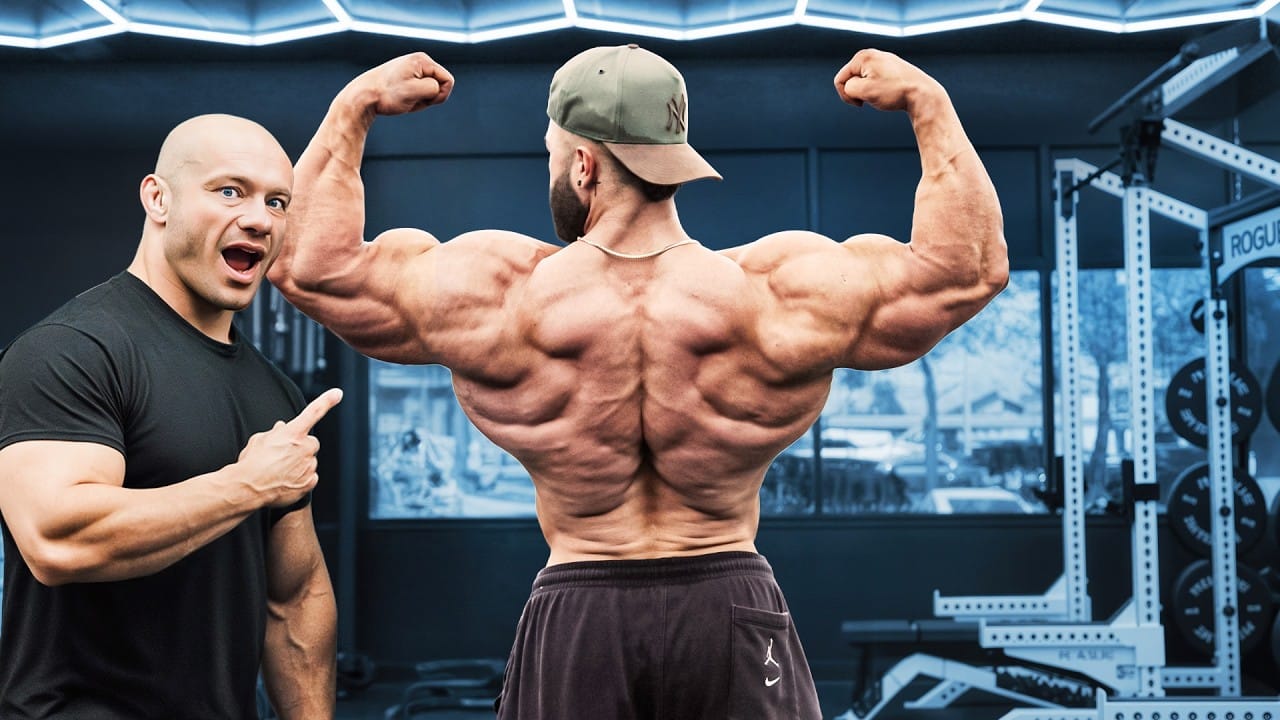
What makes this particularly fascinating is the timing—Grimes weighed in at a staggering 267 pounds just two days after competing at Mr. Olympia.
The workout demonstrates that you don’t need fancy machines to build an impressive back, just smart exercise selection and proper execution.
Jump to:
- Why Warming Up Matters More Than You Think
- Exercise One: Pull-Ups for Complete Back Development
- Exercise Two: Inverted Rows for Length-Biased Growth
- Exercise Three: Deficit Barbell Rows
- The Finishing Move: Deficit Deadlifts
- The Power Rack: Your Complete Home Gym Solution
- Post-Competition Training Considerations
- Practical Takeaways for Your Training
Why Warming Up Matters More Than You Think
Before diving into heavy pull-ups, Dr. Mike emphasized the critical importance of proper warm-up, especially for someone of Grimes’ size and post-competition condition.
He can’t just start doing pull-ups. The science term is shit will snap up, bro.
Dr. Mike explained that Grimes’ body water was in flux post-contest, with hydration levels not optimal and fluid in the wrong compartments. This created additional risk for injury, particularly bicep tears.
The solution? Banded warm-up sets before attempting bodyweight pull-ups. Using resistance bands for assistance allowed Grimes to activate his back muscles gradually, preparing connective tissue and muscle fibers for the work ahead.
Exercise One: Pull-Ups for Complete Back Development
Pull-ups served as the primary movement, and Grimes has serious history with this exercise.
I always did love pull-ups. I did a pull-up competition in college. I think it was like 38 in like 30 seconds or something.
That’s more than one pull-up per second—and Grimes won the competition.
But here’s the kicker: he weighed around 150 pounds during college. Now at 267 pounds of solid muscle, he was still cranking out technically sound pull-ups with full range of motion.
The Pull-Up Protocol
Dr. Mike coached Grimes through three working sets, emphasizing several key points:
- Big, deep stretch at the bottom to maximize lat engagement
- Full range of motion with controlled tempo
- No momentum or swinging to keep tension on target muscles
- Progressive intensity with partial reps when full reps became impossible
The coaching cue “big stretch” appeared repeatedly, highlighting the importance of achieving maximum muscle lengthening at the bottom position.
Exercise Two: Inverted Rows for Length-Biased Growth
After completing pull-ups, the workout shifted to inverted rows—an often underutilized exercise that Dr. Mike specifically praised for hypertrophy.
The beauty of inverted rows lies in their leverage advantage. When you’re closer to parallel at the bottom, you experience maximum tension. When you rise closer to vertical, tension decreases.
This creates what Dr. Mike called a “length-biased exercise,” which research suggests may be superior for muscle growth.
Technical Execution Tips
Dr. Mike provided specific coaching for optimal inverted row performance:
- Touch your nipples to the bar, not just get close
- Keep tension in your back by preventing your butt from touching the ground
- Big chest posture as you pull up to maximize mid-back engagement
- Adjust bar height based on your strength level for sets of 10-20 reps
For those who are extremely muscular and can’t touch chest to bar, Dr. Mike offered a practical modification: do as many full reps as possible, then continue with partials to 90 degrees until failure.
This incorporates both length-biased and partial rep training, extending set duration and creating additional growth stimulus.
Exercise Three: Deficit Barbell Rows
With Grimes’ pulling muscles pre-exhausted from pull-ups and inverted rows, deficit barbell rows entered as the next challenge.
Standing on a plate creates additional range of motion, allowing for greater stretch at the bottom position. This increased stretch translates to more muscle fiber recruitment and potentially greater hypertrophy stimulus.
Form Essentials
Dr. Mike was meticulous about form during this movement:
- Flat back throughout—no rounding or excessive arching
- Chest up and forward-looking to maintain spinal position
- Touch the barbell to your stomach on every rep
- Full shoulder stretch at the bottom before initiating the next pull
- Big chest, butt back, knees out for optimal hip hinge mechanics
The pre-exhaustion strategy meant that Grimes’ lats and rhomboids would be the limiting factor rather than his spinal erectors, ensuring the target muscles received maximum stimulus.
The Finishing Move: Deficit Deadlifts
For the final exercise, Dr. Mike programmed deficit deadlifts to completely exhaust Grimes’ back musculature.
This kind of quote unquote ties everything together. It’s going to hit your upper back, trap, mid-back, and lower back pump all at the same time.
Dr. Mike noted that gigantic people have particular difficulty with deadlift endurance due to the sheer amount of muscle mass requiring oxygen and energy.
The visible shaking in Grimes’ final reps demonstrated complete muscular fatigue—exactly what you want at workout’s end.
Key coaching points included controlled eccentric tempo, maintaining the illusion of performing another rep even on the final descent, and completing full lockout at the top of each repetition.
The Power Rack: Your Complete Home Gym Solution
Dr. Mike emphasized an important message throughout the workout: a single power rack can provide everything needed for comprehensive back training.
No fancy machines required. No cable stations necessary.
With just a power rack, resistance bands, and a barbell, you can execute:
- Pull-ups (assisted or bodyweight)
- Inverted rows at various angles
- Deficit barbell rows
- Deficit deadlifts
This makes the power rack one of the most valuable investments for home gym builders or for those times when commercial gym equipment is occupied.
Post-Competition Training Considerations
Training just two days after Mr. Olympia presented unique challenges that most recreational lifters won’t face, but the principles remain instructive.
Grimes was depleted, dehydrated in specific tissue compartments, and physically exhausted from competition prep and the show itself. Despite weighing 267 pounds, his body was in a compromised state.
The workout design accounted for this through:
- Extended warm-up protocols to prepare connective tissue
- Pre-exhaustion strategies to limit absolute loads while maintaining stimulus
- Controlled tempos rather than explosive movements that risk injury
- Strategic exercise order moving from safest to most technical
These same principles apply when training during periods of high life stress, poor sleep, or suboptimal nutrition.
Practical Takeaways for Your Training
Whether you’re a competitive bodybuilder or recreational lifter, this workout demonstrates several universally applicable concepts.
First, equipment limitations don’t prevent effective training. Creativity and understanding of biomechanics matter more than machine variety.
Second, exercise order significantly impacts results. Starting with pull-ups and inverted rows pre-exhausted Grimes’ back muscles, allowing subsequent exercises to create stimulus without requiring excessive loading.
Third, technique trumps weight. Throughout the session, Dr. Mike prioritized full range of motion, controlled tempo, and proper positioning over adding plates.
Finally, context matters. The same exercises performed by the same person will look different based on training status, recovery state, and proximity to competition or other stressors.
Grimes demonstrated that world-class physiques aren’t built in luxury facilities with unlimited equipment options. They’re built through consistent application of fundamental movements, proper technique, and intelligent programming—things accessible to everyone with a power rack and determination.