For decades, Soviet special forces relied on one deceptively simple exercise to build unbreakable strength.
Not a complicated program. Not expensive equipment.

Pavel Tsatsouline, a former Soviet special forces trainer turned strength coach, studied these elite soldiers and discovered their secret: five variations of the squat that can keep your legs powerful well into your 80s.
And the fifth level? That’s what Soviet champions used to stay explosive into their ninth decade of life.
Jump to:
Why Strength Matters More Than You Think
Before diving into the variations, Pavel offers a fundamental principle that changed how millions approach fitness.
Strength is the mother quality of all physical qualities. Greater strength increases your performance in absolutely everything.
This isn’t gym-bro philosophy. It’s biomechanics.
People over 50 often lose leg strength not primarily because of aging, but because they’ve stopped moving properly. Years of sitting tighten hips, stiffen backs, and create dysfunctional movement patterns that compound over time.
Level One: The Prying Goblet Squat
This isn’t a traditional workout. It’s mobility work disguised as exercise.
Start like a normal goblet squat—holding a kettlebell or dumbbell at chest height. But here’s the difference: instead of standing up after each rep, stay at the bottom.
Finding space means just pretty much kind of prying and moving your body into the position and trying to find more space in the joint.
Think of pulling a concrete post from the ground. Yanking hard in one direction snaps the rope. But wiggling it, changing angles, applying gentle pressure from different directions? The post gradually loosens.
Your hips work identically.
Sink into a full goblet squat and stay there. Shift weight from left to right. Rock your torso slightly forward. Take slow, deep breaths.
You’re teaching your body that these positions are safe. You’re reactivating muscles dormant for years.
Pavel references a famous Soviet scientist and health guru who performed this practice daily.
He would perform 100 squats every day.
You can remain in this prying position for 30 to 40 minutes if desired. There’s no rush. Your hips will thank you.
Level Two: The Goblet Squat
Why does Pavel recommend this over traditional barbell squats for people over 50?
The problem with the squat exercise is most people don’t know how to move well. So the goblet squat is kind of a squat for the people.
Most older adults have compromised movement patterns. If you immediately load a bar on your shoulders, you’ll activate all those dysfunctions—arched back, caving knees, stiff hips.
The goblet squat fixes this automatically.
How to Execute It Properly
- Hold a kettlebell or dumbbell at chest height, close to your body
- Stand with feet shoulder-width apart
- Squat down slowly—control every inch
- The weight in front naturally pulls you forward slightly, forcing upright torso position
- Your core must engage; you cannot cheat
Because weight sits in front rather than on your back, it’s significantly easier on your spine.
Critical distinction: Approach this as practice, not punishment. You’re learning a skill, not exhausting yourself. Every rep should feel like improvement, not destruction.
Perform three times weekly. Three to five sets of three to five reps. That’s it.
Level Three: The Front Squat
Once you’ve mastered goblet squats, progress to front squats.
With lower body, you can use the front squat.
This variation places a barbell across the front of your shoulders instead of your back. Consider it an advanced goblet squat.
Benefits multiply here. You can handle more weight. Your core works harder maintaining stability. And because weight remains in front, it forces good posture—lean forward even slightly and the lift collapses.
Learning to squat resembles learning to swim. You don’t jump into deep water immediately. Start where you can stand, practice fundamentals, build confidence.
Front squats represent that next step into deeper water.
Level Four: The Back Squat
This is what most people envision when they hear “squat”—a loaded barbell across your shoulders.
Back squats are incredibly powerful. Powerlifters and Olympic athletes use them for good reason.
But here’s Pavel’s crucial caveat: it’s not where you should start if you’re over 50 and haven’t trained seriously in years.
Your spine isn’t a suspension bridge meant to carry loads on top. Your legs are.
You must earn the right to back squat by first mastering goblet squats and building mobility in hips, ankles, and thoracic spine.
When you’re ready? Back squats become incredible. They allow heavy loading and train your entire posterior chain—glutes, hamstrings, lower back.
Pavel’s own father provides stunning proof. He took up powerlifting at 71. At 77, he deadlifted 413 pounds without a belt, setting American records in his age group. He added 20 pounds of muscle.
From behind, you’d guess he was in his 40s.
Level Five: The Jump Squat
This represents the apex of the Soviet squat system.
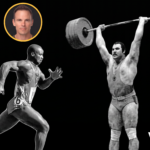
Pavel shares a remarkable story about Rudolph, a Soviet Olympic weightlifting champion. Even in his mid-80s, Rudolph performed jump squats with 200 pounds.
Not for show. Because maintaining power and explosiveness is fundamental to staying young.
Jump squats are straightforward: squat down, explode upward into a jump, land softly, repeat.
This exercise trains fast-twitch muscle fibers. It reminds your nervous system that legs are meant to be powerful, not just functional enough to shuffle through daily life.
Important caveat: If you’re just starting, this is a long-term goal. Don’t rush toward it. Respect the progression.
The Soviet Method: Your Action Plan
This isn’t a trend. Not a gym fad that’ll disappear next year.
This is a system built by Soviets, tested on their strongest soldiers, greatest Olympic athletes, and most durable humans ever studied.
Start with goblet squats three times weekly. Three to five sets. Don’t rush. Don’t skip levels.
Respect the process because the process works.
Your legs aren’t meant to weaken after 50. That’s not aging. That’s neglect.
One exercise. Five levels. A lifetime of strength.