Exercise scientist Dr. Milo Wolf recently shared eight highly effective but often overlooked exercises for muscle growth in a detailed video breakdown.
His selections aren’t based on trends or gym bro wisdom.
They’re rooted in emerging research on hypertrophy, including studies he’s personally authored.
What makes these movements special is how they leverage stretch-mediated hypertrophy, a principle that could potentially double muscle growth compared to exercises performed in shortened positions.
Jump to:
- What Actually Makes An Exercise Effective For Muscle Growth
- Exercise #1: Deep Dips For Complete Upper Body Development
- Exercise #2: Nordic Hamstring Curls For Neglected Knee Flexors
- Exercise #3: Dumbbell Side Bends For Complete Core Development
- Exercise #4: Hip-Extended Leg Extensions For The Rectus Femoris
- Exercise #5: Flexion Rows For Total Back Thickness
- Exercise #6: Smith Machine Squats For Safe Failure Training
- Exercise #7: Leg Press For Maximum Glute Development
- Exercise #8: Smith Machine Good Morning Stretch Partials
- The Common Thread: Stretch-Mediated Hypertrophy
What Actually Makes An Exercise Effective For Muscle Growth
Before diving into specific movements, Wolf outlined his evidence-based framework for exercise selection.
Stretch emphasis tops his list. Wolf has authored extensive research on this topic, and the data is compelling.
Does the exercise put the target muscle into its stretch position? And does that exercise put plenty of tension into that stretch position? Those two things alone can take hypertrophy from around half the growth if you’re training in a super shortened position for some reason to twice the growth if you’re training in a fully stretched position, roughly speaking based on the research.
Loadability matters too. You need exercises where you can approach or reach failure within 4-15 reps, ideally 4-12 reps for optimal muscle building stimulus.
Exercise specificity ensures that muscular failure aligns with task failure. Wolf explains that in some movements, cardiovascular fatigue or weaker muscle groups might limit you before your target muscle truly fails.
Beyond stimulus factors, Wolf considers fatigue management and time efficiency. Dumbbell exercises, bodyweight movements, and cable machines win here because they’re quick to set up and allow for techniques like drop sets.
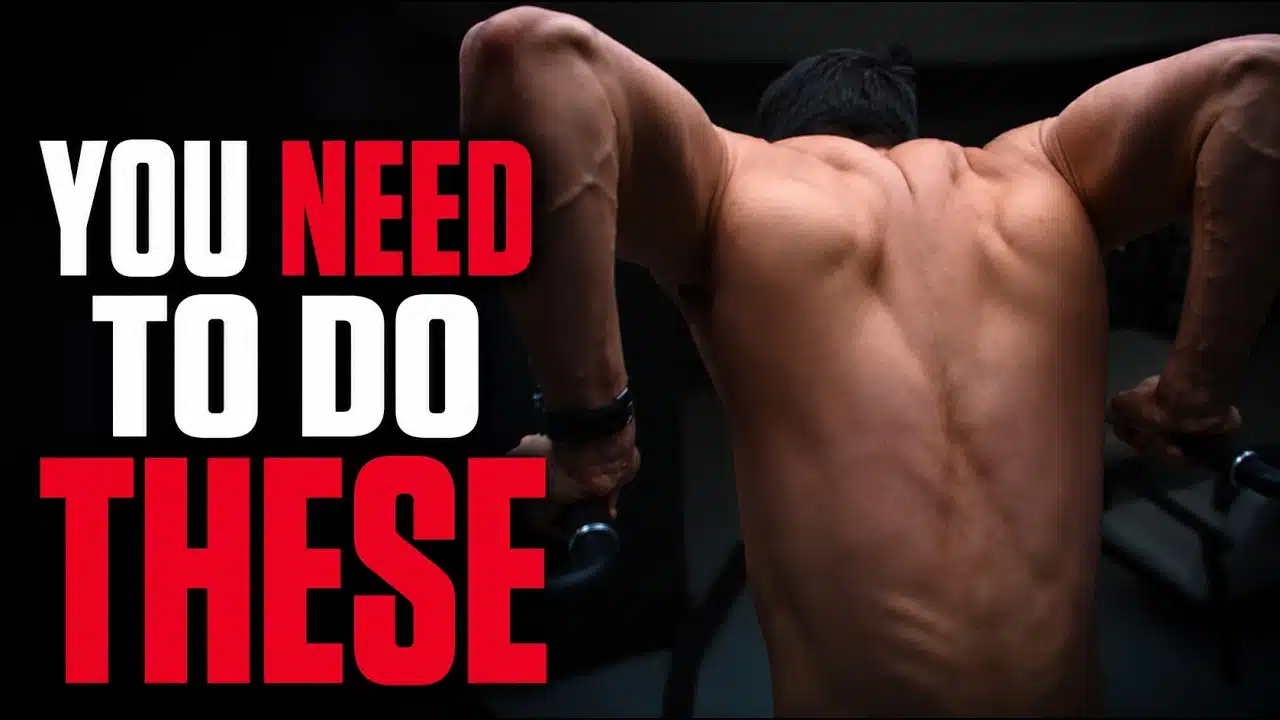
Exercise #1: Deep Dips For Complete Upper Body Development
Wolf’s first pick might surprise you with its versatility.
The dip simultaneously stretches the chest, triceps, and front deltoids at the bottom position. What most people don’t realize is how effectively dips target the upper chest.
At the bottom, you’re extending your shoulder, stretching the upper chest, and you’re horizontally abducting the shoulder at the same time. So, at the bottom, you should really be feeling a pretty deep upper chest stretch, which I do.
For the front delts specifically, dips function as a “lengthened partial” or stretch partial. Your arms move behind your body at the bottom, creating maximum shoulder flexion and deltoid stretch—a position research suggests may be more effective than full range of motion training.
The Mistakes Everyone Makes With Dips
Most lifters stay too upright and don’t descend deep enough. Wolf recommends leaning forward slightly and allowing the movement to come from multiple joints—your elbows, shoulders, and scapula.
Think of dips like squats: you’re not isolating one muscle, you’re efficiently stimulating multiple muscle groups simultaneously in a stretched position.
Exercise #2: Nordic Hamstring Curls For Neglected Knee Flexors
While seated leg curls reign supreme for the main hamstring heads, Nordic curls target two frequently overlooked muscles.
Research comparing these variations found that Nordic curls produced superior growth in the short head of the biceps femoris and the sartorius muscle.
The sartorius, a hip flexor and knee flexor, actually gets more stretch during Nordic curls than seated variations. Meanwhile, the short head benefits from the Nordic’s resistance profile, which places maximum tension at the bottom stretched position.
How To Perform Them (Even If You’re Weak)
Secure your ankles under a lat pulldown pad, ratchet strap, or similar anchor point. Wolf admits he’s not particularly strong at these and demonstrates a key modification: bending at the hips.
If you flex your hips, that’s not even necessarily a bad thing. Cuz in reality, they flex in the hips. Yes, you’re reducing stretch on the sartorius slightly, but you’re actually increasing stretch on the biarticular hamstrings.
Lower yourself as far as strength allows, pause briefly, then return. Start conservatively—these are brutally difficult.
Exercise #3: Dumbbell Side Bends For Complete Core Development
This movement trains three muscles most people completely ignore: the obliques, erector spinae, and quadratus lumborum.
These muscles control spinal lateral flexion, a movement pattern absent from compound lifts like squats and overhead presses. The erector spinae, running from your neck to your hips, adds considerable thickness to your entire back when developed.
Wolf notes an unexpected benefit beyond hypertrophy.
Anecdotally, besides training those muscles and actually growing them, this has other benefits. For one, my back doesn’t feel painful as often anymore.
Proper Execution
Hold a dumbbell in one hand with feet close together. Use lifting straps to eliminate grip limitations. Bend purely sideways—avoid letting your elbows bend or allowing excessive hip abduction to take over the movement.
Exercise #4: Hip-Extended Leg Extensions For The Rectus Femoris
The rectus femoris represents one-quarter of your quadriceps, yet compound movements like squats largely neglect it.
Why? Because it crosses both the hip and knee joints. During squats and leg presses, you simultaneously extend your hips and knees, which essentially puts the rectus femoris “to sleep.”
Wolf co-authored research demonstrating the power of addressing this limitation.
We compared doing leg extensions with your hips either in a normal position around 90° of flexion, if memory serves, to more extended, kind of lifting your butt off the seat and getting more of a stretch on the rectus femoris by having a hip angle of about 45° only. In that study, we saw that just that one little technique tweak, getting more stretch on the rectus femoris by extending the hips, led to 170% more relative growth of the rectus femoris.
The Sissy Squat Variation
Wolf’s practical application involves stretch-partial sissy squats. Stand on your toes, fully extend and lock your hips by squeezing your glutes, then let your knees travel straight forward while holding something for balance.
Descend until your hamstrings touch your calves. For stretch partials, perform only the bottom half of the movement, which intensifies stretch emphasis and typically allows you to work in a more productive 8-15 rep range.
Exercise #5: Flexion Rows For Total Back Thickness
Most rowing variations train elbow flexion, shoulder extension, and scapular retraction. Wolf adds a fourth component that transforms rows into complete back developers.
By allowing your spine to round at the stretched position and actively extend at the contracted position, you recruit the erector spinae throughout its entire length—from your neck down to your hips.
This differs critically from hip flexion and extension, which unnecessarily involves glutes, hamstrings, and adductors. Pure spinal flexion and extension keeps tension specifically on back musculature.
Wolf emphasizes this technique applies to all row variations—cables, machines, chest-supported rows—not just one specific exercise.
Exercise #6: Smith Machine Squats For Safe Failure Training
Barbell squats remain excellent, but Wolf argues the Smith machine version offers distinct hypertrophy advantages.
The primary benefit? Safe failure training. Research shows that proximity to failure directly correlates with hypertrophy—the closer you get, the more growth you stimulate.
In my experience as a coach and as a lifter, the Smith machine just allows you to get closer to failure or to failure much more consistently than a barbell squat does.
Smith machines also enable true past-failure training through stretch partials. Wolf references his own research on calf raises where participants extended sets with partials after reaching traditional failure, resulting in approximately 40% more growth.
A follow-up study found that three past-failure sets produced the same growth as six traditional sets—double the efficiency.
Exercise #7: Leg Press For Maximum Glute Development
Most lifters consider leg press a quad exercise. Wolf presents compelling evidence it may be even better for glutes.
Biomechanically, your quads start in a shortened position (full knee extension). Your glutes and adductors, however, begin pre-stretched with hips flexed at 90 degrees.
At the bottom of a deep leg press, you maximize hip flexion, creating extreme glute and adductor stretch. You’re essentially performing stretch partials for these muscles—starting pre-stretched and ending fully stretched.
We have at least a couple of studies on leg press and yeah, just leg press actually, and glute hypertrophy. And those studies seem to suggest that if anything, glute hypertrophy is on par with or actually better than quad hypertrophy from the leg press.
Foot Placement Strategy
Lower foot placement with maximum depth works all three muscle groups effectively—an excellent minimalist approach.
For glute maximization, place feet higher on the platform. This increases hip flexion at the bottom, creating even greater glute stretch and typically making glutes the limiting muscle group.
Exercise #8: Smith Machine Good Morning Stretch Partials
Wolf’s final selection targets hamstrings and glutes through hip hinge mechanics with evidence-based range of motion optimization.
Good mornings are essentially Romanian deadlifts with a bar on your back. You maintain relatively straight knees, push hips backward, and hinge until you can’t descend further without spinal rounding.
The stretch partial modification stems from unpublished conference research Wolf shared exclusively.
This study found that doing stretch partials, so only the bottom half of the rep, when the hamstrings and glutes were most stretched, going from like roughly here to here, using a multi-hip machine…led to around twice the growth in general of the hamstrings and glutes compared to a full range.
Execution Keys
Position feet hip-width apart with a slight knee bend that remains constant throughout. Your hips should move purely horizontally—straight back toward the wall behind you, never up or down.
Descend until you can’t go deeper without rounding, pause, then come approximately halfway up. This maintains constant tension in the stretched range where hamstrings and glutes benefit most.
The Common Thread: Stretch-Mediated Hypertrophy
Nearly all eight exercises leverage loaded stretching, whether through exercise selection, range of motion modification, or technique adjustments.
Wolf’s framework isn’t about chasing novelty. It’s about applying approximately 50 studies on stretch-mediated hypertrophy to practical exercise selection that most gym-goers overlook.
The exercises also emphasize safe failure training and time efficiency—critical factors when research suggests you need high volumes to maximize growth.
By targeting neglected muscles like the rectus femoris, sartorius, and erector spinae alongside optimizing common movements through stretch partials and controlled failure, these eight selections offer a scientifically-grounded approach to breaking through plateaus and building complete muscular development.