

Most people stretch for years without ever touching their toes or achieving the splits they dream of.
But mobility expert and coach to Olympic champions has cracked the code on why traditional stretching fails—and how to fix it.
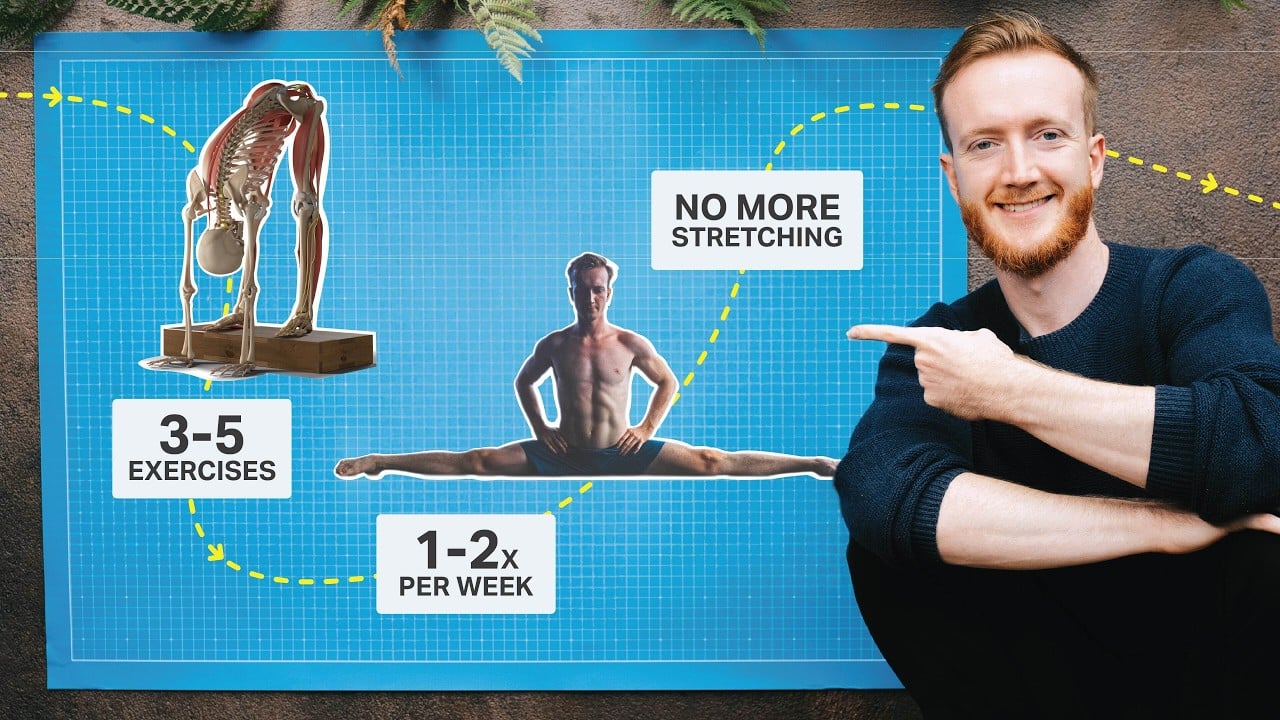
In a recent comprehensive guide, flexibility specialist Matt shared the exact blueprint that transformed him from inflexible to achieving full splits as an adult, and later helped swimmer Cam McEvoy go from 29th place at the 2021 Olympics to becoming the fastest swimmer in the world and winning gold in Paris 2024.
The secret? Stop stretching like everyone else.
Jump to:
- The Flexibility Ladder: Why You’re Probably Stretching The Wrong Things
- Path One vs. Path Two: Amateur Stretching vs. Professional Approach
- Assessment: The Missing Piece That Changes Everything
- Focus On Skills, Not Vague “Mobility”
- The Cam McEvoy Case Study: Olympic Gold Through Mobility
- Stretch Stacking: The 1+1=3 Effect
- The Assisted-Resisted Spectrum: Choosing The Right Exercise Type
- 10 Training Methods Beyond Static Stretching
- Why You Won’t Lose Flexibility When You Stop Stretching
- When To Train: Timing Is Everything
- The Complete Blueprint
The Flexibility Ladder: Why You’re Probably Stretching The Wrong Things
The fundamental problem with most stretching routines is simple: people don’t solve for their actual limiting factors.
Matt introduces the concept of a “flexibility ladder”—a visual representation of everything restricting your flexibility and at what level each restriction limits you. These can include different muscles, nerve tensions, technique issues, strength deficits, and more.
In order to achieve your goal flexibility, you need to move everything to at least that level. Anything below your goal level is limiting you.
Instead of stretching commonly tight areas like hamstrings or lats, the breakthrough progress comes from identifying and working on your personal lowest points on the flexibility ladder.
Matt’s own journey proves this approach works. After six years of traditional stretching with minimal results, he remained incredibly tight and far from basic flexibility goals.
It wasn’t until I figured out my own flexibility ladder that I was able to transform my flexibility as an adult.
He’s since helped students ranging from teenagers to people in their 60s achieve their splits, demonstrating that age is not the barrier most people believe it to be.
Path One vs. Path Two: Amateur Stretching vs. Professional Approach
Matt outlines two distinct approaches to flexibility training that produce drastically different results.
The Amateur Path (What Most People Do)
- Choosing stretches based on what “feels good” or flows well
- No measurement of starting levels or progress tracking
- Hoping exercises hit the right areas without testing
- Remaining blind to whether training actually works
- Unable to replicate or maximize accidental improvements
The Professional Path (What Actually Works)
- Measuring starting flexibility levels
- Testing which specific muscles are tight
- Determining whether to focus on range of motion or strength
- Building programs with intentionally ordered exercises
- Deliberately selecting 3-5 stretches targeting your specific needs
- Optimizing training schedules (1-2 sessions weekly) alongside other activities
The difference is like chopping down a tree with a blunt versus sharp axe. Both require effort, but sharpening the axe first cuts the total time in half.
Assessment: The Missing Piece That Changes Everything
Proper assessment reveals exactly what’s holding you back—and it’s rarely what people assume.
For shoulder mobility, most people think about stretching “the shoulders” generally. But Matt demonstrates how to isolate specific muscles using strategic positioning:
- Pec major: Tested by bringing the arm back behind you
- Subscapularis and teres major: Isolated through external shoulder rotation
- Lats: Assessed by rounding the lower back to create relative stretch
For touching your toes, the assessment goes beyond just hamstring flexibility. It includes testing adductor magnus, gastrocnemius, hip flexor strength, sciatic nerve tension, and more.
Even two people working toward the same goal may need completely different training approaches.
Matt compares two students working on side splits: Sunniva has excellent passive flexibility but lacks strength in her range, while Sondre has good strength but limited total flexibility. Their assessments revealed opposite training needs.
Focus On Skills, Not Vague “Mobility”
Just as strength training targets specific movements like squats or overhead presses rather than vague “leg strength,” flexibility training should focus on movement patterns.
Matt identifies the core flexibility skills that encompass most mobility goals:
- Pike (touching your toes)
- Pancake
- Side split
- Front split
- Bridge
- Shoulder flexion
- Shoulder extension
- Comfortable squat
These skills matter because they involve your body working together as one unit, creating better transfer to real-life activities and sports performance.
Flexibility doesn’t just make you less tight. Flexibility makes things easy.
World-renowned calisthenics athlete Andrea Larosa, who trained with Matt, put it this way:
I realized that flexibility matters a lot, especially for the athlete and also just for the normal person to be able to perform skills on a high level. You need to work on your flexibility.
The Cam McEvoy Case Study: Olympic Gold Through Mobility
Perhaps the most compelling validation of this approach comes from Olympic swimmer Cam McEvoy’s transformation.
To swim the 50m freestyle as fast as possible requires being streamlined during the dive, fluid with underwater kicks, and powerful with each stroke. This demands flexible yet strong shoulders, hips, and spine—exactly what the bridge develops.
Matt programmed McEvoy’s mobility, strength, and periodization outside of swimming, using the bridge as the metric of mobility success. As the bridge improved, swimming performance followed.
The results speak for themselves: from 29th at the 2021 Olympics to 2023 World Champion, 2024 Olympic Champion, and 2025 World Champion.
Stretch Stacking: The 1+1=3 Effect
Unlike strength training, which typically starts with compound movements when you’re fresh, flexibility training works in reverse.
Start with smaller isolated stretches, then progress to bigger compound movements. Each stretch opens up range for the next exercise, creating what Matt calls “stretch stacking.”
For example, stretching pec major first means your subsequent lat stretch can go deeper because the pec no longer limits it. This creates a multiplying effect where 1+1 actually equals 3.
By selecting 3-5 stretches all aligned toward the same skill, you benefit from this stacking effect in every session, making rapid progress that builds confidence.
The Assisted-Resisted Spectrum: Choosing The Right Exercise Type
Not all stretching methods work for all problems. Matt introduces the assisted-resisted spectrum as a framework for selecting appropriate exercises.
Using side splits as an example:
- Heavily assisted: Full body weight and gravity pushing you into the stretch
- Assisted: Small weights or leverage helping you deeper
- Neutral: Minimal external force
- Resisted: Using your strength to pull into position (like standing leg lifts)
- Heavily resisted: Adding weight while strength training through your range
Flexibility and strength training aren’t opposites—they’re two ends of the same spectrum.
Assisted training stretches you deeper, while resisted training makes your range stronger and more usable. The middle develops both qualities simultaneously.
10 Training Methods Beyond Static Stretching
While static passive stretching (holding a position while relaxed) works for some people, Matt outlines ten powerful methods for comprehensive flexibility development:
1. Post-Isometric Relaxation (PIR)
Contract muscles for a few seconds, then relax deeper than normal. Alternating between contracting and relaxing for multiple reps creates progressive relaxation.
2. Isometric Stretching
Contract the muscles being stretched to hold yourself in position, building strength and control at end range.
3. Isometric Holds for Reps
Instead of one long 30-second hold, perform reps with 3-second holds each. Short rests between reps allow deeper, higher-quality training.
4. Active Lifts
Contract opposite muscles to pull yourself into position. This resisted training develops full control so you can access range when needed.
5. Dynamic Stretching
Lifting with speed and momentum trains different muscle spindles that detect both stretch amount and speed—crucial for transferring flexibility to kicks or acrobatics.
6. Rapid Contract-Relax (RCR)
Use your muscles to pull into the deepest stretch, then release and relax. This controlled approach beats traditional ballistic stretching by keeping you in control of depth.
7. Joint Capsule Releases
Specific positions that stretch the joint capsule itself rather than muscles—essential when other methods aren’t working and you feel unusually stiff.
8. Nerve Flossing and Tensioning
Nerves can only stretch 8-10% beyond resting length. When entrapped, they cause pain or completely halt flexibility progress without obvious symptoms. Nerve exercises remove these restrictions.
9. Soft Tissue Treatments
Chronically tight muscles and scar tissue require manual intervention. Strategic soft tissue work becomes a “cheat code” when targeted properly—but should be done through the stretch rather than blindly foam rolling.
10. Technique Drills
Perhaps the most underrated category. Small technique changes can break through plateaus instantly.
For side splits, most people try simply opening their legs. This causes the hip to jam (bone-on-bone), stopping progress and causing pain.
The solution? Anteriorly tilt the hips forward or externally rotate by pointing feet up. This single technique adjustment has helped multiple stuck students break through plateaus dramatically.
Why You Won’t Lose Flexibility When You Stop Stretching
Matt can still drop into side splits despite not training them properly for over three years. Here’s why.
Two categories of adaptations increase flexibility:
Brain and nervous system changes: Your brain learns to tolerate greater stretch perception. These adaptations stay long-term.
Physical body changes: Including tendon stiffness and muscle length (sarcomere addition). These reverse after about 6 weeks without use.
Most programs don’t optimize for lasting brain changes. Even worse, many people are essentially just warming up—improving the viscoelastic nature of muscles temporarily, like warming honey to pour more easily.
This only lasts a few hours, leaving you back where you started once everything “cools down.”
To create permanent brain adaptations, training must avoid fatigue that sends signals limiting your brain’s stretch tolerance. Balancing your training schedule with proper rest becomes essential for gains that last years.
When To Train: Timing Is Everything
Both strength and flexibility training cause calcium ion accumulation in muscle fibers, activating enzymes that cause damage, inflammation, and ultimately brain fatigue—hours after training.
Understanding this delay reveals optimal training timing:
Best option: Train flexibility 2+ days after strength or sport training that affects the same areas.
Second best: Train on the same day—strength in the morning, flexibility in the evening. Brain fatigue hasn’t fully hit yet.
Third best: Flexibility immediately after strength or sport, reducing volume of each slightly.
Common mistake: Stretching the day after strength training or adding it on rest days as “active recovery.” It’s not recovery—flexibility training creates similar fatigue to strength work.
The Complete Blueprint
Matt’s system distills into a straightforward process:
- Set the goal: Focus on 1-2 flexibility skills that improve movement and performance
- Assess the problem: Find what’s at the bottom of your flexibility ladder
- Select exercises: Choose 3-5 that target your specific limitations
- Stretch stack: Order exercises so they multiply each other’s effectiveness
- Train smart: 1-2 sessions weekly, timed to optimize long-term adaptations
- Apply and enjoy: Use your new mobility in sports and daily life
This focused approach means you don’t need to stretch forever. Go through a season of transforming your mobility to the level you need, then maintain it with minimal effort.
Stretch right, stretch once.
When flexibility is built properly through brain adaptations and skill-focused training, it stays with you—giving you the freedom that comes from a flexible, strong, and capable body that moves the way you want it to.








