For over a decade, Wendy Jeal was a familiar name in British athletics—consistently standing on the podium, often just behind the finish line’s brightest stars.
While she never clinched a national title, her presence loomed large across every major hurdle race in the 1980s.
She raced with grit, edged into Olympic and Commonwealth teams, and earned a silver medal on one of the world’s most visible stages.
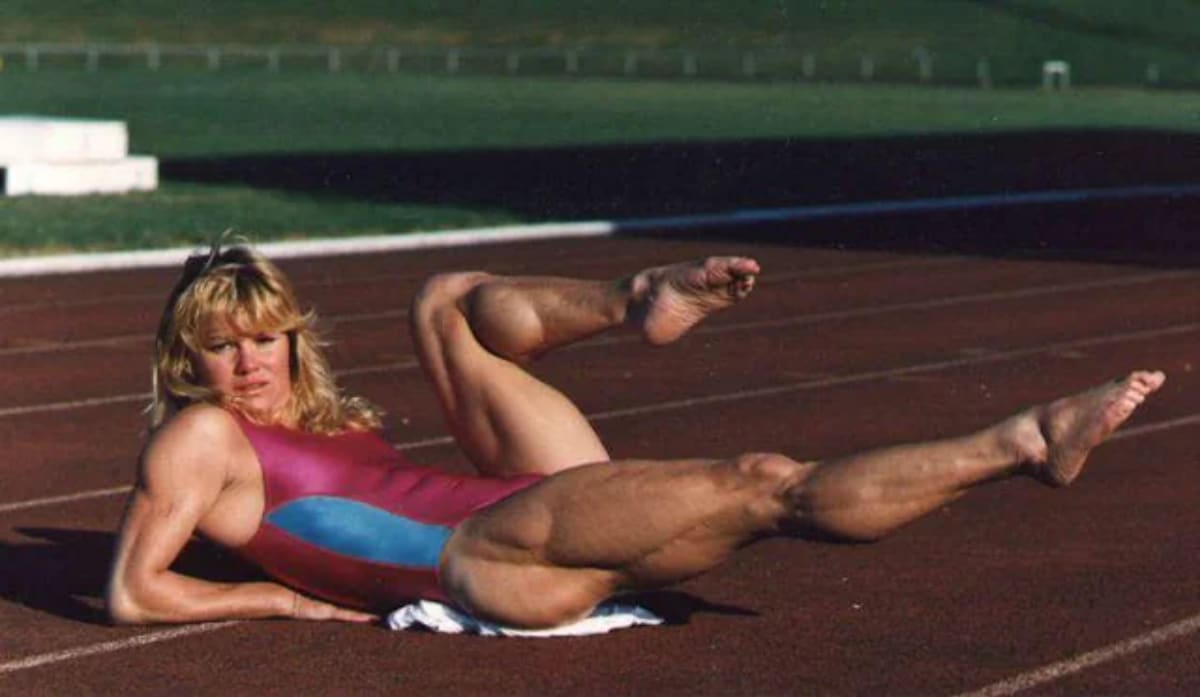
But in recent years, whispers have begun to circulate. Social media users have questioned whether her muscular physique was all-natural.
So, what do we really know about Wendy Jeal—and what’s just speculation?
Jump to:
A Career Built on Consistency
Wendy Jeal (née McDonnell), born November 21, 1960, in Epping, Essex, started her hurdling journey early. As a teenager, she was already a national force, winning the AAAs under-15 and under-17 titles in the mid-1970s. Her transition to the senior level came fast and strong: at just 17, she medaled at the national indoor championships.
Throughout the 1980s, Jeal became a regular podium presence at both the UK National Championships and the AAA Championships—two of the most competitive domestic stages in British track and field. Despite the near misses, she consistently finished second or third a staggering fourteen times at national senior-level events.
That kind of consistency wasn’t just luck.
She was selected to represent Great Britain at the 1988 Seoul Olympics, and England at the 1986 Commonwealth Games, where she brought home silver in the 100m hurdles. Her 13.41-second finish in Edinburgh remains one of her defining moments, especially considering she held off Australian champion Glynis Nunn and Canadian rising star Julie Rocheleau (now Baumann).
Just weeks later at the European Championships in Stuttgart, she clocked her lifetime best: 13.16 seconds in the heats—a time that would be competitive even today.
Standing in the Shadows of Giants
The 1980s were a golden era for British women’s hurdles. Jeal was racing against names like Sally Gunnell, Lesley-Ann Skeete, and Shirley Strong—athletes who would go on to earn Olympic and World titles. Being in their company wasn’t a sign of coming up short; it was proof of how stacked the field truly was.
Despite her results, Jeal never quite broke through for a national title. She was always the contender, always just a fraction behind the top spot. Still, she made every final count—securing Olympic, World Championship, and Commonwealth Games appearances in a packed competitive landscape.
The PED Speculation: Internet Chatter vs. Hard Evidence
In today’s age of internet sleuths and retroactive judgment, even clean records are subject to doubt.
A viral Reddit post showed a striking image of Jeal mid-race, flexing defined quads and hamstrings, sparking a firestorm of comments. One user wrote, “She 99.999% used steroids. No way you get those legs naturally.” Others chimed in with similar skepticism, pointing to her physique as supposed proof.
But here’s the reality: no evidence exists to suggest Jeal ever used performance-enhancing drugs.
She has never failed a drug test, never been mentioned in official doping investigations, and has never made headlines for scandal. No mainstream media outlets, athletics federations, or official sources have linked her to PEDs.
It’s worth remembering that elite female athletes—especially in sprint and hurdle events—often develop physiques that differ drastically from average women. Intense sprint work, resistance training, and natural genetic variation all contribute to lean muscle mass.
And if muscularity alone were the standard for suspicion, many of Jeal’s contemporaries—both tested and proven clean—would also be under the microscope.
Why She Still Matters Today
Jeal’s career wasn’t about dominance. It was about persistence. In a field packed with world-class hurdlers, she remained competitive for over a decade.
- She never missed a beat during the selection years leading to the 1988 Olympics.
- She kept pushing through defeats, always returning for another shot.
- She represented her country with dignity and resilience, despite narrowly missing medals in global championships.
For young athletes today, especially those grinding just outside the spotlight, Wendy Jeal’s story offers a reminder: you don’t have to win gold to make an impact.
Final Word
Wendy Jeal may not be the household name that Sally Gunnell is. She may not have a cabinet filled with gold medals. But her career speaks volumes: of endurance, discipline, and relentless effort.
While the internet speculates based on photos and armchair science, her legacy is etched in times, team selections, and international finals—not suspicions.
In a sport where milliseconds decide greatness, Jeal proved that showing up, year after year, and leaving everything on the track is a victory in itself.