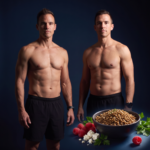
What if shedding body fat didn’t mean starving yourself or obsessively counting every calorie?
Popular fitness researcher Jeremy Ethier recently put two volunteers through a radical 30-day experiment that challenges everything most people believe about dieting.

Instead of restricting portions, participants ate from massive bowls filled to the brim at every meal—and the results were nothing short of remarkable.
By the end, one lost over 10 pounds of pure fat while the other dropped nearly three percent body fat, all without tracking a single calorie.
Jump to:
- Meet The Guinea Pigs
- Three Simple Rules That Change Everything
- The Science Behind Strategic Fullness
- Early Struggles And Adjustments
- Adding Science-Based Fullness Strategies
- Addressing Muscle Loss Concerns
- Remarkable Physical Transformations
- The Final Results
- The Most Effective Foods And Strategies
- Lasting Mindset Shifts
Meet The Guinea Pigs
Ethier recruited two very different participants for his experiment. Matson, one of the strongest guys in his gym, had never been able to stick to any diet despite his impressive strength. His initial body scan revealed 24.7% body fat.
Melody had been lifting weights for five years and believed she was eating around 2,000 calories daily. Testing revealed a shocking truth—she was actually consuming 3,000 calories per day. As her weight crept upward, she became increasingly self-conscious, hiding her body with baggy clothes even during workouts. Her starting body fat measured 32.5%.
No products found.
Three Simple Rules That Change Everything
Rather than complicated macros or calorie tracking, Ethier’s approach centered on three straightforward rules that leveraged cutting-edge nutrition science.
Rule One: The Bowl Mandate
Each participant received their own designated massive bowl—the only vessel they could eat from for 30 days. Matson’s was slightly larger to account for his size, but both were intentionally oversized to accommodate enormous portions of strategic foods.
Rule Two: The Three Food Groups
Every single meal required at least one food from each category: a protein source, a “volume food,” and exactly one measured serving of fat. Protein options included chicken breast, shrimp, egg whites, and lean ground turkey. Volume foods encompassed vegetables like lettuce, cucumber, zucchini, and broccoli. Fat sources were limited but included whole eggs and specific measured portions.
Calorie-free sauces, sweeteners, and seasonings were unlimited. However, snacking between meals was strictly forbidden.
Rule Three: Fill It To The Top
Perhaps most counterintuitive—participants had to fill their enormous bowls completely at every meal.
I think that might be a problem. I think breakfast will be hard.
Their concerns proved justified almost immediately.
No products found.
The Science Behind Strategic Fullness
Ethier’s approach exploits a fascinating aspect of human physiology: stomach stretch receptors. These specialized sensors line stomach walls and communicate fullness to your brain based purely on physical stretching, not calorie content.
Consider this striking comparison: 200 calories of pork versus 200 calories of chicken breast provides over double the volume. When examining 200 calories from approved volume foods, half don’t even fit on a standard plate—yet contain fewer calories than a small handful of trail mix.
This principle mirrors gastric bypass surgery, which physically shrinks the stomach so it stretches more from less food. Bypass patients typically lose 12 to 18 pounds in the first three months. Ethier’s diet aimed to replicate similar results without any surgical intervention.
Early Struggles And Adjustments
The first week revealed drastically different approaches. Melody experimented constantly, creating new combinations daily.
We have chicken breast on cottage cheese and squash, cucumber on a bed of lettuce.
Matson, however, ate identical meals repeatedly—shrimp, eggs, and strawberries at every sitting.
Every time I eat like green vegetable, I feel disgusting, to be honest. I don’t think I am built for that. But like fruit is okay, especially strawberry.
When Ethier analyzed Matson’s intake, he discovered critical micronutrient deficiencies. He created four demonstration meals showcasing breakfast bowls, cucumber salads, konjac noodle stir-fries, and sugar-free dessert options. Despite loving the demos, Matson immediately reverted to his routine.
No products found.
His reasoning? Simple cleanup. With his repetitive meals, he only needed to rinse his bowl rather than wash multiple dishes.
Adding Science-Based Fullness Strategies
After one week, both participants had already dropped three pounds. To maximize their results, Ethier introduced weekly “strategy additions” via a spinning wheel.
Week Two: Mandatory Carbonation
The first strategy required drinking at least one diet soda or carbonated beverage with every meal. Research demonstrates that carbonation fills the stomach with air bubbles, causing expansion that significantly increases fullness for nearly an hour after consumption.
Multiple studies show diet sodas enhance meal satisfaction and eliminate post-meal cravings, leading to greater weight loss and better maintenance.
I’m already having a hard time finishing my meals, and adding on the extra drink is making me so full.
Matson embraced the change enthusiastically, though Melody initially resisted carbonated drinks.
Social Challenges Emerge
By week two, Melody faced the diet’s biggest psychological hurdle—social isolation. Family barbecues became awkward affairs where she brought her own chicken breast while others enjoyed traditional foods.
No products found.
I feel like I want to avoid going to these family dinners. It just feels awkward when you have to bring your own food. It’s just watching people eat.
Interestingly, Matson experienced no similar social friction, settling comfortably into his routine and even forcing himself to explore vegetables for the first time.
Week Three: Bone Broth Addition
Fifteen days in, Melody had lost five pounds while Matson dropped six. The next strategy wheel spin landed on bone broth—requiring one meal daily to include or start with broth.
Research shows subjects who begin meals with low-calorie soup consume 20% fewer total calories compared to meals without soup. Combined with volume foods and carbonation, participants were now experiencing extreme fullness from meals under 500 calories.
However, bone broth’s high sodium content triggered temporary water retention, stalling scale progress for several days—a development that frustrated both participants despite continued fat loss.
Addressing Muscle Loss Concerns
Matson’s rapid weight loss raised legitimate concerns about muscle preservation.
I’m really happy about the weight loss because I’m going to get married next year and I want to look nice, but I’m worried. I’m losing weight way too fast and I don’t want to lose the muscle and the strength in the gym.
Ethier employed two protective strategies. First, unlimited protein at every meal ensured adequate intake for recovery. Second, both participants followed structured progressive overload training through the Built With Science app, consistently increasing workout intensity week-over-week.
No products found.
Critically, both participants’ strength actually increased throughout the experiment—a strong indicator that muscle mass remained intact.
Week Four: The Baby Utensil Challenge
The final strategy proved most frustrating. Participants had to swap regular utensils for baby spoons and baby forks, dramatically slowing eating pace. Extended meal duration increases post-meal fullness and satisfaction.
I don’t know if this is actually slowing me down or just making the meal harder to eat. It’s semi frustrating, but also you don’t get much.
Despite complaints, the strategy worked remarkably well. Matson reduced from three daily meals to just two because he couldn’t finish the third.
Remarkable Physical Transformations
As day 30 approached, visible changes became undeniable. Melody noticed abdominal definition appearing for the first time.
Today I was getting ready, and I could actually see the top part of my abs come in, which is super exciting.
Comparison headshots revealed dramatic facial fat loss, with leaner cheeks and more defined jawlines visible in both participants. Perhaps most significantly, Melody’s relationship with clothing changed completely.
This is actually the first time I’ve worn a short sleeve that isn’t crazy oversized to the gym. And mainly because I finally feel somewhat comfortable.
The Final Results
After 30 days of eating massive bowls of food without counting calories, Ethier used doubly labeled water testing to determine Matson’s actual intake: just 1,900 calories daily—far below his 2,600 calorie estimate.
No products found.
DEXA scans revealed the true extent of their transformations:
- Melody: Lost 8+ pounds total, with virtually all loss coming from fat. Body fat percentage dropped from 32.5% to 29.7%—a 2.8% reduction in just 30 days.
- Matson: Lost 10.4 pounds on the scale, with 10.2 pounds being pure fat. Body fat plummeted from 24.7% to 20.7%—a 4% decrease.
Both participants successfully preserved muscle mass while achieving fat loss comparable to gastric bypass surgery results.
The Most Effective Foods And Strategies
When asked to identify the single most helpful food and strategy, both participants agreed:
Top food: Shrimp provided maximum fullness relative to calories consumed.
Top strategy: Carbonated beverages created the most dramatic fullness effect.
Interestingly, the baby utensils—while most annoying—proved remarkably effective at reducing total food intake.
No products found.
Lasting Mindset Shifts
Beyond physical changes, both participants experienced profound psychological transformations.
This 30-day plan has really transformed the way I see food, how it fills my body.
Matson discovered cooking capabilities he never knew existed, even earning rare praise from his mother for eating vegetables. Melody developed sustainable eating patterns she felt confident continuing long-term.
Perhaps most tellingly, when finally allowed to return to previous eating habits, both noted how unfilling their former favorite foods had become. Rice and chicken—once satisfying—now left them hungry within 20 minutes, while volume-based meals kept them satisfied for hours.
The experiment demonstrated that strategic food selection based on fullness rather than calorie restriction can produce remarkable fat loss results without the hunger and misery typically associated with traditional dieting approaches.