Dips and push-ups have stood the test of time as two of the most effective bodyweight exercises for building upper body strength.
But which one deserves more attention in your training routine?
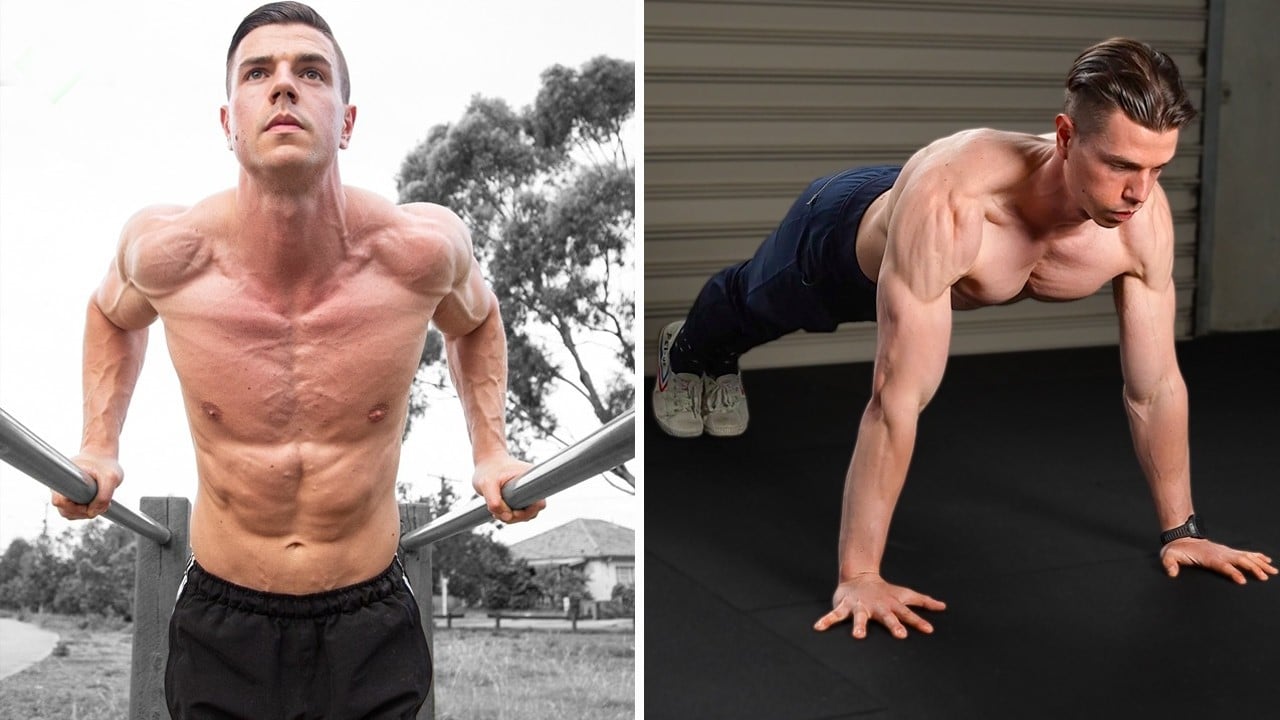
According to a calisthenics expert with over 17 years of experience training both movements, the answer isn’t as simple as choosing one over the other.
Understanding the unique benefits and challenges of each exercise can transform how you approach upper body training.
Jump to:
- The Intensity Factor: Why Dips Demand More
- Progressive Overload: Where Dips Truly Shine
- Muscle Activation: Understanding What Gets Worked
- Equipment Requirements and Practical Considerations
- Progression Methods: Adding Challenge Without Weight
- Joint Health and Range of Motion Differences
- Making Your Choice: Dips, Push-Ups, or Both?
The Intensity Factor: Why Dips Demand More
Dips present a significantly greater challenge right from the start. You’re supporting 100% of your body weight suspended in the air, compared to roughly 70% during standard floor push-ups.
The technical demands extend beyond raw strength. Balance becomes critical when your entire body hangs from just two contact points—your hands.

If you want something simple that actually works, this is one of the most effective tools I’ve used to build strength, conditioning, and endurance without needing a full gym setup.
- Full-body training with one weight using swings, squats, and presses
- Solid cast iron build that feels stable and lasts for years
- Comfortable grip that makes high-rep workouts easier to handle
Dips are more technical because you’re supporting yourself with just your hands while the rest of your body is moving around. The real challenge is at the scapula, controlling the shoulder blades.
That scapular control separates beginners from advanced athletes. Fighting to keep shoulders locked in position throughout every single rep requires coordination that takes time to develop.
Push-ups offer considerably more stability. With feet anchored to the ground, balance concerns fade into the background, allowing complete focus on generating force and perfecting technique.
Progressive Overload: Where Dips Truly Shine
While both exercises can be loaded with additional weight, dips hold a decisive advantage for long-term progression.
Just like this, dips are the superior choice when it comes to long-term overload with weights. All you need is a dip belt, and you can stack on as many plates to your body as you need.
The simplicity cannot be overstated. Attach a dip belt, add weight plates, and continue making linear strength gains indefinitely.
Weighted push-ups work effectively but present logistical headaches. Setting up requires organizing multiple pieces of equipment, and maintaining proper form becomes exponentially harder as weight increases.
Core fatigue emerges as the primary limiting factor with loaded push-ups. Abs give out before chest muscles reach failure, cutting sets short and leaving potential gains on the table.
If you want something simple that actually works, this is one of the most effective tools I’ve used to build strength, conditioning, and endurance without needing a full gym setup.
- Full-body training with one weight using swings, squats, and presses
- Solid cast iron build that feels stable and lasts for years
- Comfortable grip that makes high-rep workouts easier to handle
It’s really annoying when you have to stop a set because of core fatigue when you could have kept doing more push-ups.
This explains why weighted dips have become the mainstream choice for serious calisthenics athletes pursuing strength and muscle mass. Technique remains easier to standardize, and nobody questions the legitimacy of loading up dips with serious weight.
Muscle Activation: Understanding What Gets Worked
Both exercises hammer chest, front deltoids, and triceps with impressive efficiency. These compound pressing movements deliver exceptional bang for your buck.
The distinction lies in which portion of the chest receives primary emphasis.
Dips Build Lower Chest Development
Dips excel at targeting lower pectoral fibers. Whether this aligns with your goals depends entirely on current physique balance and aesthetic priorities.
After years of prioritizing dips in my workouts at the expense of most other exercises, shame on me. I noticed that my lower chest became more developed than my upper chest.
Individual response varies based on technique, anatomical structure, and genetic factors. Some athletes feel dips intensely in lower chest, while others experience different activation patterns.
Push-Up Versatility Targets Multiple Angles
Push-ups offer unmatched adaptability through simple body angle adjustments. Elevating feet shifts emphasis toward upper chest fibers, creating targeted stimulus that dips cannot replicate.
If you want something simple that actually works, this is one of the most effective tools I’ve used to build strength, conditioning, and endurance without needing a full gym setup.
- Full-body training with one weight using swings, squats, and presses
- Solid cast iron build that feels stable and lasts for years
- Comfortable grip that makes high-rep workouts easier to handle
This versatility makes push-ups invaluable for developing balanced chest proportions. Experiment with different angles during your next session—delayed onset muscle soreness will confirm activation in new areas.
Equipment Requirements and Practical Considerations
Dips require specific equipment that introduces variables beyond your control. Gym-goers face inconsistent bar widths, uncomfortable spacing, or poorly designed V-shaped handles that feel wrong for individual body proportions.
For my bros who train dips all the time, you can relate to how particular we get with the tools of the trade. When using a new set of bars that aren’t the exact width that you’re used to, the dip can feel really awkward.
Strength develops specific to equipment used most frequently. Switching to unfamiliar dip stations can temporarily decrease performance and comfort.
Push-ups eliminate these concerns entirely. Floor equals gym. This simplicity has kept push-ups relevant throughout human history.
Zero cost. Zero barrier to entry. Maximum accessibility.
Teenagers can start building strength immediately without gym memberships or expensive equipment. That democratization of fitness holds immense value.
If you want something simple that actually works, this is one of the most effective tools I’ve used to build strength, conditioning, and endurance without needing a full gym setup.
- Full-body training with one weight using swings, squats, and presses
- Solid cast iron build that feels stable and lasts for years
- Comfortable grip that makes high-rep workouts easier to handle
Progression Methods: Adding Challenge Without Weight
Push-ups shine through creative progressions that increase difficulty dramatically without added load. Unilateral variations, tempo manipulations, and instability challenges provide virtually unlimited progression pathways.
This highlights calisthenics beauty—your bodyweight provides everything needed for challenging upper body development. No excuses exist for skipping push-ups since they’re performable anytime, anywhere.
Joint Health and Range of Motion Differences
Shoulder extension reaches greater depths during dips compared to even deficit push-ups. This extended range of motion creates both opportunities and risks.
Athletes with adequate mobility, strength, and control find deep dips incredibly satisfying. That bottom stretch position feels phenomenal and promotes muscle growth through full range stimulation.
However, dips have earned reputation for causing shoulder discomfort or costochondritis among those lacking necessary preparation. The movement simply asks more from shoulders than many people currently possess.
If you took the average person off the street, most would probably be able to do push-ups pretty comfortably. Whereas, if you got them to try dips, not necessarily the same thing.
Push-ups present fewer joint concerns for most individuals:
If you want something simple that actually works, this is one of the most effective tools I’ve used to build strength, conditioning, and endurance without needing a full gym setup.
- Full-body training with one weight using swings, squats, and presses
- Solid cast iron build that feels stable and lasts for years
- Comfortable grip that makes high-rep workouts easier to handle
- Less bodyweight load reduces stress on shoulder structures
- Reduced shoulder extension keeps joint angles safer
- Adjustable grip width accommodates individual anatomy
- Free scapular movement allows natural shoulder blade motion
Making Your Choice: Dips, Push-Ups, or Both?
Select dips when pursuing weighted calisthenics progression with unlimited loading potential. They’re ideal for building maximum strength and muscle through straightforward, measurable advancement.
Choose push-ups for accessibility, joint-friendly training, or when seeking variation in horizontal pressing movements. Their versatility supports complete chest development through angle manipulation.
But why choose at all?
If your goal is building a complete upper body, which obviously that’s what you want, you don’t have to choose one. Together, they make one of the best pushing combinations in calisthenics and in gym.
Combining both movements creates synergistic benefits that exceed what either provides alone. Dips deliver progressive overload simplicity and lower chest emphasis. Push-ups offer accessible training, joint-friendly mechanics, and upper chest targeting.
Program both exercises strategically and watch upper body development accelerate beyond what singular focus could achieve.