Competing in a full-distance triathlon is a challenge in itself—add powerlifting a 1,200-pound total beforehand, and you’re in uncharted territory.
That’s exactly what Fergus Crawley set out to do, one year after his jaw-dropping feat of squatting 500 pounds and running a sub-5-minute mile on the same day.
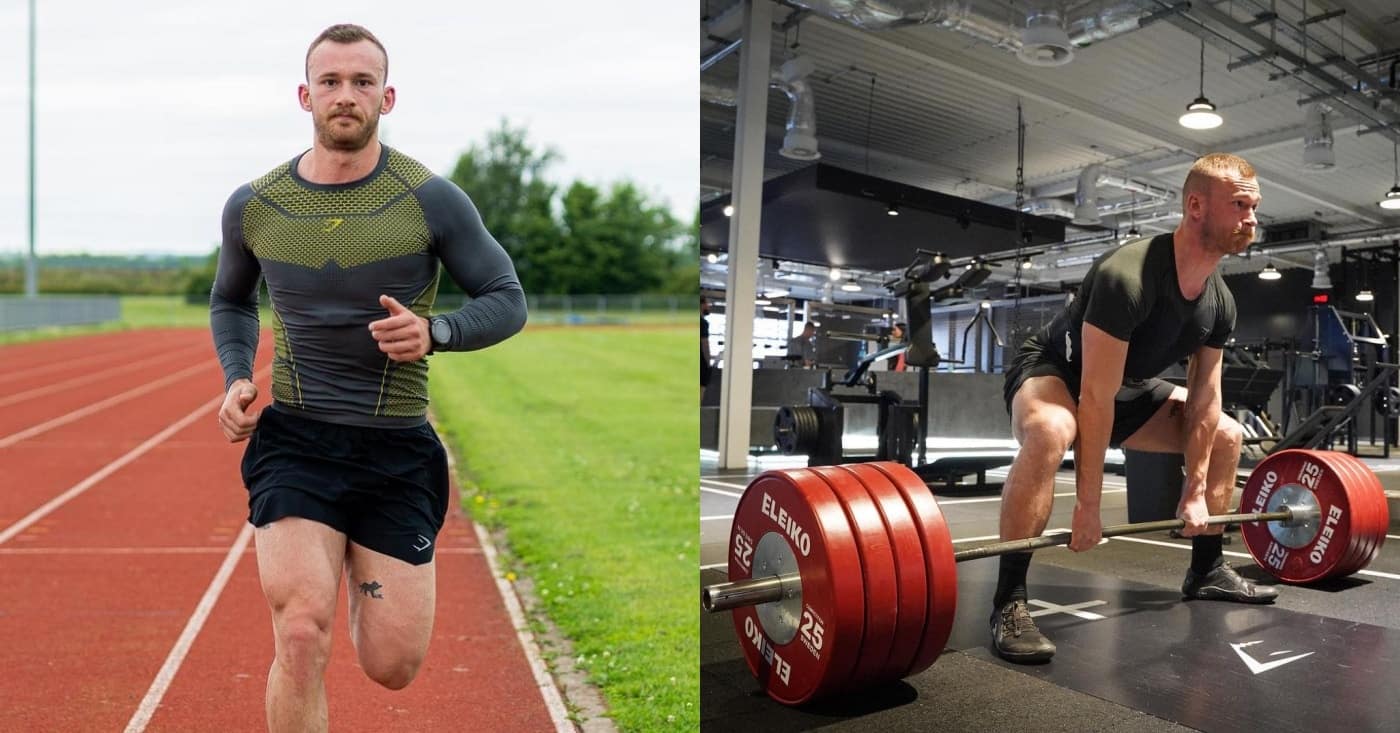
His latest endeavor brought him to Nottingham, UK, where he completed a full-distance triathlon—comprised of a 3.8km swim, 180km bike ride, and marathon—just hours after crushing a full powerlifting meet at 3 a.m.
The goal? Push mental and physical boundaries—and maybe inspire a few others along the way.
Jump to:
- Backstory: One Year Later, Another Massive Challenge
- Powerlifting at 3 AM: 1,200-Pound Total Locked In
- Then: Full Distance Triathlon, Under 12 Hours
- Swim Troubles: “I Just Couldn’t Find Rhythm”
- Bike Leg: Fast, But Fueling Fell Apart
- The Run: “Every Aid Station Was Survival Mode”
- Which Was Harder? Sub-5 Mile & 500lb Squat vs This
- No Ego—Just Purpose
- Takeaways for Hybrid Athletes
- A Challenge With a Message
Backstory: One Year Later, Another Massive Challenge
In 2022, Crawley captured attention by combining highly contrasting athletic feats on the same day—elite-level strength and aerobic capacity. His combination of a 500-pound squat followed by a sub-5 mile went viral.
For the 2023 anniversary, he upped the difficulty: a 1,200-pound powerlifting total followed by completing the full “Outlaw” Triathlon in under 12 hours. “Arbitrary numbers, I know,” he admitted, “but it’s about holding the standard as a hybrid athlete.”

If you want something simple that actually works, this is one of the most effective tools I’ve used to build strength, conditioning, and endurance without needing a full gym setup.
- Full-body training with one weight using swings, squats, and presses
- Solid cast iron build that feels stable and lasts for years
- Comfortable grip that makes high-rep workouts easier to handle
Powerlifting at 3 AM: 1,200-Pound Total Locked In
Crawley hit the gym at 2:45 AM and was lifting by 3. The weights moved well, considering the hour and looming endurance test.
His lifts included:
- Squat: 205kg (452 lbs)
- Bench Press: 121kg (266 lbs)
- Deadlift: 220kg (485 lbs)
Total: 546kg (1,204 lbs)
“All of the lifts were around RPE 7-8 — far from max effort, and that was the point,” Crawley said, emphasizing control over PR chasing.
Post-deadlift, though, signs of trouble were already brewing. “My stomach did a tumble turn,” he said. “I felt pressure in there I wasn’t ready for.”
Then: Full Distance Triathlon, Under 12 Hours
With the lifting portion completed by 4 a.m., Crawley had just two hours before the 6 a.m. triathlon swim start. No sleep. Still digesting food. And battling gastrointestinal discomfort.
Split breakdown:
- Total time: 11:53:38
- Swim: 1:30:54
- Transition 1 (T1): 8:29
- Bike: 5:29:23
- Transition 2 (T2): 8:31
- Run: 4:35:21
Swim Troubles: “I Just Couldn’t Find Rhythm”
The 3.8k swim proved to be the first hurdle. After 5-10 minutes in the water, the upper body fatigue from the lifting session kicked in.
If you want something simple that actually works, this is one of the most effective tools I’ve used to build strength, conditioning, and endurance without needing a full gym setup.
- Full-body training with one weight using swings, squats, and presses
- Solid cast iron build that feels stable and lasts for years
- Comfortable grip that makes high-rep workouts easier to handle
“My pecs, scaps, and shoulders were over-compensating—just couldn’t get into my usual rhythm,” he explained. “I knew right away the bench press had hurt my swim performance.”
Still, he gritted through, finishing roughly 10-15 minutes slower than anticipated. The focus now shifted to the 180km bike ride—on zero sleep and with a stomach growing more stormy by the hour.
Bike Leg: Fast, But Fueling Fell Apart
The bike started strong. Crawley averaged over 32 km/h—a pace that would eventually place him inside the top 200 split times out of more than 1,200 finishers.
His plan was to carry all his nutrition without relying on aid stations for food, utilizing electrolytes, gels, bananas, and fluids rigged onto his setup from the start.
But stomach issues intensified.
“About 50k in, I couldn’t get food in. Everything made me gag,” he recalled. “I’m talking full-on puking urges at every bite.”
If you want something simple that actually works, this is one of the most effective tools I’ve used to build strength, conditioning, and endurance without needing a full gym setup.
- Full-body training with one weight using swings, squats, and presses
- Solid cast iron build that feels stable and lasts for years
- Comfortable grip that makes high-rep workouts easier to handle
Despite this, he never unclipped, stopped, or left the saddle—cycling straight through aid stations while swapping out empty bottles and stuffing bananas mid-ride.
“I pissed myself twice for speed. Not proud, but efficient,” he joked. A true endurance athlete move.
The Run: “Every Aid Station Was Survival Mode”
After a brutal 42.2km marathon already compounded by dehydration and under-fueling, Crawley found his breaking point.
“Fifteen minutes after I passed someone throwing up, I was bent over doing the same,” he said, half-laughing. “What goes around comes around.”
By the halfway point of the marathon, his pacing strategy transitioned from “performance” to “preservation.” Aid stations became lifelines instead of checkpoints.
Every stop included sips of flat Coke, water, cautious gel intake, and the internal mantra: “Don’t throw up, don’t throw up.”
If you want something simple that actually works, this is one of the most effective tools I’ve used to build strength, conditioning, and endurance without needing a full gym setup.
- Full-body training with one weight using swings, squats, and presses
- Solid cast iron build that feels stable and lasts for years
- Comfortable grip that makes high-rep workouts easier to handle
With 8km remaining, his stomach gave in—but the vomiting actually helped.
“I finally felt relief. Felt hollow, but capable. I pushed through and barely cranked in under 12.”
Which Was Harder? Sub-5 Mile & 500lb Squat vs This
When asked which challenge was tougher—last year’s squat/mile combo or this year’s powerlift triathlon—Crawley didn’t hesitate.
“This, hands down,” he said. “The sub-5 prep was soul-crushing but short. This? Full-body endurance, strength, nutrition, mental toughness… all while balancing volume with intensity for months.”
He also noted the psychological strain of entering strength training sessions already exhausted from triathlon prep. “I was fearing getting pinned by weights I used to hit on autopilot.”
No Ego—Just Purpose
Crawley acknowledges that neither the lifting total nor the triathlon time were elite. But that’s not the point.
If you want something simple that actually works, this is one of the most effective tools I’ve used to build strength, conditioning, and endurance without needing a full gym setup.
- Full-body training with one weight using swings, squats, and presses
- Solid cast iron build that feels stable and lasts for years
- Comfortable grip that makes high-rep workouts easier to handle
“I never claimed this was elite. The point is combining them in one day—just like last year. Balancing opposing disciplines is the challenge.”
His motivation also stems from a darker place.
After surviving a suicide attempt in 2016, Crawley found his way back through physical challenges that gave him purpose, structure, and community.
“I like to push myself creatively and physically—to see how far I can go. It helps me. And if it helps others along the way, even better.”
Takeaways for Hybrid Athletes
Crawley’s hybrid feat offers plenty of insight for anyone chasing both strength and endurance:
1. Accept trade-offs
You won’t hit PRs in both if you’re training for extremes—but you can still be highly capable in both domains. Define your standard.
If you want something simple that actually works, this is one of the most effective tools I’ve used to build strength, conditioning, and endurance without needing a full gym setup.
- Full-body training with one weight using swings, squats, and presses
- Solid cast iron build that feels stable and lasts for years
- Comfortable grip that makes high-rep workouts easier to handle
2. Fueling is a skill
GI distress is common in high-volume events. Practice fueling strategies early and often in training.
3. Train fatigue resistance, not cherry-picked efforts
Strength in fatigue, not just fresh, should be the focus when planning hybrid events.
A Challenge With a Message
At its core, this was never about impressing anyone. It was about proving—to himself and others—that growth, resilience, and self-expression can coexist in the pursuit of physical freedom.
“If one person watches this and decides to push themselves with intention—for strength, endurance, or mental health—I’ve done my job.”